

In 2026, the pace of change in business is relentless. Organizations must adapt quickly to stay competitive, and innovation is the new engine driving success. Yet, without the right structure, even the best ideas can lose momentum.
This essential guide explores the most effective frameworks for innovation, equipping leaders to navigate uncertainty and foster breakthrough growth. You will discover why frameworks for innovation matter, the latest models fueling business success, and real-world strategies to select the right approach for your team.
Prepare to unlock practical insights and actionable tools designed to help your organization thrive in a rapidly evolving landscape.
The Strategic Importance of Innovation Frameworks in 2026
In 2026, businesses face an environment defined by rapid change and unpredictability. Organizations need more than creativity; they need robust frameworks for innovation to navigate complex challenges and seize new opportunities.
Frameworks for innovation offer a structured approach to generating, evaluating, and implementing fresh ideas. In volatile global markets, this structure is essential. Rather than relying on sporadic inspiration, businesses can use systematic methods to consistently drive progress.
One major advantage of using frameworks for innovation is risk reduction. By guiding teams through proven stages, these frameworks help organizations avoid common pitfalls and accelerate the journey from concept to market. The result is a repeatable culture where innovation is not a one-time event but an ongoing process.
According to Harvard research, transforming challenges into opportunities requires structured methodologies. Harvard’s online courses highlight how industry leaders apply frameworks for innovation to adapt in uncertain times. These methods provide clarity and direction, even when external pressures intensify.
The impact is measurable. Recent industry reports show that in 2026, over 70% of Fortune 500 companies attribute their sustained growth to the adoption of formal frameworks for innovation. This statistic underscores the strategic value of a systematic approach.
Beyond large corporations, frameworks for innovation help align teams, prioritize scarce resources, and scale up successful initiatives. They ensure everyone moves in the same direction, making it easier to adapt and win in shifting markets.
Real-world case studies from Harvard Online courses reveal how leading organizations have disrupted industries by embedding frameworks for innovation into their operations. These companies foster environments where experimentation is encouraged, learning is prioritized, and success is scaled.
Importantly, frameworks for innovation are not reserved for industry giants. Small and medium-sized enterprises, as well as startups, increasingly leverage structured approaches to stay agile and competitive. For more on how small businesses benefit from these methods, see Innovation in Small Businesses.
Whether you lead a global enterprise or an emerging startup, adopting the right frameworks for innovation can transform uncertainty into growth and position your organization for long-term success.

Core Frameworks Shaping Innovation in 2026
The business landscape in 2026 is defined by rapid change and mounting complexity. To navigate this environment, organizations turn to proven frameworks for innovation. These frameworks provide a structured path for transforming creative ideas into market-ready solutions, supporting leaders in making sense of uncertainty and accelerating growth. Let us explore the core models powering innovation success this year.

Design Thinking: Human-Centered Innovation
Design Thinking stands at the forefront of frameworks for innovation, emphasizing empathy and creativity. The process unfolds in five stages: Empathize, Define, Ideate, Prototype, and Test. Each stage encourages teams to deeply understand user needs before generating and refining solutions.
This approach is widely embraced because it bridges the gap between what users desire and what organizations deliver. By engaging users early and often, companies uncover insights that fuel inventive products and services.
A compelling example is IDEO’s collaboration with clients to co-create solutions directly with end-users. In 2026, 82% of top-performing innovators report using Design Thinking in their product and service development. These results highlight the framework’s power to drive relevant, scalable outcomes.
Design Thinking’s emphasis on collaboration and rapid iteration makes it a cornerstone in the toolkit of frameworks for innovation.
Lean Startup: Rapid Experimentation and Validation
The Lean Startup methodology is a leading force among frameworks for innovation, valued for its focus on speed and learning. At its core lies the Build, Measure, Learn cycle, which allows organizations to develop a Minimum Viable Product (MVP), gather user feedback, and quickly pivot or improve.
This process reduces risk and shortens time to market. By prioritizing real-world validation over lengthy planning, teams can avoid costly missteps. Tech startups have long leveraged Lean Startup to find product-market fit, but its reach now extends to healthcare and education.
Organizations across industries deploy this framework to test hypotheses, conserve resources, and adapt on the fly. The Lean Startup approach ensures that frameworks for innovation remain agile and responsive to market needs.
For those interested in a deeper dive, The Lean Startup Methodology offers a comprehensive overview of this influential framework.
Blue Ocean Strategy: Creating Uncontested Market Space
Blue Ocean Strategy redefines competition by steering organizations toward untapped markets. Instead of battling rivals in crowded arenas, this approach seeks value innovation—offering distinctive value at lower cost.
Tools such as the Strategy Canvas and Four Actions Framework guide businesses in mapping current conditions and identifying opportunities for differentiation. Cirque du Soleil’s transformation of the circus industry exemplifies Blue Ocean Strategy in action.
Industry data from 2025 shows that companies adopting this model report profit margins twice as high as their peers. The framework empowers organizations to escape the confines of traditional competition and unlock new demand.
For a practical perspective on applying this strategy, explore Blue Ocean Strategy Consulting, which details proven methods for leveraging frameworks for innovation to create uncontested market space.
Business Model Innovation: Adapting to Disruption
In a world of evolving customer expectations and technological shifts, Business Model Innovation is essential among frameworks for innovation. The Business Model Canvas, with its nine building blocks, helps organizations visualize, test, and adapt how they create, deliver, and capture value.
This framework supports pivots to new revenue streams and enhances resilience. Netflix’s evolution from DVD rental to global streaming leader is a classic illustration. By continuously refining their business models, companies can respond to disruption and seize emerging opportunities.
Frameworks for innovation like this enable organizations to remain relevant and profitable as markets transform.
AI-Powered Innovation Frameworks
Artificial intelligence is reshaping frameworks for innovation by automating analysis, enhancing ideation, and predicting market trends. Tools powered by AI assist in brainstorming sessions, prototype testing, and opportunity discovery, helping teams make data-driven decisions faster.
In 2026, 65% of enterprises integrate AI tools into their innovation frameworks. These technologies streamline workflows, uncover patterns, and support more informed risk-taking. For example, generative AI platforms are now common for developing creative concepts, while predictive analytics identify the most promising market segments.
AI-powered frameworks for innovation equip organizations with a competitive edge, ensuring they can adapt quickly and launch products with higher success rates.
The Innovation Process: From Opportunity Finding to Market Launch
Innovation is not a single event, but a structured journey. In 2026, organizations that master frameworks for innovation move ideas from discovery to market launch with clarity and confidence. Let us explore each step of this process, highlighting the practical actions that drive results.
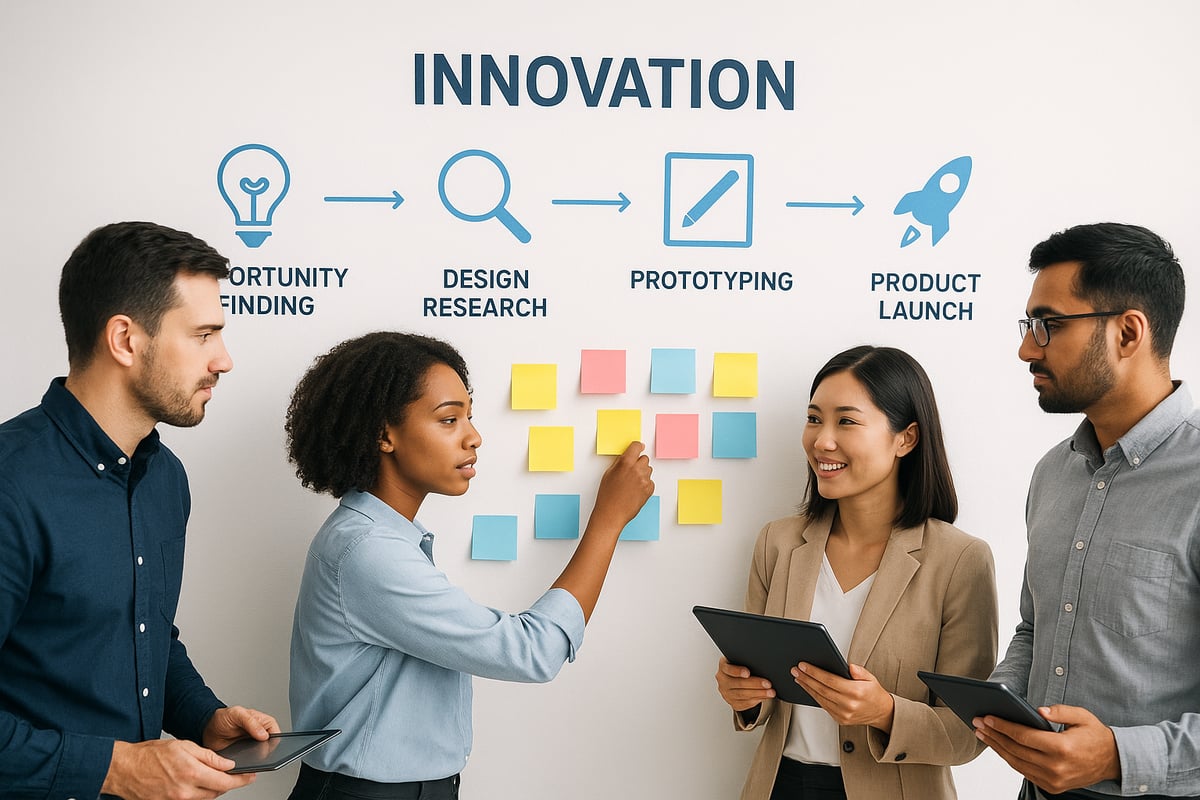
Step 1: Opportunity Identification and Design Research
Every successful innovation starts with discovering unmet needs. Teams using frameworks for innovation rely on interviews, ethnographic studies, and data analytics to uncover new opportunities. Design research helps organizations deeply understand customer challenges, ensuring solutions are anchored in real-world insights.
One effective tool at this stage is the innovation pyramid, which ranks opportunities by impact and feasibility. For example, Harvard’s case studies reveal how reframing customer pain points can spark high-value ideas. Early research is vital, as it sets the foundation for all subsequent steps.
Step 2: Ideation and Collaborative Creativity
Once opportunities are identified, the focus shifts to generating ideas. Frameworks for innovation encourage structured brainstorming, often combining in-person sessions with AI-assisted ideation tools. This blend of human creativity and technology accelerates concept generation and ensures a diverse range of solutions.
Ideas are then prioritized using criteria such as market potential and strategic fit. Collaborative sessions, involving cross-functional teams, often yield breakthrough concepts that might not surface in isolated environments. This phase benefits from an open mindset and rapid sharing of perspectives.
Step 3: Prototyping and De-Risking Ideas
With promising ideas in hand, prototyping becomes the next focus. Frameworks for innovation advocate rapid, iterative prototyping to test assumptions and gather feedback early. Methods range from simple sketches to advanced digital twins, allowing teams to learn quickly and adjust course as needed.
Tech companies often use simulation tools to visualize solutions before committing resources. Real-world Innovation Case Studies show how structured prototyping de-risks investments and improves final outcomes. The goal is to validate value propositions and address risks before scaling.
Step 4: Business Modeling and Value Capture
After refining prototypes, it is time to shape the business model. Frameworks for innovation recommend tools like the Business Model Canvas to clarify how value will be delivered and captured. Teams explore different revenue streams, cost structures, and customer segments to maximize impact.
Startups, for instance, iterate their business models based on market feedback, adapting to shifts in demand. This step ensures that innovations are not only technically feasible, but also commercially viable. Stress-testing ideas against real-world constraints is crucial for long-term success.
Step 5: Implementation and Go-to-Market Strategy
The final stage involves launching the innovation and driving adoption. Frameworks for innovation guide organizations in overcoming barriers, aligning stakeholders, and selecting the right go-to-market approach for their industry. Developing an innovation roadmap helps ensure sustained execution and continuous improvement.
Teams identify potential risks, prepare contingency plans, and set measurable goals. This structured approach increases the likelihood of market success and supports ongoing growth. By following these steps, companies turn ideas into impactful solutions that shape their future.
Embedding and Scaling Innovation Across the Organization
Building a culture that consistently delivers results with frameworks for innovation is not a one-time initiative. It requires deliberate leadership, ongoing investment in people, and alignment of processes across every level of the organization.
Leaders play a pivotal role in shaping the environment where frameworks for innovation thrive. By modeling flexibility, resilience, and a willingness to experiment, executives set the tone for the entire workforce. Transparent communication about strategic priorities and the value of innovation encourages employees to contribute ideas and take calculated risks.
Effective organizations invest in training and capability-building to empower teams. Structured programs—such as workshops on design thinking, business model innovation, or lean experimentation—equip staff with practical tools and shared language for collaboration. For example, Harvard’s approach to cultivating an innovation mindset includes cross-functional learning experiences and peer-to-peer knowledge sharing, fostering both skill and confidence.
A sustainable innovation culture embeds frameworks for innovation into daily operations. This means integrating creative problem-solving into project planning, budgeting cycles, and performance management. Teams are encouraged to use structured methods for opportunity identification, ideation, and rapid prototyping as part of their regular workflow. When frameworks for innovation become second nature, organizations are better positioned to adapt quickly to shifting market dynamics.
Monitoring external signals and internal performance is critical. Leading companies use digital dashboards, pulse surveys, and feedback loops to track the impact of frameworks for innovation. By leveraging emerging tools such as AI-Based Measurement of Innovation, organizations gain real-time insights into the effectiveness of their innovation pipelines and identify areas for improvement.
Measuring innovation performance goes beyond counting new product launches. Metrics might include speed-to-market, revenue from new offerings, or the percentage of employees engaged in innovation projects. These indicators help leaders refine their frameworks for innovation and allocate resources where they drive the greatest value.
Despite the benefits, challenges persist. Resistance to change, siloed mindsets, and innovation fatigue can hinder progress. To overcome these barriers, organizations must celebrate small wins, recognize champions of change, and provide clear pathways for idea implementation. Ongoing leadership support and visible commitment are essential for sustaining momentum.
Data consistently shows that companies with embedded innovation cultures are three times more likely to achieve long-term growth compared to those without. The journey to scale frameworks for innovation is ongoing, but by investing in people, integrating proven processes, and leveraging data-driven measurement, organizations set the stage for breakthrough results and resilience in the face of uncertainty.

Real-World Case Studies: Frameworks in Action
In 2026, organizations across sectors are leveraging frameworks for innovation to transform challenges into growth opportunities. These structured approaches have moved beyond theory, delivering measurable business results. By examining real-world cases, we see how diverse companies adapt frameworks for innovation to their unique contexts, unlocking value and driving change.

Design Thinking in Consumer Brands
A global consumer brand recently embraced design thinking to reinvent its customer experience and enter new markets. By focusing on empathy and user research, the team uncovered unmet needs that traditional surveys missed. Through iterative prototyping and rapid testing, they co-created solutions with real users.
This process led to a product line that outperformed forecasts and increased market share in competitive regions. For more insights on how design thinking frameworks for innovation are transforming consulting and business, see Design Thinking in Consulting.
Lean Startup in Healthcare
The healthcare sector, traditionally slow to change, has adopted frameworks for innovation like Lean Startup to accelerate new digital health solutions. One provider piloted a remote monitoring platform, using the Build Measure Learn cycle to refine features based on real patient feedback.
As a result, time to market was reduced by 40 percent and patient satisfaction improved significantly. This case highlights how frameworks for innovation can lower risk and speed up the delivery of life-changing services.
Business Model Innovation in Education and AI in Industry
Education networks are also reaping the benefits of frameworks for innovation. For example, a leading network reimagined its business model to scale affordable, high quality schooling. By leveraging the Business Model Canvas, they identified new revenue streams and optimized operations, similar to strategies described in the Blue Ocean Strategy Overview.
In the industrial sector, AI-powered frameworks for innovation have enabled companies to boost product launch success rates by 25 percent. Generative AI tools streamline ideation, while predictive analytics guide investment toward the most promising opportunities.
Insights and Lessons Learned
Data from the Harvard Online course shows organizations using structured frameworks for innovation achieve 60 percent higher success rates. What drives this performance?
Key factors include:
- Leadership commitment to innovation
- Cross-functional collaboration
- Ongoing capability development
Lessons from failures are equally instructive. Successful teams iterate quickly, seek customer feedback early, and adapt frameworks for innovation as needed. Ultimately, the path to breakthrough growth requires both discipline and flexibility.
Selecting and Customizing the Right Framework for Your Organization
Choosing the right frameworks for innovation is a pivotal step for any organization aiming to thrive in 2026. With the rapid acceleration of change, a one-size-fits-all approach no longer suffices. Instead, careful selection and thoughtful customization of frameworks for innovation can help leaders unlock new growth, foster agility, and create a culture of continuous improvement.
Assessing Organizational Needs and Readiness
Every organization’s journey with frameworks for innovation begins by assessing its unique context. Consider your company’s size, industry, and current innovation maturity. Is your team experienced in structured innovation, or are you just starting out?
A readiness assessment helps you understand whether your culture supports experimentation and learning. This step ensures that the frameworks for innovation you choose will align with your existing capabilities and highlight areas needing development.
Aligning Frameworks with Strategic Goals and Resources
Frameworks for innovation are most powerful when they directly support your organization’s strategic objectives. Begin by mapping your innovation goals, such as entering new markets, improving customer experience, or increasing operational efficiency.
Next, evaluate available resources. Large enterprises may deploy comprehensive models like Blue Ocean Strategy, while small and medium enterprises (SMEs) often benefit from the agility of Lean Startup. This alignment ensures that frameworks for innovation become enablers of measurable results, not just theoretical exercises.
Customization and Blending of Frameworks for Innovation
There is no universal solution when it comes to frameworks for innovation. Many organizations create a hybrid approach by blending elements from multiple frameworks. For example, combining the empathy-driven methods of Design Thinking with AI-powered analytics can accelerate the discovery and validation of new opportunities.
Customizing frameworks for innovation allows you to address industry-specific challenges. Companies in regulated sectors might integrate Lean Startup cycles with compliance checkpoints, while tech firms may embed AI tools into every stage of their innovation pipeline.
| Framework | Best For | Customization Example |
|---|---|---|
| Design Thinking | User-centric products | AI-assisted user research |
| Lean Startup | Rapid experimentation | Compliance-driven MVP testing |
| Blue Ocean | Market creation | Digital tools for strategy mapping |
Building Champions and Overcoming Challenges
Adopting frameworks for innovation requires more than new processes; it demands cultural change. Build internal champions—leaders who advocate for innovation and model new behaviors. Cross-functional teams help break down silos and encourage diverse perspectives.
Challenges like resource limitations, resistance to change, or lack of leadership buy-in are common. Address them by investing in training, celebrating quick wins, and communicating the value of frameworks for innovation at every level.
- Appoint innovation champions in each department
- Facilitate regular cross-functional workshops
- Provide ongoing training on selected frameworks for innovation
Evaluation, Evolution, and Actionable Checklist
Selecting frameworks for innovation is not a one-time decision. Regularly review performance metrics, gather feedback, and evolve your approach as your organization grows. Leveraging insights from Innovation Forecasting with Global Indicators can help you benchmark against industry standards and global trends.
To ensure successful adoption, follow this actionable checklist:
- Define clear innovation objectives aligned with strategy.
- Assess organizational readiness and culture.
- Select or blend frameworks for innovation that fit your needs.
- Build cross-functional teams and internal champions.
- Pilot, measure, and refine your chosen frameworks for innovation.
- Scale successful practices and embed innovation into daily operations.
By systematically selecting and customizing frameworks for innovation, your organization will be equipped to navigate uncertainty, capture new opportunities, and sustain long-term growth.
As you’ve explored the essential frameworks shaping innovation in 2026, you know how critical it is to align your strategy with proven methodologies and AI-powered insights. Whether you’re looking to spark new growth, refine your business model, or foster a culture of continuous innovation, taking the first step can be transformative. If you’re ready to discover fresh opportunities tailored to your organization, I invite you to Book a Free Opportunity Assessment. Let’s work together to unlock your next wave of innovation and set your business on a path to sustained success.