

In 2025, innovation stands as the driving force behind sustainable business growth. Yet, many organizations find it challenging to transform bold ideas into measurable value.
This guide aims to demystify innovation strategy consulting, offering leaders proven frameworks and expert insights to unlock breakthrough growth in today’s fast-changing environment.
How do top performers turn innovation into real results? Inside, you’ll discover the fundamentals of innovation strategy, the consulting process, emerging trends, and the steps to select the right partner for your journey.
Ready to future-proof your business? Use this guide to take practical action and stay ahead in a disruptive market.
Understanding Innovation Strategy Consulting
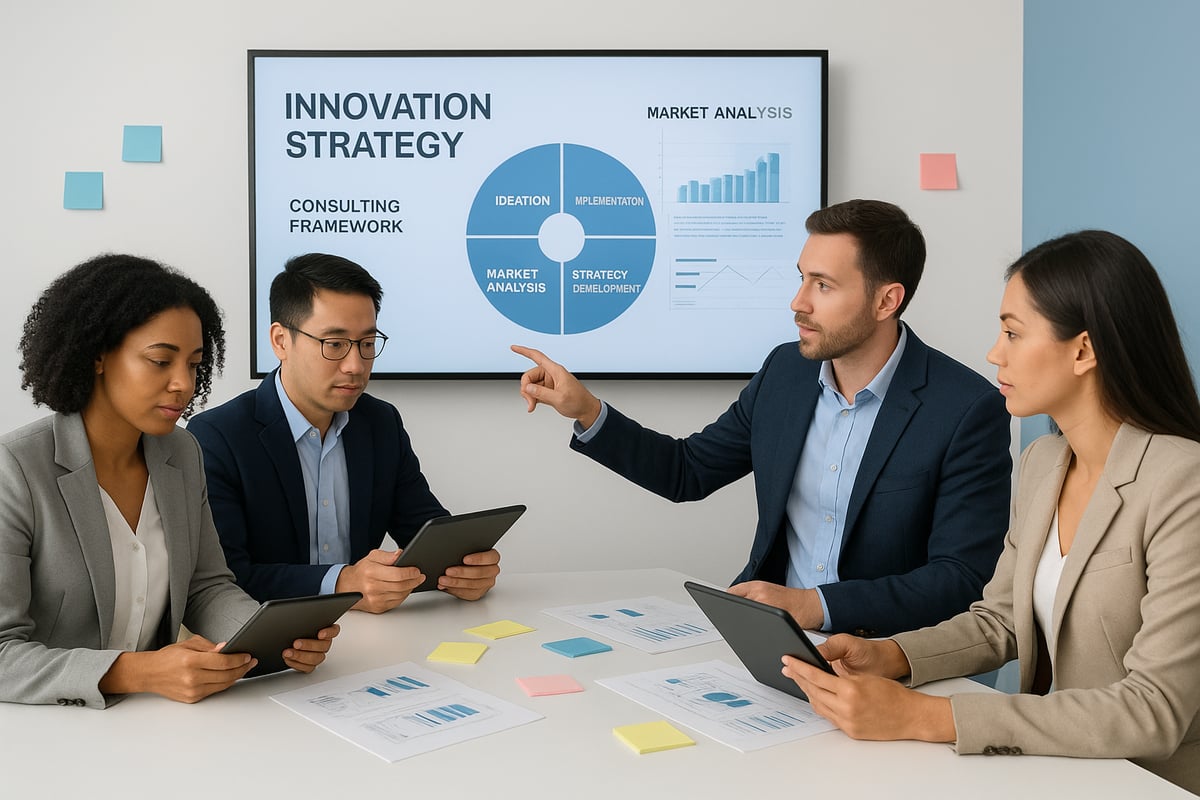
Innovation strategy consulting is a specialized advisory service focused on helping organizations design, implement, and scale innovation strategies that align with their business goals. Unlike general strategy consulting, this discipline places a strong emphasis on both incremental improvements and disruptive change to create lasting value. Consultants work closely with leadership teams to understand evolving market demands and customer needs, ensuring innovation is not just a buzzword but a driver of measurable outcomes. For example, a healthcare company recently partnered with consultants to reimagine its patient experience, resulting in streamlined digital services and improved satisfaction. For a comprehensive overview of these services and their impact, see the Innovation Consulting Services Overview.
What is Innovation Strategy Consulting?
Innovation strategy consulting is defined by its goal to bridge the gap between bold ideas and tangible business results. These consultants ensure that innovation efforts are directly linked to organizational vision, customer expectations, and upcoming market shifts. Distinct from broader business consulting, innovation strategy consulting zeroes in on creating a structured process for both incremental upgrades and transformative change. A recent example includes a healthcare organization working with consultants to overhaul its patient journey, leading to digital-first solutions and more efficient care delivery.
Why Innovation Strategy Matters in 2025
The importance of innovation strategy consulting in 2025 has never been greater. Rapid advances in AI, automation, and digital transformation are reshaping entire industries at an unprecedented pace. Global competition means companies must constantly adapt or risk falling behind. According to Bain, while 84 percent of executives see innovation as crucial for growth, only 6 percent are satisfied with their results. Innovation strategy consulting helps organizations rethink business models, enhance customer experience, and unlock new revenue streams. Retailers, for instance, are leveraging innovation to survive and thrive in the face of digital disruption.
Key Roles of Innovation Consultants
Innovation strategy consulting professionals play several critical roles within an organization. They identify new opportunities through detailed market analysis, facilitate ideation and rapid prototyping sessions, and help build a culture that supports ongoing innovation. Consultants also provide expertise in risk management and portfolio balancing, ensuring that resources are allocated across core, adjacent, and transformational initiatives. For example, a logistics firm benefited from consultants guiding its automation journey, resulting in increased efficiency and reduced operational risks.
Who Needs Innovation Consulting?
A wide range of organizations benefit from innovation strategy consulting. Large enterprises navigating digital transformation rely on consultants to modernize legacy systems and processes. High-growth SMEs use these services to scale quickly and sustainably. C-suite executives turn to innovation strategy consulting for long-term growth planning, while public sector organizations seek help to modernize citizen services. Technology companies, in particular, partner with consultants when launching new products in highly competitive markets, ensuring their innovations are market-ready and strategically aligned.
The Innovation Strategy Consulting Process: Step-by-Step
Unlocking growth through innovation strategy consulting requires a clear, structured process. Each step builds a foundation for sustainable transformation, ensuring ideas move from concept to impact. Here is a detailed look at the consulting journey, with real-world examples and practical insights at every stage.
Step 1: Discovery & Opportunity Assessment
The innovation strategy consulting process starts with a comprehensive discovery phase. Consultants interview key stakeholders to align on business objectives and identify pain points.
They conduct market and competitor analysis to spot emerging trends and gaps. Data-driven tools help map opportunities by analyzing customer feedback, industry benchmarks, and financial performance.
Identifying unmet customer needs is crucial. For example, a retail client leveraged AI analytics to uncover new customer segments, resulting in a targeted growth strategy.
This foundation ensures every subsequent step in the innovation strategy consulting journey is tailored to real-world opportunities.
Step 2: Ideation & Concept Development
Next, innovation strategy consulting shifts to ideation. Facilitated workshops, such as design thinking sessions and innovation sprints, bring cross-functional teams together.
Consultants use divergent and convergent thinking techniques to generate and refine ideas. Rapid prototyping and low-fidelity testing help validate concepts quickly and cost-effectively.
For instance, a fintech client developed new digital solutions for customer onboarding, testing wireframes with users before full development.
This phase ensures the best ideas are prioritized, reducing risk and accelerating time to market in innovation strategy consulting projects.
Step 3: Business Model Innovation & Validation
Business model innovation is a pivotal step in innovation strategy consulting. Consultants use tools like the business model canvas and value proposition design to reimagine how value is created and delivered.
Assumptions are tested with real customers, often through pilot programs. Scenario planning and risk assessment help anticipate challenges, while financial modeling supports go-to-market decisions.
A manufacturing firm, for example, pivoted to Industry 4.0 by validating new service-based offerings with key clients.
This stage ensures that innovative ideas are not just creative, but viable and aligned with overall strategy.
Step 4: Roadmap Creation & Portfolio Management
At this stage, innovation strategy consulting focuses on building a robust roadmap. Consultants prioritize initiatives based on impact and feasibility, balancing a portfolio of core, adjacent, and transformational projects.
Resource allocation and timelines are mapped out in detail. Key performance indicators are defined to measure progress and success.
A retailer, for example, used this approach to balance investments between digital and in-store innovation, ensuring both channels drive growth.
This structured planning helps organizations navigate uncertainty and focus resources where they matter most.
Step 5: Implementation Support & Change Management
Implementation is where innovation strategy consulting delivers tangible outcomes. Consultants provide project management expertise, often leveraging agile methodologies for iterative execution.
They help establish innovation governance, ensuring leadership oversight and accountability. Change management is critical, with consultants supporting stakeholder alignment and capability development.
Training programs equip teams to adopt new tools and processes. For example, a healthcare provider successfully rolled out digital services by combining strong governance with staff training.
This hands-on support transforms plans into measurable business results.
Step 6: Measurement, Scaling & Continuous Improvement
Continuous improvement is at the core of innovation strategy consulting. Feedback loops and learning systems are established to monitor project outcomes and capture lessons learned.
Successful pilots are scaled across the organization, leveraging data analytics to refine offerings. Ongoing market and technology monitoring ensures the strategy stays ahead of change.
For instance, a tech company used analytics to iterate product launches, improving customer adoption with each cycle. Consultants help embed these practices for sustained innovation.
To see more real-world examples of these steps in action, explore the Innovation Case Studies Collection.
Six Paths Consulting: AI-Powered Strategic Innovation
Six Paths Consulting exemplifies end-to-end innovation strategy consulting. The firm specializes in AI-powered growth, helping leaders discover new opportunities and design innovative business models.
Their experts guide clients through discovery, ideation, validation, and execution. Recognized for frameworks like Blue Ocean Strategy and Design Thinking, Six Paths delivers actionable insights and tailored training.
They support industry leaders in building in-house innovation capabilities and future-proofing their strategies for 2025 and beyond.
With proven results across sectors, Six Paths Consulting is a trusted partner for organizations seeking measurable innovation outcomes.
Key Methodologies and Frameworks in Innovation Strategy Consulting
Innovation strategy consulting empowers organizations by leveraging proven methodologies to drive sustainable growth. These frameworks help teams systematically identify, develop, and scale new ideas. Understanding the core approaches equips leaders to choose the best fit for their unique challenges and goals.

Design Thinking
Design Thinking is a cornerstone of innovation strategy consulting. It is a human-centered, iterative approach that encourages empathy for users, creative problem-solving, and rapid prototyping. Consultants use empathy mapping, ideation, and testing to uncover unmet needs and develop viable solutions.
For instance, financial services firms have improved customer experiences by mapping user journeys and prototyping new digital tools. Companies applying this approach report a 56% higher ROI on innovation initiatives, according to Forrester. Design Thinking is effective for both B2C and B2B innovation strategy consulting engagements.
Blue Ocean Strategy
Blue Ocean Strategy is central to innovation strategy consulting for organizations seeking uncontested market space. This framework focuses on value innovation, encouraging companies to eliminate, reduce, raise, or create factors that redefine industry boundaries.
A classic example is Cirque du Soleil, which reinvented circus entertainment by blending theater and acrobatics. The Six Paths Framework, part of Blue Ocean Strategy, helps teams discover new opportunities. For more on this methodology, explore Blue Ocean Strategy Consulting for deeper insights into practical implementation.
Lean Startup & Rapid Prototyping
Lean Startup and Rapid Prototyping are vital in innovation strategy consulting, especially for organizations aiming to test ideas quickly with minimal risk. The build-measure-learn cycle underpins these methods. Teams develop minimum viable products (MVPs), gather feedback, and iterate swiftly.
Tech startups often use these techniques to validate product-market fit before scaling. The benefits include faster time-to-market, reduced costs, and lower failure rates. Many corporate innovation labs now integrate Lean Startup principles into their innovation strategy consulting efforts.
Open Innovation & Ecosystem Partnerships
Open Innovation is a growing focus in innovation strategy consulting. It involves leveraging external networks such as startups, universities, and industry partners to co-create solutions. Consultants facilitate idea crowdsourcing, technology scouting, and ecosystem building.
Automotive companies, for example, partner with tech startups to access cutting-edge mobility solutions. Open Innovation provides access to new technologies and spreads risk across partners. This approach maximizes the value of innovation strategy consulting by expanding beyond internal resources.
Digital Transformation & AI-Driven Innovation
Digital Transformation and AI-Driven Innovation are now essential in innovation strategy consulting. Embedding digital tools and artificial intelligence into business processes enables data-driven decisions and automation.
Retailers use AI to personalize customer journeys and optimize operations. In fact, 61% of organizations cite AI as a key innovation driver. Consultants guide firms through technology adoption and change management, ensuring digital solutions align with strategic objectives in innovation strategy consulting.
Innovation Portfolio Management
Innovation Portfolio Management is a structured approach used in innovation strategy consulting to balance risk and reward. Consultants help organizations prioritize projects across core, adjacent, and transformational categories.
Tools like the innovation matrix support portfolio decisions. For example, consumer goods companies use these frameworks to manage a pipeline of new offerings aligned with business goals. Ongoing review and adaptation ensure the portfolio remains relevant as market conditions evolve, reinforcing the value of innovation strategy consulting.
Emerging Innovation Trends for 2025
The innovation strategy consulting landscape is rapidly shifting as new technologies and business demands reshape priorities for 2025. Leaders who anticipate these trends position their organizations for sustained growth, agility, and relevance. Let us explore the five most critical innovation trends and how consulting expertise can help you capitalize on them.

AI and Automation as Growth Catalysts
Artificial intelligence and automation continue to drive transformative change across industries. In 2025, organizations are harnessing these technologies to streamline operations, enhance product development, and improve customer service. According to Bain, 75% of executives plan to increase AI investments, signaling a clear priority for digital acceleration.
Innovation strategy consulting plays a pivotal role in helping firms identify high-impact use cases, design robust AI roadmaps, and manage implementation risks. Consultants guide companies through everything from process automation in logistics to AI-powered personalization in retail. For a deeper dive, review these AI-Powered Innovation Platforms that automate tasks and enable smarter, data-driven decision-making.
Customer Experience (CX) Innovation
Customer expectations have never been higher. Personalization, seamless omnichannel engagement, and human-centered design are now essential for differentiation. In 2025, 80% of consumers value experience as much as products or services, making CX a core driver of loyalty and revenue.
Innovation strategy consulting helps organizations reimagine customer journeys and embed design thinking into every touchpoint. By leveraging digital tools and agile methodologies, consultants enable healthcare providers to offer digital patient engagement and retailers to deliver personalized shopping experiences. This focus on CX is a proven path to sustainable growth.
Sustainability and ESG-Driven Innovation
Sustainability is no longer a trend, but a business imperative. Companies are integrating environmental, social, and governance (ESG) goals into product design, supply chains, and brand strategy. In 2025, 63% of consumers prefer sustainable brands, compelling organizations to innovate responsibly.
Innovation strategy consulting empowers firms to adopt circular economy models, reduce carbon footprints, and align innovation with ESG objectives. Consultants facilitate cross-functional collaboration, enabling food and beverage companies to develop eco-friendly packaging or manufacturers to enhance resource efficiency. Embedding sustainability into the innovation agenda is now a competitive advantage.
Industry-Specific Innovation (Healthcare, Logistics, Tech, Financial)
Each sector faces unique challenges and opportunities in the era of rapid change. Healthcare organizations are advancing digital health, telemedicine, and AI diagnostics. Logistics firms leverage automation, IoT, and real-time tracking to boost efficiency. Technology providers are embracing edge computing and 5G, while the financial sector is transforming with fintech, blockchain, and open banking.
Innovation strategy consulting delivers tailored solutions for these industry shifts. Consultants apply proven tools and frameworks to help organizations adapt their business models and capture new market opportunities. For further industry insights, consult the Emerging Technology Trends 2025 report for a comprehensive overview.
Building Organizational Innovation Capability
Sustained innovation requires more than one-off projects. Organizations must develop a culture of experimentation, support leadership development, and invest in robust governance structures. Yet, only 20% of companies have mature innovation processes in place.
Innovation strategy consulting assists in building these foundational capabilities. Consultants design training programs, establish clear incentives, and implement governance models that encourage learning and adaptability. By embedding innovation into the organizational DNA, firms can continuously respond to market shifts and maintain a competitive edge.
Selecting the Right Innovation Strategy Consulting Partner
Selecting the right innovation strategy consulting partner is a pivotal decision for leaders aiming to drive growth. The right partner brings specialized expertise, proven frameworks, and a collaborative approach that aligns with your business vision. In a rapidly evolving landscape, making an informed choice ensures your innovation investments deliver measurable results.

Criteria for Choosing a Consulting Firm
When evaluating innovation strategy consulting firms, focus on a blend of expertise, results, and cultural compatibility. Look for partners with deep industry knowledge, a strong record of client success, and a collaborative mindset. Proven methodologies such as Design Thinking and Innovation Consulting can be a differentiator, especially if they offer tailored solutions.
Key criteria include:
- Demonstrated impact on client growth and transformation
- Ability to customize frameworks for your industry
- Breadth of services from initial strategy to hands-on execution
- Track record with organizations similar to yours
A thorough comparison of client portfolios and outcomes can reveal which firms consistently deliver business value. Always prioritize transparency and measurable impact.
Questions to Ask Potential Partners
Choosing an innovation strategy consulting partner requires asking the right questions to ensure alignment. Start by inquiring how they adapt their approach to your industry and business model. Ask about the specific frameworks, tools, and methodologies they employ for innovation.
Key questions to consider:
- Can you share case studies relevant to our challenges?
- How do you facilitate knowledge transfer and capability building?
- What is your process for stakeholder engagement and buy-in?
- How do you handle change management during transformation?
By probing these areas, you gain insight into the firm’s ability to deliver sustainable innovation and empower your team for long-term growth.
Evaluating Consulting Approaches: AI, Digital, and Human-Centric
As innovation strategy consulting evolves, firms increasingly blend AI, digital, and human-centered approaches. Assess whether the partner leverages advanced technologies, such as predictive analytics and automation, to enhance strategic decision-making. Review their expertise in digital transformation and their commitment to human-centered design.
For a deeper dive, explore how AI-Driven Strategic Decision-Making is shaping the future of consulting. Firms that seamlessly integrate technology with empathy and change management are best positioned to address complex business challenges. According to recent research, 70 percent of innovation leaders prefer partners with strong digital and AI capabilities.
Engagement Models and Pricing Structures
Innovation strategy consulting firms offer a range of engagement models to suit different needs and budgets. Common structures include project-based engagements, ongoing retainers, and innovation-as-a-service models. Transparent pricing and value-based fees are important for building trust and ensuring alignment with your strategic goals.
Consider these factors when evaluating engagement models:
- Flexibility to scale services as your needs evolve
- Customization for enterprise vs. SME clients
- Clarity on deliverables, timelines, and milestones
For example, some firms provide innovation as a service, allowing businesses to access continuous support. Always ensure the pricing structure matches your expected outcomes and resource requirements.
Measuring Success: KPIs and Outcomes
Measuring the success of innovation strategy consulting is essential for demonstrating ROI and guiding future investments. Define clear key performance indicators such as revenue growth, time-to-market, and customer satisfaction. Leading firms provide ongoing tracking and transparent reporting, so you can monitor progress against benchmarks.
Essential metrics include:
- Number of new products or services launched
- Customer adoption rates and feedback
- Efficiency gains and cost savings
- Impact on competitive positioning
Post-engagement support is also critical. Ensure your partner remains committed to knowledge transfer and continuous improvement after the project concludes.
Building a Long-Term Innovation Partnership
Transitioning from one-off projects to a long-term innovation strategy consulting partnership unlocks sustained growth. The most effective relationships are built on co-creation, shared vision, and ongoing capability development. Embedding consultants within your innovation teams fosters collaboration and accelerates learning.
Key elements of successful partnerships:
- Continuous alignment as market conditions evolve
- Leadership development and training programs
- Innovation governance and incentive structures
By investing in a trusted partner, organizations can future-proof their innovation journey and stay ahead of disruption.
As you look ahead to 2025, the ability to turn innovative ideas into tangible growth will set your business apart. We’ve explored how strategy, AI-powered insights, and a strong innovation culture can unlock new opportunities and drive sustainable success. But every organization’s path is unique—sometimes, a fresh perspective can reveal possibilities you haven’t yet considered. If you’re ready to take the next step and see where innovation can lead your business, I invite you to Book a Free Opportunity Assessment. Let’s work together to identify your growth potential and chart a confident course forward.