

In a rapidly changing business landscape, organizations that drive innovation workshop initiatives consistently set themselves apart from the competition. As we approach 2026, industries are facing unprecedented disruption and complexity, making creative problem-solving more urgent than ever.
Traditional brainstorming no longer delivers the breakthrough solutions businesses need. Instead, the innovation workshop provides a structured way to unlock real creative value and tackle complex challenges.
This guide gives you actionable strategies, proven frameworks, and expert insights to turn team creativity into measurable business results. Explore step-by-step methods to design, facilitate, and maximize the impact of your next innovation workshop.
Discover what innovation workshops are, their core benefits, essential frameworks, planning steps, facilitation best practices, technology tools, and tips for sustaining innovation long after the session ends.
Understanding Innovation Workshops: Definition, Purpose, and Impact
An innovation workshop is a structured, collaborative session that focuses on generating, refining, and prioritizing creative ideas to address specific business challenges or opportunities. Unlike casual brainstorming, an innovation workshop uses guided processes, clear objectives, and expert facilitation to ensure every voice is heard and every idea is considered.
What sets an innovation workshop apart from traditional meetings or unstructured brainstorming? The answer lies in its use of proven frameworks and a results-driven agenda. Participants follow a well-defined path from problem identification to actionable solutions. This structure not only boosts engagement but also keeps teams focused on outcomes that matter.
The core purposes of an innovation workshop are to foster creativity, accelerate problem-solving, break down organizational silos, and deliver tangible results. Organizations use these workshops to tackle a wide range of challenges, such as product design sprints, customer experience improvements, operational efficiency projects, and cross-departmental problem-solving. According to peer-reviewed studies like Vibe (2025), structured workshops significantly increase participants’ confidence and lower barriers to engagement even six months after the event.
Diversity is another key strength of an innovation workshop. Bringing together cross-functional teams with varied backgrounds leads to richer ideas and more innovative solutions. When participants with different perspectives collaborate, they are more likely to identify unique opportunities and develop breakthrough strategies.
Innovation workshops also play a vital role in building a culture of continuous improvement. By embedding creative problem-solving into regular workflows, organizations encourage ongoing experimentation and adaptability. In today’s hybrid and remote work environments, digital collaboration tools such as virtual whiteboards make it possible for teams to engage effectively regardless of location. For organizations seeking to elevate these skills, structured Creativity and Innovation Training can further maximize the value of every innovation workshop.
Overall, the innovation workshop has become an essential practice for organizations aiming to thrive amid disruption and complexity. It empowers teams to generate actionable solutions, strengthens cross-functional collaboration, and supports a dynamic culture of innovation.
Key Elements of a Successful Innovation Workshop
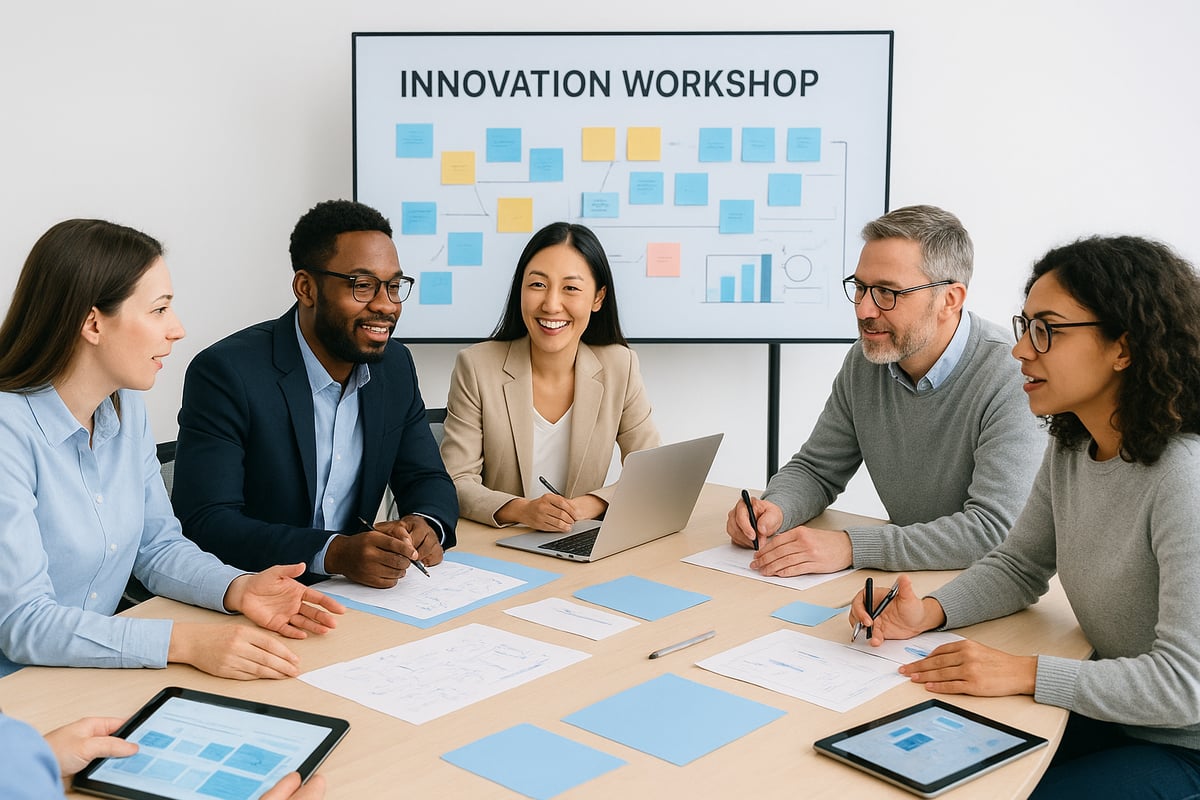
Designing a highly effective innovation workshop requires more than gathering a group of creative minds. Each element must be purposefully structured to unlock creativity, sustain engagement, and deliver measurable results. Let us explore the core ingredients that set successful innovation workshops apart.

Clear Problem Definition and Goal Setting
Every innovation workshop starts with a sharp, well-defined challenge and explicit goals. This focus prevents the session from drifting and keeps participants aligned on what matters most.
A precise problem statement, such as “How might we reduce customer onboarding time by 50% in Q3,” sets clear boundaries for ideation. Establishing measurable criteria for success ensures the innovation workshop generates actionable outcomes, not just ideas.
Diverse and Engaged Participant Mix
A successful innovation workshop thrives on diversity. Bringing together individuals from various roles, departments, and backgrounds leads to richer solutions and stronger buy-in.
Research consistently shows that teams with broad knowledge bases form more novel connections. By involving a cross-functional mix, the innovation workshop breaks down silos and fosters a truly collaborative environment.
- Include representatives from different departments.
- Invite stakeholders with unique perspectives.
- Encourage open-minded participation.
Structured Creativity and Time-Boxed Activities
Structured activities are the backbone of an effective innovation workshop. Techniques such as mind mapping, role-storming, and silent sketching rounds guide participants to think beyond the obvious.
Time-boxed sprints, such as 10-minute ideation sessions, maintain energy and focus. For those interested in proven methods, Design Thinking for Innovation offers a valuable framework that many organizations use to facilitate creative breakthroughs in an innovation workshop.
- Mind mapping for rapid idea generation.
- Silent sketching for visual thinkers.
- Dot voting to prioritize ideas quickly.
Expert Facilitation
Trained facilitators are essential to the success of any innovation workshop. They balance group energy, manage conflicts, and ensure every voice is heard.
Facilitators use tools like breakout groups, impact/effort grids, and clear ground rules to keep the session productive. Their expertise helps transform raw ideas into actionable plans, making the innovation workshop a catalyst for real change.
Action Orientation and Follow-Through
The innovation workshop must move beyond ideation to implementation. Sessions conclude with prioritized ideas, clear next steps, and assigned responsibilities.
Validating concepts through quick prototypes or low-fidelity storyboards ensures only the strongest ideas advance. Accountability measures, like action plans and documented outcomes, drive follow-through after the innovation workshop ends.
Psychological Safety and Engagement
Psychological safety is foundational for creative risk-taking in any innovation workshop. Establishing ground rules ensures that all participants feel respected and empowered to contribute.
Safe, inclusive environments encourage participants to share bold ideas without fear of judgment. This culture of trust raises the quality and quantity of ideas generated during the innovation workshop.
Technology Enablement
In today’s hybrid and remote work environments, technology is a key enabler for innovation workshop success. Digital whiteboards, collaboration platforms, and real-time feedback tools make participation seamless for both in-person and virtual teams.
Tools like Vibe Board and Miro support live annotation, digital sticky notes, and instant sharing. By leveraging technology, organizations maximize engagement and outcomes in every innovation workshop.
Each of these elements, when intentionally integrated, transforms a routine meeting into a high-impact innovation workshop that delivers creative solutions with lasting business value.
Essential Frameworks and Formats for Innovation Workshops
In today’s fast-paced business environment, selecting the right frameworks and formats can determine the success of any innovation workshop. The right approach not only sparks creativity but also ensures that ideas are actionable and aligned with business objectives.

Design Thinking
Design Thinking stands out as a human-centered methodology for driving innovation workshop outcomes. It encourages teams to deeply understand user needs, reframe problems, and generate creative solutions through a structured process.
The five key steps are:
- Empathize: Gather user insights and pain points.
- Define: Clearly articulate the core challenge.
- Ideate: Brainstorm multiple solutions without judgment.
- Prototype: Build simple models or mockups.
- Test: Gather feedback and iterate.
Design Thinking is especially effective in innovation workshop settings where customer experience and product development are priorities. By grounding activities in empathy and rapid prototyping, teams can quickly move from abstract ideas to practical, user-validated solutions.
TRIZ (Theory of Inventive Problem Solving)
TRIZ is a powerful, systematic approach often used in technical or process-focused innovation workshop sessions. This framework helps participants resolve contradictions—those situations where improving one aspect seems to worsen another—by applying patterns from thousands of patented inventions.
Key features of TRIZ include:
- Contradiction analysis to pinpoint root conflicts.
- Use of 40 inventive principles to inspire novel solutions.
- Tools for mapping and overcoming technical barriers.
TRIZ is best suited for situations where teams face complex engineering or operational challenges. Its structured methodology ensures that an innovation workshop does not get stuck in conventional thinking, instead pushing for breakthrough outcomes.
Business Model Canvas
The Business Model Canvas offers a visual, one-page tool for mapping and innovating business models during an innovation workshop. It helps teams align on value propositions, customer segments, key activities, and revenue streams.
Core sections of the canvas:
- Value Propositions: What unique solution is being offered?
- Customer Segments: Who are the target users?
- Channels: How will the solution reach customers?
- Key Resources and Partnerships: What assets and alliances are needed?
- Revenue Streams and Cost Structure: How does the model sustain itself?
An innovation workshop using the Business Model Canvas is ideal for startups exploring new markets or established companies aiming to pivot. By seeing the business model holistically, teams can identify gaps, test assumptions, and prioritize high-impact changes.
Alternative Formats: Hackathons, Innovation Sprints, Labs, and Crowdsourcing
Beyond traditional frameworks, alternative formats energize the innovation workshop landscape. Hackathons are time-bound events where teams race to ideate and prototype, often producing tangible results in just days. Recent research highlights how corporate hackathons can improve productivity and foster a culture of rapid experimentation; see Improving Productivity through Corporate Hackathons for real-world examples.
Innovation sprints focus on urgent challenges, leveraging agile principles for fast results. Innovation labs provide ongoing space and resources for experimentation. Crowdsourcing taps external expertise, expanding the pool of ideas.
Each format can be tailored to fit the specific objectives and culture of your innovation workshop, making them versatile tools for different business needs.
Choosing the Right Framework and Format
Selecting the best approach for your innovation workshop starts with the challenge type and desired outcomes. Use Design Thinking for customer-centric problems, TRIZ for technical hurdles, or Business Model Canvas for business model innovation.
Consider team composition and the urgency of the issue. For example, hackathons are ideal when rapid prototyping is needed, while innovation labs support sustained, cross-team collaboration.
A simple comparison table can help clarify the decision:
| Framework/Format | Best For | Key Strength |
|---|---|---|
| Design Thinking | User-driven product/service issues | Empathy, speed |
| TRIZ | Technical/process challenges | Systematic ideas |
| Business Model Canvas | Business strategy/model shifts | Big-picture view |
| Hackathons/Sprints | Rapid prototyping/experimentation | Energy, focus |
Matching the framework to your innovation workshop goals ensures both engagement and measurable results.
Virtual and Hybrid Workshop Formats
As hybrid and remote work environments become standard, adapting the innovation workshop to digital spaces is essential. Online collaboration platforms like Miro and Vibe Board enable real-time brainstorming, sticky note clustering, and instant feedback.
Virtual innovation workshop formats maintain inclusivity, allowing participants from different locations and backgrounds to contribute equally. Time-boxed digital activities, breakout rooms, and live polling tools keep energy high and ensure every idea is captured.
By leveraging technology and flexible formats, organizations can scale their innovation workshop efforts, engaging larger and more diverse teams while sustaining creative momentum.
Step-by-Step Guide: Planning and Running an Innovation Workshop in 2025
In 2025, organizations face complex challenges that demand structured creativity. A well-run innovation workshop can unlock breakthrough solutions, but success depends on careful planning and execution. This guide walks you through each critical step, ensuring your innovation workshop delivers measurable results.

Step 1: Define the Challenge and Set Goals
Every successful innovation workshop starts with a sharp problem statement. Define what you want to solve and set clear, measurable goals. This focus prevents scope drift and ensures the group channels energy into impactful solutions.
For example, instead of a broad objective like “improve customer experience,” try “How might we reduce customer onboarding time by 50 percent in Q3?” Involve stakeholders early to align on scope, resources, and desired outcomes.
A precise goal sets the stage for the entire innovation workshop, guiding activities and decision-making from start to finish.
Step 2: Frame Insights and Opportunities
Before generating ideas, ground your innovation workshop in real data and user needs. Use personas, journey maps, or “How might we” prompts to frame the challenge from multiple perspectives.
Identify key constraints and opportunity spaces. For instance, map out current customer pain points or workflow bottlenecks. This step helps participants empathize with end users and reveals hidden areas for creative solutions.
A well-framed insight ensures your innovation workshop is rooted in reality, increasing the relevance and impact of generated ideas.
Step 3: Ideation—Divergent Thinking (Time-Boxed)
Now, shift into divergent thinking. Structure your innovation workshop with rapid, silent idea generation rounds to ensure everyone’s voice is heard. Techniques like reverse brainstorming, mind mapping, and silent sketching can spark unexpected connections.
Use time-boxed sprints (such as 10-minute sessions) to maintain momentum. Encourage “yes and” collaboration, where participants build on each other’s ideas rather than critique prematurely.
This creative burst is the heart of the innovation workshop, producing a wide range of solutions for further refinement.
Step 4: Synthesize and Prioritize Ideas
After ideation, it’s time to make sense of the ideas generated. Cluster similar concepts into themes and label them based on user value. Use visible criteria such as desirability, feasibility, and potential impact to filter the best ideas.
Techniques like dot voting or impact/effort grids help the team decide which solutions to pursue further. This process turns a flood of ideas into actionable priorities.
By synthesizing and prioritizing, your innovation workshop moves from creativity to clarity, setting up the next phase for tangible progress.
Step 5: Prototype and Test
Translate top ideas into quick, low-fidelity prototypes. These can be storyboards, paper mockups, or digital wireframes. The goal is to visualize solutions and gather feedback rapidly.
Run small tests with real users or stakeholders, such as hallway testing or online surveys. This step allows teams to validate assumptions and learn before investing heavily in development.
Prototyping and testing ensure that your innovation workshop produces ideas that are both creative and practical.
Step 6: Action Planning and Commitment
An innovation workshop must end with a clear action plan. Assign responsibilities, set timelines, and outline next steps for implementation. Document outcomes and share them with all stakeholders to maintain momentum.
Accountability is key. Assign owners for each action item and schedule follow-ups. For inspiration, review Innovation Case Studies to see how leading organizations translate workshop results into real business impact.
A strong finish ensures your innovation workshop delivers results long after the session ends.
Tips for Effective Facilitation and Engagement
A trained facilitator can make or break an innovation workshop. They manage energy, resolve conflict, and ensure equal participation. Set ground rules for psychological safety so everyone feels comfortable sharing bold ideas.
Leverage digital tools like Miro or Vibe Board for real-time collaboration, especially with hybrid or remote teams. Breakout groups and structured activities keep engagement high and discussions focused.
Effective facilitation transforms your innovation workshop into a dynamic, inclusive, and productive experience.
Common Pitfalls and How to Avoid Them
Even with the best intentions, innovation workshops can stumble. Common pitfalls include unclear objectives, participant disengagement, and lack of follow-up.
To avoid these, always start with a focused problem statement. Prepare participants with pre-workshop briefings and clear agendas. Document every decision and assign owners for follow-up actions.
Regular post-workshop check-ins ensure that ideas do not fade away. Addressing these pitfalls keeps your innovation workshop on track and maximizes its long-term impact.
Leveraging Technology and Tools to Maximize Workshop Outcomes
In 2025, the right technology can make or break an innovation workshop. Digital tools have evolved from simple whiteboards to powerful platforms that fuel creativity, collaboration, and measurable results. Today, a successful innovation workshop often relies on smart integration of these tools to ensure every idea is captured, every voice is heard, and every solution is actionable.

Digital Tools Transforming Innovation Workshops
The innovation workshop landscape has been reshaped by platforms like Miro, Mural, and Vibe Board. These digital whiteboards offer real-time collaboration, allowing teams to brainstorm, cluster ideas, and vote from anywhere.
| Platform | Key Features | Best For |
|---|---|---|
| Miro | Templates, integrations | Visual mapping |
| Mural | Facilitation tools | Ideation sessions |
| Vibe Board | Live annotation, sharing | Hybrid workshops |
These tools support visual thinking and ensure that even remote or hybrid teams can contribute equally. For example, Vibe Board enables instant digital sticky notes and live annotation, making it easy to document every step of the innovation workshop. With seamless integration to project management systems, teams move from ideation to execution without missing a beat.
AI-Powered Features for Enhanced Collaboration
Artificial intelligence is now a game-changer for the innovation workshop process. Many platforms offer AI-driven features such as automatic idea clustering, sentiment analysis, and prioritization, helping teams manage large volumes of input and focus on high-impact solutions.
AI can also facilitate unbiased decision-making by highlighting patterns and surfacing hidden connections among ideas. According to recent research on the Impact of Generative AI on Innovation Teams, these tools are proven to accelerate ideation and improve team performance during innovation workshop activities.
Teams benefit from faster decision cycles and deeper insights, allowing them to test and refine solutions in real time. This level of support is especially valuable in complex or large-scale innovation workshop settings.
Best Practices for Selecting and Using Workshop Tools
Choosing the right technology for your innovation workshop is essential for success. Consider these best practices:
- Match the tool to your workshop format and team size.
- Prioritize platforms with intuitive interfaces and accessibility features.
- Ensure seamless integration with existing workflows and project management systems.
- Test the tool in advance to avoid technical issues during the session.
Data shows that teams using digital collaboration tools in their innovation workshop report higher engagement and faster decision-making. Ultimately, the right technology empowers your team to focus on creative problem-solving, not logistics.
Sustaining Innovation: Post-Workshop Execution and Culture Building
Turning insights from an innovation workshop into lasting business value requires more than a successful session. The real impact emerges in the days and months that follow, as teams translate creative ideas into tangible outcomes.
Embedding innovation into daily workflows is essential. Establishing regular check-ins, progress reviews, and visible action plans helps teams maintain momentum after an innovation workshop. Assigning clear responsibilities and measurable KPIs ensures accountability and keeps everyone aligned on goals.
Leadership plays a vital role in sustaining the culture sparked by an innovation workshop. By providing resources, recognizing achievements, and modeling openness to experimentation, leaders help foster an environment where new ideas can thrive. Organizations that run recurring workshops report higher engagement and faster implementation of ideas, demonstrating the power of ongoing support.
Sharing knowledge across departments is another key factor in maintaining innovative energy. Encouraging open dialogue, cross-functional collaboration, and feedback loops allows lessons from each innovation workshop to benefit the broader organization. Platforms like the Corporate Innovation Platform offer structured approaches and tools to help organizations institutionalize these practices.
To keep innovation alive, it is crucial to address common post-workshop challenges:
- Accountability gaps: Assign owners for each action item and schedule follow-ups.
- Idea fatigue: Celebrate quick wins and highlight visible successes to sustain motivation.
- Resistance to change: Involve stakeholders early and communicate the value of innovation workshop outcomes.
The table below summarizes strategies for sustaining innovation workshop results:
| Strategy | Description |
|---|---|
| Action Planning | Assign tasks, set deadlines, and monitor progress |
| Regular Check-Ins | Hold brief, focused meetings to review status |
| Leadership Support | Allocate resources and celebrate achievements |
| Knowledge Sharing | Facilitate sharing across teams and departments |
| Continuous Learning | Encourage learning from both successes and failures |
| Feedback Loops | Collect input and refine processes over time |
Staying connected to the broader innovation community can also enrich your approach. Participating in events like the World Open Innovation Conference 2025 Call for Best Practices helps leaders and facilitators learn from others and share what works.
Ultimately, sustaining the momentum of an innovation workshop requires commitment, structure, and a willingness to adapt. By embedding innovation into the fabric of daily work, organizations can transform creative energy into measurable results and build a resilient culture ready for the challenges of 2025.
After exploring the step-by-step strategies and proven frameworks for running impactful innovation workshops, you might be wondering how your organization can put these insights into action. If you’re ready to unlock new market opportunities, accelerate revenue growth, and build innovation capabilities that truly last, let’s take the next step together. I invite you to Book a Free Opportunity Assessment—it’s a chance to discuss your unique challenges and see how structured, AI-powered innovation can drive meaningful results for your team in 2025 and beyond.