

The convergence of consulting and design represents a fundamental shift in how organizations approach strategic challenges and innovation opportunities. As businesses navigate increasingly complex markets in 2026, the integration of analytical rigor with human-centered design principles has become essential for driving sustainable growth and competitive differentiation. This powerful combination enables companies to move beyond traditional problem-solving approaches toward creating entirely new value propositions that resonate deeply with customer needs while delivering measurable business outcomes.
The Evolution of Consulting and Design Integration
Traditional consulting focused primarily on analytical frameworks, process optimization, and financial engineering. Design, meanwhile, emphasized user experience, aesthetics, and creative problem-solving. The modern business environment demands both.
Strategic consulting firms now recognize that sustainable competitive advantage requires more than efficiency improvements. Organizations need transformative solutions that reimagine entire business models, customer experiences, and value delivery systems. Design thinking in consulting has emerged as a critical methodology for achieving these breakthrough outcomes.
Why Traditional Approaches Fall Short
The limitations of conventional consulting include:
- Overreliance on historical data in rapidly changing markets
- Solutions that optimize existing models rather than creating new ones
- Insufficient attention to human factors and customer emotions
- Implementation challenges due to lack of stakeholder buy-in
- Difficulty translating strategy into tangible customer experiences
The integration of design methodologies addresses these gaps by bringing empathy, experimentation, and iterative refinement into strategic engagements. This approach has proven particularly valuable for innovation consulting services focused on discovering untapped market opportunities.
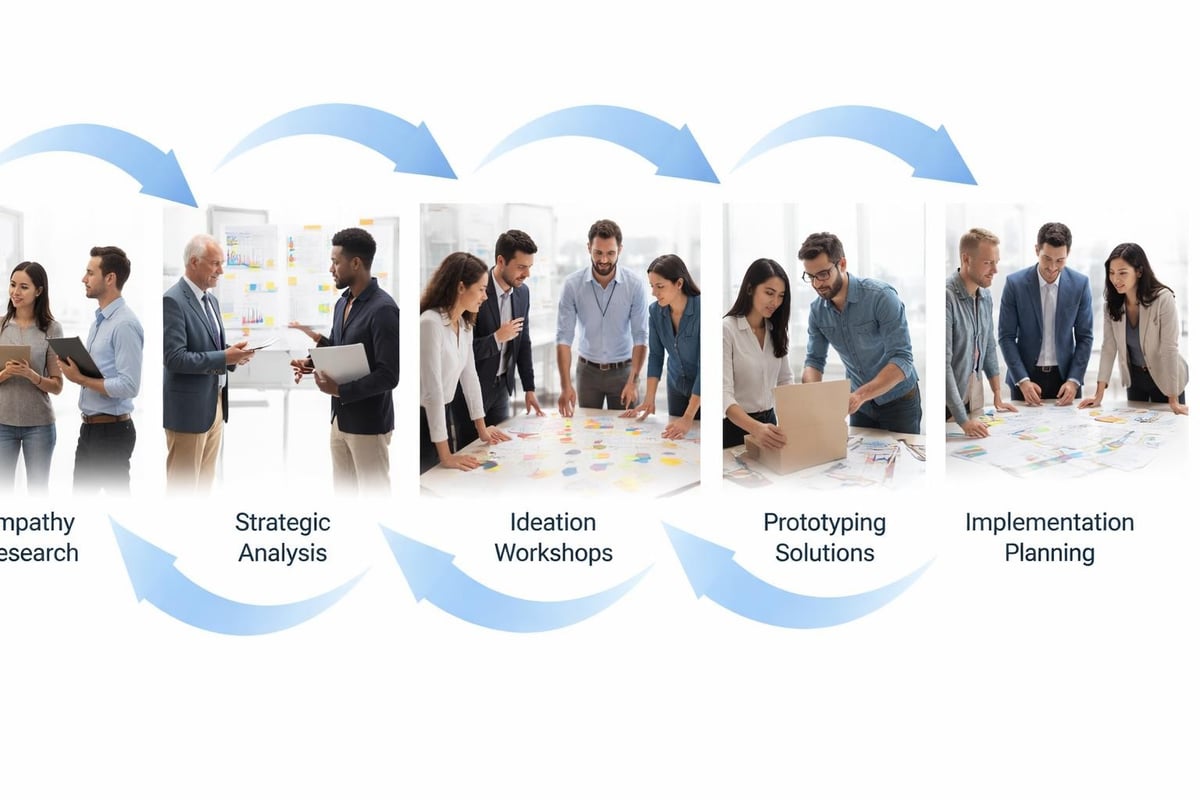
Core Principles of Effective Consulting and Design
Successful integration of consulting and design rests on several foundational principles that distinguish transformative engagements from conventional advisory services.
Human-Centered Strategy Development
Every strategic initiative ultimately affects people whether customers, employees, or partners. Consulting and design practices place human needs at the center of strategic decision-making. This means conducting deep ethnographic research, understanding emotional drivers, and mapping complete customer journeys before recommending solutions.
Organizations working with top management consulting partners expect insights that go beyond surface-level data analysis. They seek understanding of underlying motivations, unmet needs, and emerging behavior patterns that signal future opportunities.
Iterative Prototyping and Validation
Rather than developing complete strategies in isolation, modern consulting and design approaches embrace rapid experimentation. Teams create low-fidelity prototypes of new business models, services, or experiences to test assumptions before committing significant resources.
| Traditional Consulting | Consulting and Design Integration |
|---|---|
| Comprehensive analysis before recommendation | Continuous learning through experimentation |
| Single delivery of strategic plan | Iterative refinement based on feedback |
| Hypothesis-driven from existing data | Discovery-driven exploring new possibilities |
| Implementation as separate phase | Design integrated throughout execution |
This iterative approach reduces risk while accelerating time to value. Organizations can validate strategic directions with real customer feedback rather than relying solely on projected scenarios.
Cross-Functional Collaboration
Consulting and design projects thrive when diverse perspectives converge. This requires breaking down silos between strategy, operations, marketing, technology, and customer-facing teams. Collaborative workshops, co-creation sessions, and cross-functional working groups become essential tools for developing holistic solutions.
The consulting industry trends for 2026 emphasize the growing importance of multidisciplinary teams that combine analytical capabilities with creative thinking. Firms that excel in this integration deliver more comprehensive value to clients.
Practical Applications Across Business Challenges
The consulting and design methodology applies across diverse business contexts, from launching new ventures to transforming established enterprises.
Market Opportunity Discovery
Identifying white space opportunities requires both rigorous market analysis and deep customer understanding. Consulting and design teams combine competitive intelligence, trend analysis, and voice-of-customer research to uncover unmet needs.
The discovery process typically includes:
- Quantitative market sizing and segmentation analysis
- Qualitative customer interviews and observational studies
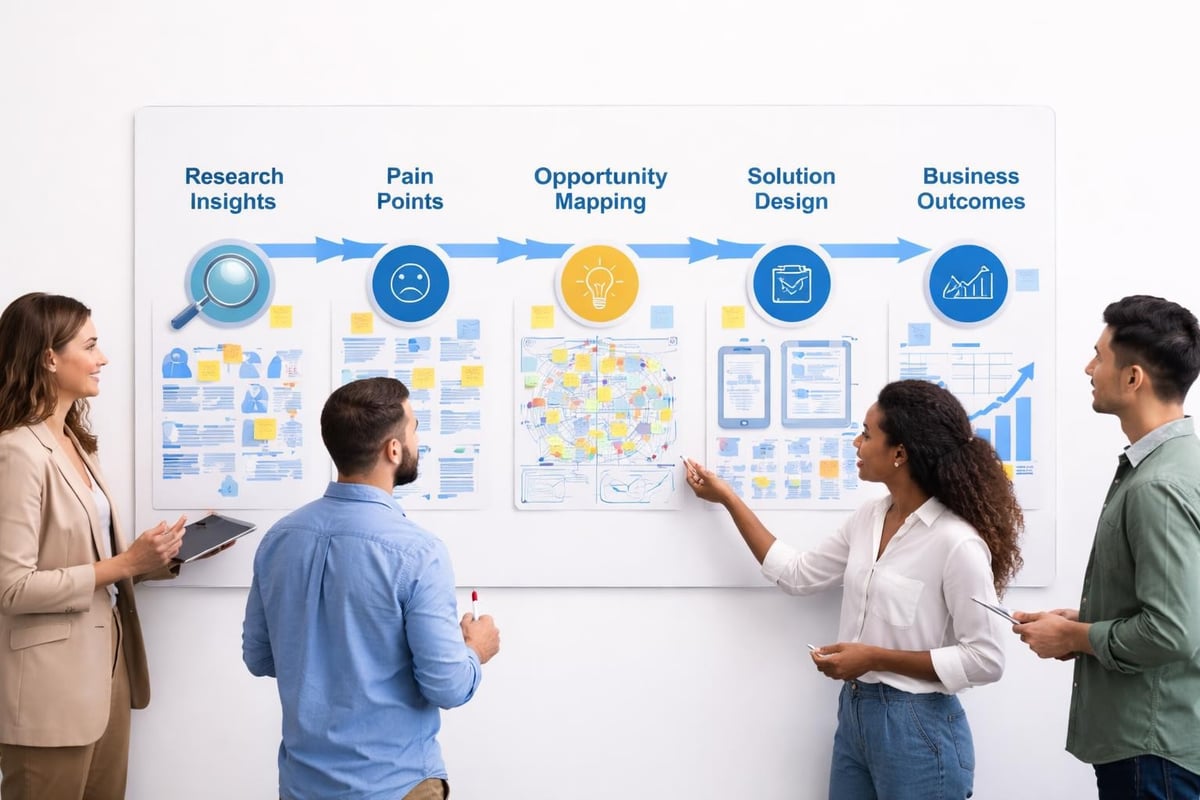
- Journey mapping to identify pain points and moments of truth
- Value curve analysis comparing industry offerings
- Ideation workshops generating novel solution concepts
- Prototype development and customer validation testing
This comprehensive approach has proven particularly effective for business model innovation initiatives where organizations seek to create entirely new revenue streams.
Customer Experience Transformation
Many consulting engagements now center on reimagining how customers interact with products, services, and brands. Consulting and design integration ensures these transformations align with strategic objectives while delivering meaningful improvements in customer satisfaction.
Experience design goes beyond interface improvements to encompass the entire ecosystem of touchpoints, from initial awareness through post-purchase support. Strategic consultants help prioritize investments based on business impact while designers ensure solutions resonate with target audiences.
Organizational Change and Culture
Implementing new strategies often requires significant organizational change. Consulting and design methodologies help leaders navigate this complexity by involving employees in the transformation process.
Change management programs that incorporate design thinking principles achieve higher adoption rates because they address emotional and cultural dimensions alongside structural changes. Employees become co-creators rather than passive recipients of new directives.
Technology Integration in Modern Consulting and Design
The rapid advancement of artificial intelligence and digital technologies has fundamentally altered how consulting and design services deliver value. Technology consulting revenue is projected to surpass $400 billion in 2026, reflecting the critical role of tech-enabled transformation.
AI-Powered Strategic Insights
Modern consulting and design practices leverage artificial intelligence to accelerate research, generate insights, and test scenarios at unprecedented scale. Machine learning algorithms analyze vast datasets to identify patterns that human analysts might miss, while generative AI tools facilitate rapid ideation and concept development.
Organizations partnering with AI strategy consulting firms gain competitive advantage by embedding these capabilities into their strategic processes. The combination of human creativity and machine intelligence unlocks possibilities that neither could achieve independently.
Digital Prototyping and Simulation
Advanced simulation tools enable consulting and design teams to model complex business scenarios, test market responses, and optimize solutions before implementation. Digital twins of customer journeys, operational processes, and entire business ecosystems allow for risk-free experimentation.
Key technologies transforming consulting and design include:
- Predictive analytics for market forecasting and opportunity assessment
- Virtual reality for immersive customer experience prototyping
- Process mining for operational insight discovery
- Natural language processing for customer feedback analysis
- Scenario planning software for strategic option evaluation
These tools complement rather than replace human judgment, enabling consultants and designers to focus on high-value creative and strategic work.
Measuring Impact and Value Creation
Successful consulting and design engagements deliver tangible business results that justify investment and build long-term partnerships.
Defining Success Metrics
Before beginning any engagement, leading firms establish clear metrics aligned with client objectives. These typically span multiple dimensions including financial performance, customer satisfaction, operational efficiency, and innovation capability.
| Impact Category | Example Metrics | Measurement Timeline |
|---|---|---|
| Revenue Growth | New product revenue, market share gains | 6-12 months |
| Customer Value | NPS, retention rate, lifetime value | 3-6 months |
| Operational Excellence | Cycle time reduction, cost savings | 3-6 months |
| Innovation Capability | Ideas generated, experiments conducted | Ongoing |
| Strategic Positioning | Brand perception, competitive differentiation | 12-24 months |
Consulting and design projects create value across this spectrum, with different engagements emphasizing various outcomes based on client priorities. Revenue consulting engagements, for example, focus heavily on measurable commercial impact.
Building Internal Capabilities
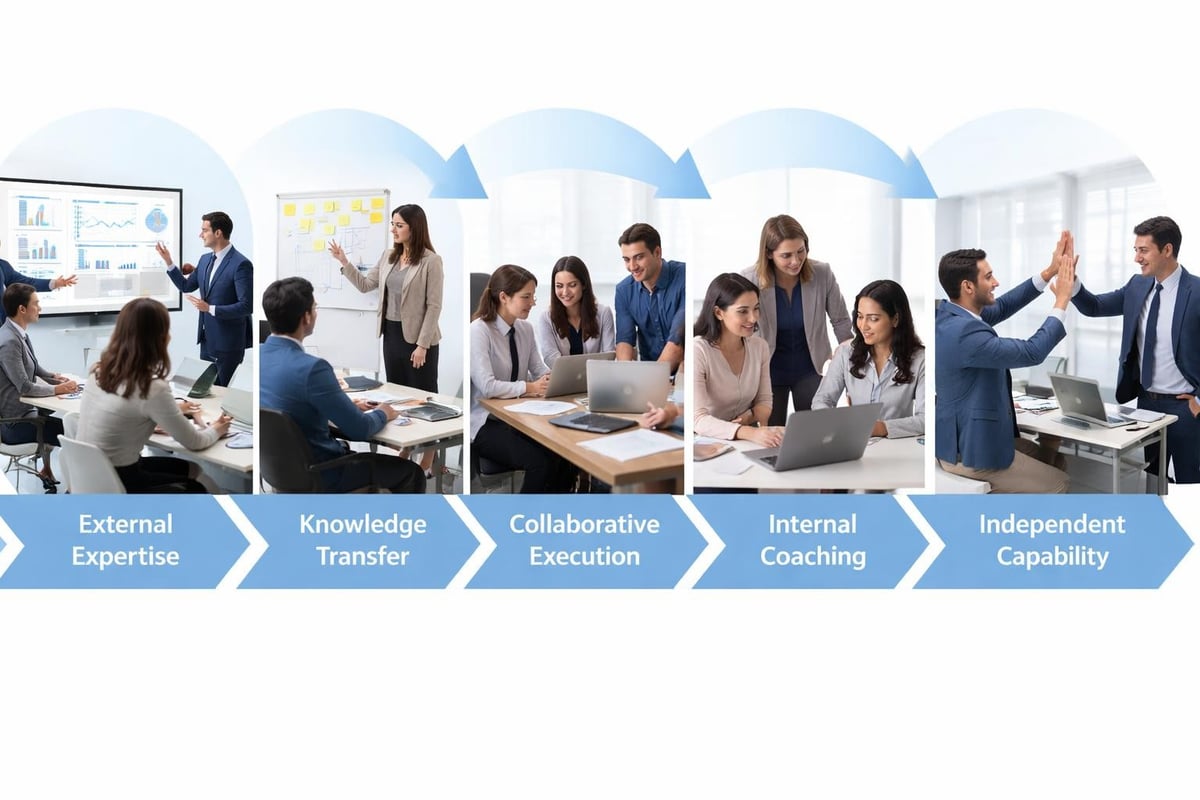
The most valuable consulting and design relationships transfer knowledge and capabilities to client teams rather than creating dependency. Organizations that develop internal innovation competencies achieve sustained competitive advantage beyond any single project.
Training programs, embedded coaching, and collaborative delivery models ensure clients can continue applying consulting and design methodologies independently. This capability-building approach aligns with emerging consulting industry trends emphasizing client empowerment over traditional advisor dependency.
Industry-Specific Applications
While consulting and design principles apply universally, their implementation varies significantly across industries based on unique challenges and opportunities.
Technology and Software Companies
Fast-moving technology markets require consulting and design approaches that keep pace with rapid innovation cycles. Firms in this sector benefit from agile methodologies that deliver incremental value while maintaining strategic coherence. Product-market fit validation, platform strategy development, and ecosystem design represent common focus areas.
Healthcare and Life Sciences
The healthcare industry faces unique constraints including regulatory requirements, complex stakeholder ecosystems, and fundamental human implications. Consulting and design work in this sector demands deep domain expertise alongside creative problem-solving. Patient experience optimization, care delivery model innovation, and digital health strategy exemplify key application areas.
Financial Services and Fintech
Banking, insurance, and financial technology companies operate in highly regulated environments while facing disruption from innovative competitors. Consulting and design engagements help these organizations balance compliance requirements with customer experience innovation. Common projects include digital transformation, product innovation, and operational redesign.
Manufacturing and Industrial
Traditional manufacturing companies increasingly recognize that competitive advantage requires more than operational excellence. Consulting and design services help these organizations develop service-based business models, integrate smart technologies, and create differentiated customer experiences. The shift from product-centric to outcome-based value propositions represents a fundamental strategic transformation.
Selecting the Right Consulting and Design Partner
Organizations seeking to leverage consulting and design capabilities should evaluate potential partners across several critical dimensions.
Demonstrated Expertise and Track Record
Review case studies, client testimonials, and documented results from similar engagements. The best consulting agencies combine deep industry knowledge with proven methodologies and a portfolio of successful transformations.
Essential partner capabilities include:
- Strategic thinking and analytical rigor
- Human-centered design expertise
- Technology and digital fluency
- Change management and implementation support
- Ability to transfer knowledge and build internal capabilities
Cultural Fit and Collaboration Approach
Successful consulting and design engagements require genuine partnership rather than traditional advisor-client dynamics. Assess how potential partners approach collaboration, knowledge sharing, and joint problem-solving. Organizations that value transparency, co-creation, and mutual learning achieve superior outcomes.
Flexibility and Customization
Avoid firms that offer only standardized solutions or rigid methodologies. The most valuable consulting and design partners tailor their approach to each client's unique context, challenges, and aspirations. Strategy and transformation consulting should adapt frameworks and tools rather than force-fitting predetermined answers.
Future Directions in Consulting and Design
The consulting and design landscape continues evolving rapidly as new technologies emerge and business challenges grow more complex. Several trends will shape the field over the coming years.
Hyper-Specialization and Deep Expertise
While breadth remains valuable, clients increasingly seek hyper-specialized expertise in specific domains, technologies, or methodologies. Consulting and design firms differentiate through distinctive capabilities rather than trying to serve all needs for all clients.
Sustainable and Purpose-Driven Strategy
Organizations face growing pressure from stakeholders to address environmental, social, and governance considerations. Consulting and design practices increasingly incorporate sustainability, ethical considerations, and social impact into strategic recommendations. Purpose-driven business models that create value for multiple stakeholders represent an expanding focus area.
Embedded and Continuous Engagement Models
Traditional project-based consulting gives way to ongoing relationships where advisors work alongside client teams as embedded partners. This shift enables faster response to emerging opportunities and challenges while building stronger knowledge transfer and capability development.
The integration of consulting and design represents more than a methodological trend. It reflects fundamental changes in how organizations create value, compete effectively, and build lasting customer relationships. Companies that embrace this integrated approach position themselves to thrive amid ongoing disruption and uncertainty.
The convergence of analytical rigor and human-centered creativity defines successful strategy development in today's complex business environment. Organizations that master consulting and design integration unlock breakthrough innovations while building sustainable competitive advantages. Six Paths Consulting specializes in helping ambitious leaders discover new market opportunities and develop innovative business models through AI-powered strategic innovation, combining deep analytical capabilities with design-led approaches that deliver measurable revenue growth and profitability. Partner with us to transform your strategic challenges into opportunities for exceptional growth.