
In today’s rapidly evolving business world, the ability to innovate creatively sets leaders apart. A design innovation company empowers organizations to stay ahead of the curve by transforming ideas into actionable solutions.
This guide will show how a design innovation company unlocks creative success in 2026. You will discover the essential qualities these firms possess, step-by-step strategies for breakthrough ideas, and how technology and AI are reshaping the landscape.
Explore future trends, real-world examples, and practical frameworks that a design innovation company can use to achieve measurable results. Let this roadmap inspire your next transformation.
The Role and Value of Design Innovation Companies in 2026
In 2026, the importance of a design innovation company is more pronounced than ever. These organizations set themselves apart by integrating creativity, technology, and business acumen to deliver human-centered solutions. Unlike traditional design agencies or consultancies, a design innovation company operates at the intersection of multiple disciplines. The focus is on problem-solving, using cross-functional teams that blend design thinking with strategic business insight. For example, IDEO’s approach combines creative ideation and real-world business strategy, making them a leader in this space. To learn more about how these companies operate, explore Design Thinking and Innovation Consulting.

Defining a Design Innovation Company
A design innovation company is defined by its commitment to creating transformative solutions through a human-centered lens. What distinguishes it from a typical design agency is its holistic approach, integrating design, technology, and business strategy within every project. These companies prioritize understanding real user needs, often employing ethnographic research and co-creation sessions. Their teams are cross-disciplinary, ensuring that each challenge is addressed from multiple perspectives. IDEO, for example, exemplifies how design thinking can be merged with business strategy to solve complex problems. This approach is what makes a design innovation company a true catalyst for breakthrough change.
Why Design Innovation Matters for Business Growth
The business world is rapidly evolving, and a design innovation company plays a critical role in driving growth. According to PwC's 2023 data, 85% of CEOs see innovation as their top growth driver. By consistently delivering new ideas and experiences, these companies help organizations increase profitability and expand market share. Apple’s design-led development process is a prime example, where innovation is central to every product launch. Continuous improvement and differentiation are vital, and a design innovation company ensures businesses stay ahead by focusing on customer experience. This commitment to innovation is what gives companies a sustainable competitive edge.
Key Services and Capabilities Offered
A design innovation company provides a comprehensive suite of services that covers the entire innovation journey. These include research and insights, ideation workshops, prototyping, and implementation support. They also offer business model innovation, customer journey mapping, and digital transformation expertise. Experience design, both for products and services, is another key capability. For instance, Fjord is known for delivering end-to-end service design for global brands, ensuring seamless integration of technology and user experience. The value lies in their ability to bring together diverse skills, enabling holistic solutions that drive measurable business results.
The 2026 Landscape: Trends Shaping Design Innovation
The landscape for any design innovation company in 2026 is shaped by several transformative trends. Artificial intelligence and automation are revolutionizing the creative process, enabling faster prototyping and smarter decision-making. Sustainability is now a core requirement, with circular design principles influencing every stage of development. Remote collaboration and globalization have become standard, supported by digital platforms that facilitate teamwork across borders. Data-driven personalization is on the rise, allowing companies to deliver tailored experiences at scale. Generative AI is also being used to accelerate ideation and prototyping, helping businesses respond quickly to changing market demands.
Choosing the Right Design Innovation Partner
Selecting the right design innovation company requires careful evaluation. Key criteria include proven expertise, relevant industry experience, and a transparent methodology. It is essential to assess portfolios and client success stories to gauge their track record. Cultural fit and open communication are critical for effective collaboration. Look for companies that focus on delivering measurable outcomes and a clear return on investment. Transparency in both process and pricing builds trust. Be mindful of red flags, such as vague methodologies or a lack of demonstrable results, to ensure your chosen partner can truly drive innovation success.
The Design Innovation Process: Step-by-Step Framework for Creative Success
Unlocking creative success in 2026 requires a robust, repeatable process. Every leading design innovation company follows a structured framework to turn insights into impactful solutions. Below, we break down each step, showing how these companies transform challenges into opportunities for growth.
Step 1: Discover – Identifying Opportunities
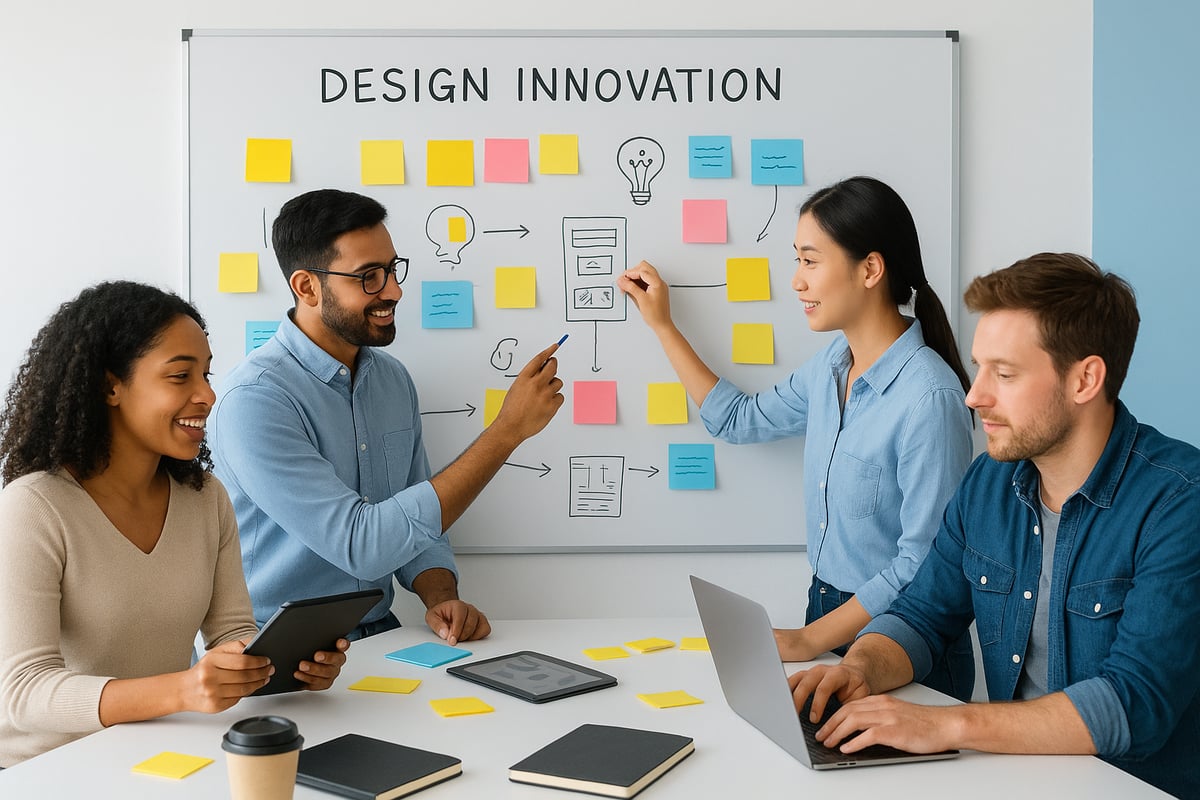
The journey for any design innovation company begins with the discovery phase. Here, teams dig deep to understand user needs, market gaps, and emerging trends. They use methods such as user research, ethnographic studies, and stakeholder interviews to uncover valuable insights.
- Tools: surveys, focus groups, data analytics
- Techniques: journey mapping to reveal pain points
- Outputs: opportunity areas, user personas
A thorough discovery phase ensures that innovation is rooted in real-world problems. To explore more about step-by-step frameworks, see Frameworks for Innovation Success.
Step 2: Define – Framing the Challenge
Once opportunities are identified, a design innovation company moves to define the challenge clearly. This step involves synthesizing research findings, running problem definition workshops, and crafting value propositions.
- Setting measurable innovation goals
- Aligning challenges with business objectives
- Example: Airbnb’s reframing of the travel accommodation problem
By framing the right challenge, teams focus their creative energy on what truly matters, setting the stage for breakthrough ideas.
Step 3: Ideate – Generating Breakthrough Ideas
Ideation is where the magic happens for a design innovation company. Teams brainstorm, use creative facilitation techniques, and encourage cross-functional collaboration to generate a wide range of solutions.
- Methods: digital ideation platforms, brainstorming sessions
- Encouraging diverse perspectives and risk-taking
- Example: Google’s “20% time” policy for fostering innovation
This phase thrives on quantity and diversity of ideas, increasing the likelihood of uncovering game-changing concepts.
Step 4: Prototype – Bringing Concepts to Life
Prototyping turns abstract ideas into tangible forms. A design innovation company leverages rapid prototyping methods, ranging from low-fidelity sketches to high-fidelity digital models.
- Tools: Figma, Sketch, 3D printing
- Iterative testing with real users
- Example: IDEO’s quick feedback loops through prototyping
Prototypes allow teams to experiment, fail fast, and refine solutions before significant resources are committed.
Step 5: Test & Iterate – Validating Solutions
Testing is a critical step where a design innovation company ensures solutions work for real users. Teams conduct user testing sessions, A/B testing, and usability studies to gather direct feedback.
- Data-driven refinement of concepts
- Metrics for measuring success
- Example: Amazon’s culture of relentless user testing
Iterative testing and feedback loops help teams optimize solutions, reducing risk and maximizing impact.
Step 6: Implement – Scaling and Launching Innovation
The final step is implementation, where a design innovation company brings innovation to market. This involves building business cases, securing stakeholder buy-in, and managing change throughout the organization.
- Go-to-market strategies and pilot programs
- Team training and performance monitoring post-launch
- Example: Spotify’s phased approach to feature rollouts
Successful implementation ensures that creative ideas deliver measurable value and drive real business results.
Technology and AI: Catalysts for Design Innovation in 2026
In 2026, technology and artificial intelligence are redefining the landscape for every design innovation company. These advancements are not just supporting creativity, they are actively accelerating the pace of innovation and opening new possibilities for businesses. Let us explore how these catalysts are shaping the future of design-led problem solving.

AI-Driven Creativity and Automation
Artificial intelligence is now central to the toolkit of every design innovation company. AI-driven platforms generate new concepts, automate repetitive design tasks, and validate ideas at unprecedented speed. For example, Adobe Sensei uses machine learning to enhance creative workflows, reducing time spent on manual adjustments.
AI also enables rapid iteration, allowing teams to test more ideas in less time. By integrating AI features, companies streamline concept development and improve output quality. Striking the right balance between human insight and machine intelligence ensures that creativity remains at the heart of every solution.
To discover how AI is transforming design practices and uncovering new opportunities, see AI in Design Innovation.
Data-Driven Design and Personalization
A design innovation company leverages data analytics to gain deep user insights. Big data reveals patterns in customer behavior, helping teams identify unmet needs and emerging trends. Predictive analytics further guide product development, enabling companies to anticipate market shifts.
Personalization is now achievable at scale. Netflix, for example, uses user data to recommend content tailored to individual preferences. However, with increased data usage comes responsibility. Ethical considerations and privacy regulations must guide every step, ensuring trust and transparency.
By making data central to the design process, companies deliver experiences that resonate with users and drive measurable results.
Collaborative Tools and Remote Innovation
The rise of cloud-based platforms has made remote collaboration seamless for any design innovation company. Tools like Miro and Figma support real-time co-creation, enabling distributed teams to brainstorm, prototype, and iterate together regardless of location.
Virtual workshops and digital whiteboards foster creative exchanges, while structured remote sprints help manage global projects efficiently. Google Ventures, for instance, runs remote design sprints to keep teams aligned and productive.
Success in this environment depends on clear communication, shared goals, and the right digital infrastructure. As global collaboration becomes standard, companies are learning to turn distance into an advantage.
Emerging Technologies Shaping the Future
Emerging technologies are expanding the boundaries for every design innovation company. Augmented and virtual reality (AR/VR) bring prototyping and user testing to life, offering immersive feedback before launch. The Internet of Things (IoT) allows for smarter, connected products and services.
Blockchain is also entering the design space, supporting transparent processes and secure transactions. IKEA’s AR app lets customers visualize furniture in their homes, transforming the shopping experience.
Staying ahead means monitoring technology trends and preparing teams to adopt new tools quickly. Companies that embrace these innovations will shape the industry’s next chapter.
Sustainability and Responsible Innovation
Sustainability is no longer optional for a design innovation company. Eco-friendly materials, circular design principles, and social responsibility are key requirements. Measuring environmental impact is now part of the design process, driving companies to minimize waste and maximize value.
Unilever’s sustainable packaging initiatives set a strong example, showing how innovation can align with environmental goals. Regulatory trends and consumer expectations are pushing companies to rethink traditional practices.
Responsible innovation also means creating inclusive solutions that benefit society as a whole. By integrating sustainability from the outset, companies future-proof their offerings and build lasting trust.
Building an Innovation Culture: Teams, Mindsets, and Leadership
A thriving design innovation company understands that creative success depends on more than just great ideas or technology. The foundation lies in building a resilient innovation culture, where teams, mindsets, and leadership work in harmony to foster breakthrough thinking and sustainable growth.

Fostering a Culture of Creativity
For any design innovation company, nurturing a culture that sparks creativity is essential. Leaders must encourage experimentation and establish psychological safety so employees feel comfortable sharing bold ideas. Recognizing and rewarding innovative contributions motivates teams to push boundaries.
Embedding design thinking into company values helps every team member approach challenges with empathy and openness. Overcoming barriers to creativity, such as fear of failure or rigid processes, is a constant journey. Organizations can draw inspiration from real-world Innovation Case Studies to see how a supportive culture leads to outstanding results.
Cross-Functional Teams and Collaboration
A design innovation company thrives when it brings together diverse skillsets and perspectives. Cross-functional teams, comprising designers, technologists, strategists, and subject matter experts, are structured for agile collaboration and rapid learning.
Key roles like facilitators and innovation champions help bridge gaps between disciplines. Programs such as Procter & Gamble’s Connect + Develop demonstrate how external partnerships can fuel new ideas. Modern collaboration tools enable seamless communication, keeping distributed teams aligned and focused.
Leadership’s Role in Driving Innovation
Leadership is the compass guiding a design innovation company towards its vision. Visionary leaders set clear innovation agendas, empower teams to make decisions, and decentralize authority to foster ownership.
Investing in training and upskilling ensures leaders are equipped to guide innovation initiatives. The transformation led by Satya Nadella at Microsoft illustrates how leadership can revitalize company culture. Balancing risk with accountability allows organizations to pursue ambitious goals while managing uncertainty.
Measuring and Sustaining Innovation Success
To ensure ongoing progress, a design innovation company must track its innovation efforts through clear KPIs and metrics. Continuous learning and feedback loops are vital for refining processes and scaling what works.
Institutionalizing innovation through frameworks, such as Intuit’s innovation accounting, helps embed creativity into daily operations. Avoiding innovation fatigue requires celebrating small wins and keeping teams engaged over the long term.
Overcoming Common Challenges
Every design innovation company faces obstacles, from resistance to change and risk aversion to limited resources and competing priorities. Aligning innovation with business strategy is crucial for securing support and funding.
Managing failure as a learning opportunity rather than a setback builds resilience. Lessons from failed product launches show that adaptability and openness to change are critical for long-term success.
Case Studies: Creative Success Stories from Leading Design Innovation Companies
Examining the real-world impact of a design innovation company provides actionable insights for organizations seeking creative breakthroughs. Below, we highlight five leaders, each demonstrating unique approaches that drive results in the evolving innovation landscape.

IDEO: Pioneering Human-Centered Design
IDEO is often cited as the quintessential design innovation company, setting the standard for human-centered design. Their approach integrates empathy, creativity, and iterative prototyping, which has influenced industries worldwide. Notable projects, such as Apple’s first computer mouse and advanced medical devices, showcase IDEO’s ability to blend user needs with technical feasibility.
Central to their success is the adoption of human-centered design principles, ensuring solutions are both effective and desirable. IDEO’s collaborative culture and cross-disciplinary teams have become a model for any design innovation company aiming for sustained impact.
Fjord (Accenture): Service Design at Scale
Fjord, now part of Accenture, exemplifies how a design innovation company can transform global brands through service design. With a focus on end-to-end user experiences, Fjord has helped organizations such as the BBC reimagine their digital platforms, prioritizing intuitive navigation and consistent branding.
Their methodology emphasizes co-creation with clients, ensuring solutions are tailored and scalable. By integrating business strategy with design thinking, Fjord delivers measurable improvements in user satisfaction and operational efficiency, reinforcing the value of a strategic design innovation company partnership.
Frog Design: Blending Technology and Experience
Frog Design stands out as a design innovation company that merges digital and physical experiences. Their portfolio includes iconic products like the Sony Walkman and the Disney+ streaming interface, demonstrating versatility across sectors. Frog’s rapid prototyping and iterative design processes accelerate time-to-market for clients.
Their teams leverage technology to create seamless interactions, focusing on both aesthetic appeal and functionality. This holistic approach enables a design innovation company like Frog to deliver solutions that resonate with users and adapt to technological advancements.
R/GA: Digital Transformation and Brand Innovation
R/GA has redefined what it means to be a digital-first design innovation company. Their award-winning work with brands such as Nike+, where they developed a connected ecosystem of products and services, highlights their expertise in bridging technology and creativity.
R/GA’s success is rooted in leveraging data-driven insights to inform design decisions, ensuring relevance and engagement. The growing adoption of design thinking methodologies across industries, as detailed in Design Thinking Market Growth, underscores the importance of working with a design innovation company that understands both digital transformation and human behavior.
Emerging Innovators: Startups to Watch in 2026
Several rising design innovation company players are making waves with fresh perspectives and agile methodologies. Companies like Continuum, which specializes in inclusive design, and Gravity Sketch, a pioneer in immersive 3D collaboration tools, are gaining traction for their innovative applications.
These startups leverage advanced technology and user-centric frameworks to address complex challenges. Early successes in sectors like healthcare and entertainment position each design innovation company as a catalyst for market disruption, signaling a bright future for creative innovation.
The Future of Design Innovation: Trends and Predictions for 2026 and Beyond
The landscape for every design innovation company is rapidly shifting as we approach 2026. Businesses are seeking more than creative outputs—they want measurable impact, flexible engagement, and global perspectives. To thrive, design innovation companies must anticipate and adapt to these emerging trends while maintaining their core strengths.
Shifting Client Expectations and New Business Models
Clients are increasingly demanding results-driven partnerships with their chosen design innovation company. Instead of traditional project fees, outcome-based models and subscription services are gaining traction. This shift empowers clients to invest in long-term value and continuous innovation.
Many organizations now seek on-demand design teams and platform-based access to expertise. This trend is reinforced by the growing desire for agility and scalability. According to Innovation for Business Growth, innovation is now seen as a necessity for sustainable growth, not just a differentiator.
For a design innovation company, adapting to these new business models is crucial for remaining relevant and competitive.
The Evolving Role of Designers and Innovators
In 2026, the design innovation company will prioritize designers as strategic business partners, not just creative contributors. Designers are expected to possess hybrid skillsets that blend design, technology, and business acumen. Familiarity with frameworks like the Double Diamond Design Process is increasingly important for structuring innovation efforts.
Lifelong learning and adaptability have become core competencies. As technology advances, the ability to pivot and integrate new tools is essential. The design innovation company must foster a culture where continuous upskilling is encouraged and supported.
This evolution positions the design innovation company as a key driver of strategic transformation.
Globalization, Diversity, and Inclusion in Innovation
Globalization is expanding the reach of every design innovation company, enabling access to diverse talent pools and markets. Multicultural teams bring a wealth of perspectives, leading to more creative, inclusive solutions that resonate worldwide.
Diversity and inclusion are now recognized as catalysts for breakthrough ideas. Companies that prioritize these values often see greater innovation success. For a design innovation company, building teams with varied backgrounds and experiences is not just a trend—it is a competitive advantage.
By embracing diversity and global collaboration, the design innovation company is better equipped to design products and services for an interconnected world.
As you look ahead to 2026, unlocking creative success means more than just following trends—it’s about proactively seeking new opportunities, leveraging AI, and building a culture of innovation that sets you apart. If you’re ready to move from inspiration to action and want tailored insights for your unique business challenges, we’re here to help. Let’s explore how you can identify high-impact opportunities, strengthen your innovation capabilities, and accelerate growth together.
Book a Free Opportunity Assessment
and take the first step toward your organization’s next breakthrough.