

In 2026, innovation is no longer optional; it is the engine driving business survival in a rapidly shifting marketplace. Organizations face constant pressure to deliver new solutions, but the real question remains: how can teams reliably generate breakthrough ideas?
This essential guide will equip you with the strategies and tools to plan, facilitate, and maximize results from a design thinking workshop. You will discover what these workshops are, why they matter, and how to execute them for the highest impact—whether in person or remotely.
Expect actionable steps, expert insights, and the latest best practices for 2026. Leverage these proven approaches to transform your next design thinking workshop and give your team the edge in solving complex problems and driving meaningful innovation.
Understanding Design Thinking Workshops
Innovation leaders in 2026 recognize that every design thinking workshop is a catalyst for solving complex business problems. These workshops have become essential for organizations striving to foster creativity and drive user-centered solutions. Let us break down what makes these workshops so effective, how they are structured, and who should be involved to maximize results.

What is a Design Thinking Workshop?
A design thinking workshop is a structured, collaborative session where diverse teams tackle business challenges using design thinking principles. These sessions emphasize empathy, creative ideation, rapid prototyping, and real-world testing. Unlike traditional meetings, a design thinking workshop is not just for designers; it involves professionals from sales, management, technology, and more.
Workshops are adaptable to in-person, virtual, or hybrid environments, making them accessible for global teams. For example, leading companies routinely bring cross-functional teams together in design thinking workshops to spark breakthrough innovation. Sessions can range from a few hours to an entire week, depending on the complexity of the challenge.
According to a 2025 report, design thinking is ranked as a top-3 innovation methodology. For organizations ready to dive deeper, Design Thinking and Innovation Consulting provides further insights into workshop strategies and impact.
Core Principles and Phases of Design Thinking
Every design thinking workshop revolves around five core phases: empathize, define, ideate, prototype, and test. Teams begin by empathizing with users, often through interviews or observation, to deeply understand their needs. Next, they define the problem, reframing challenges for clarity.
The ideation phase generates a wide array of creative solutions, encouraging input from all participants. Prototyping follows, where ideas are turned into tangible models or mockups. Finally, teams test these solutions with real users, gathering feedback for iteration.
Practical tools such as empathy maps and user personas guide the process. This iterative, human-centered approach ensures that each design thinking workshop adapts to changing insights and fosters innovation at every step.
Workshop Goals and Outcomes
A design thinking workshop aims to solve complex, ambiguous problems that often resist traditional approaches. These workshops are proven to foster collaboration, creativity, and cross-functional teamwork, placing the user at the heart of every solution.
Key outcomes include:
- Accelerated time-to-market for new products or services
- Improved customer satisfaction scores
- Development of internal problem-solving skills
- Strengthened innovation culture
For instance, companies frequently report faster delivery cycles and measurable gains in customer experience after a design thinking workshop. Data shows that 75 percent of organizations using design thinking report increased ROI on innovation initiatives.
Who Should Attend and Facilitate?
The success of a design thinking workshop hinges on assembling the right participants and facilitator. The ideal team is diverse, drawing expertise from product, marketing, customer experience, and technology.
Key roles include:
| Role | Responsibility |
|---|---|
| Facilitator | Guides process, maintains engagement and focus |
| Decider | Makes final calls on priorities |
| Customer Expert | Brings user insights and feedback |
| Business Expert | Ensures alignment with strategy and feasibility |
| Prototyper | Builds rapid models and mockups |
Facilitators need empathy, strong communication, organization, and neutrality. While internal facilitators bring valuable context, external experts offer objectivity. Cross-disciplinary teams consistently deliver more innovative results, making diversity a cornerstone of every design thinking workshop.
Planning a Successful Design Thinking Workshop
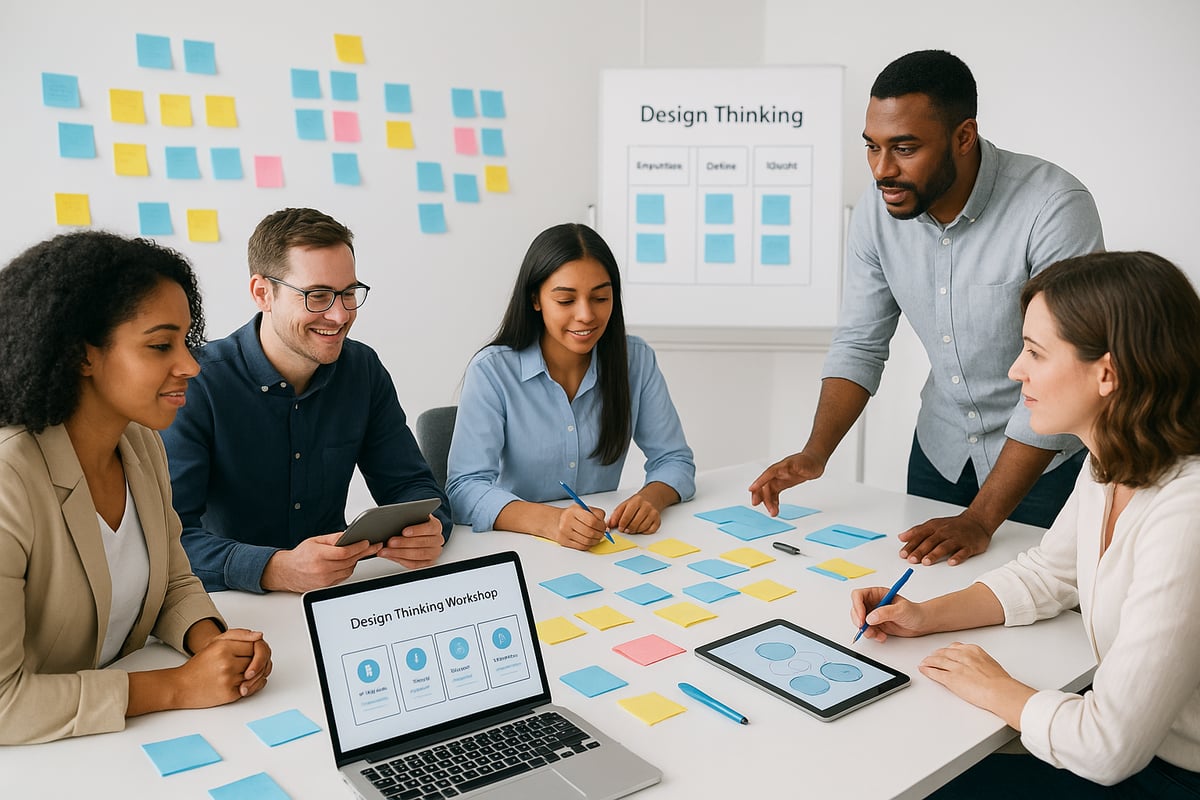
Strategic planning is the foundation of every successful design thinking workshop. With thoughtful preparation, teams can unlock creativity, align on goals, and drive innovation that delivers measurable results. This section walks you through the essential steps to ensure your workshop is both engaging and impactful.
Defining Objectives and Scoping Challenges
Every design thinking workshop must start with clear, actionable objectives. Without a defined purpose, sessions often lose direction and fail to deliver results. Begin by asking: What business challenge are we solving, and how does it connect to our strategy?
Frame the challenge as a "How might we" question. For example, "How might we enhance customer onboarding for our digital platform?" This approach ensures the workshop remains focused, unlocking relevant solutions.
A well-scoped problem increases the likelihood of workshop success. According to CareerFoundry, 60% of failed sessions lacked a clearly defined scope. Invest time upfront to clarify goals with stakeholders and align on priorities.
Assembling the Right Team
The impact of a design thinking workshop depends on assembling a diverse, cross-functional team. Include participants from product, design, marketing, technology, and customer experience. Diversity sparks creativity and prevents groupthink.
Key roles to fill:
- Facilitator: guides the process and ensures engagement
- Decider: makes final calls on key decisions
- Customer expert: represents user needs
- Business expert: aligns solutions to strategy
- Prototyper: brings ideas to life
Aim for 6-12 participants for optimal collaboration. Mix senior leaders with hands-on team members to balance vision and practicality. The right mix fuels creative problem-solving and ensures all perspectives are heard.
Designing the Agenda and Structure
A well-structured agenda keeps the design thinking workshop on track while allowing space for creativity. Allocate time for each phase—empathize, define, ideate, prototype, and test—with room for feedback and reflection.
Consider one-hour blocks per phase, interspersed with breaks and debriefs. Build in flexibility to respond to team dynamics or breakthrough moments. Focus on concrete deliverables rather than rigid time slots, adjusting as needed.
For additional guidance on structuring your session, explore Design Thinking Workshop Best Practices, which provides expert tips for designing effective agendas and maximizing outcomes.
Preparing Materials and Tools
Equipping your design thinking workshop with the right materials boosts engagement and productivity. For in-person sessions, stock up on post-its, markers, whiteboards, and prototyping supplies. Digital workshops require collaborative tools like Miro, Mural, and Zoom.
Prepare templates for empathy maps, journey maps, and user personas. Share research summaries and pre-created assets to jumpstart activities. Well-prepared materials help participants focus on problem-solving rather than logistics.
Test all tools and resources before the workshop. A seamless setup minimizes distractions and maximizes creative output.
Selecting the Ideal Location (Physical or Virtual)
The environment shapes creativity and participation in a design thinking workshop. For physical sessions, choose a space with natural light, comfortable seating, and ample room to move. Dedicated creative spaces foster innovation better than traditional meeting rooms.
For virtual or hybrid workshops, ensure reliable internet, quality audio/video, and intuitive collaboration platforms. Set up digital whiteboards and clear communication channels to keep everyone engaged.
The right location, whether physical or virtual, creates an atmosphere where teams can think freely and work collaboratively.
Communicating Expectations and Pre-Workshop Prep
Set your design thinking workshop up for success by communicating expectations early. Share pre-reads, user research, and workshop objectives in advance. Define ground rules that encourage participation and respectful collaboration.
Use pre-workshop surveys to identify pain points or knowledge gaps. This data helps tailor the session to participant needs and ensures everyone arrives prepared and focused.
Clear communication and thorough preparation align the team, reduce anxiety, and foster a collaborative spirit from the outset.
Step-by-Step Guide to Running the Workshop
Organizing a successful design thinking workshop requires thoughtful planning, clear communication, and dynamic facilitation. Each phase builds momentum, ensuring your team remains engaged and focused on delivering actionable outcomes. The following step-by-step guide outlines how to run an effective design thinking workshop in 2026, maximizing creativity and impact at every stage.

Step 1: Kickoff, Intros, and Icebreakers
Begin your design thinking workshop by welcoming participants and introducing the facilitator alongside all roles. Clearly state the objectives and agenda, setting expectations for outcomes and participation.
Use engaging icebreakers to build rapport and trust. Activities like "Two truths and a lie" or asking "What’s your innovation superpower?" break the ice and encourage open dialogue.
A strong kickoff energizes the room and helps participants feel comfortable sharing ideas. To ensure your session starts on the right foot, review Innovation Workshop Best Practices for effective strategies that set the tone for a productive workshop.
Step 2: Explaining Design Thinking and Workshop Flow
Provide a concise overview of the design thinking workshop methodology and its five core phases. Clarify the process, ground rules, and the open, non-judgmental mindset required for innovation.
Address any questions participants may have about the workshop structure. Share brief case studies of successful design thinking workshops to inspire confidence and highlight potential outcomes.
Teams with a clear understanding of each phase are twice as likely to achieve their goals. Setting this foundation ensures everyone is aligned and ready to contribute.
Step 3: Empathize – Understanding the User
In this phase of the design thinking workshop, guide participants through activities like user interviews, empathy mapping, and journey mapping. Encourage the team to challenge their assumptions and dig deep into real user needs.
Role-playing exercises, where participants step into users’ shoes, foster empathy and surface hidden pain points. Use visuals, such as empathy maps, to capture findings collaboratively.
Building empathy is the cornerstone of the design thinking workshop, as it uncovers insights that drive meaningful solutions.
Step 4: Define – Framing the Problem
Synthesize user research to create a focused problem statement. Use "How might we…" questions to reframe challenges, ensuring everyone understands the core issue.
Facilitate a group discussion to converge on a single, actionable challenge. This clarity prevents wasted effort and ensures the design thinking workshop remains targeted.
A well-defined problem statement is the north star for the rest of the process. It keeps the team aligned and maximizes the relevance of generated solutions.
Step 5: Ideate – Generating Solutions
Encourage participants in your design thinking workshop to brainstorm as many ideas as possible. Use techniques like Crazy 8s, mind mapping, and SCAMPER to inspire creative thinking.
Begin with silent ideation, then share and build on ideas as a group. Aim for quantity and diversity—teams often generate 50 or more ideas before narrowing down.
Diverse teams in a design thinking workshop consistently produce more unique solutions, setting the stage for innovation.
Step 6: Select and Prioritize Ideas
Guide the team to select and prioritize ideas using dot voting or decision matrices. Evaluate concepts based on feasibility, desirability, and viability, ensuring alignment with workshop objectives.
Facilitate discussion to reach consensus and shortlist three to five top ideas for prototyping. This step in the design thinking workshop builds ownership and commitment among participants.
Structured prioritization ensures your team focuses on ideas with the greatest potential impact.
Step 7: Prototype – Bringing Ideas to Life
Transition to rapid prototyping, where participants create low-fidelity prototypes using simple materials or digital tools. Assign roles for building, presenting, and testing each prototype.
Common prototypes in a design thinking workshop include storyboards, mockups, or role-play scenarios. Emphasize simplicity and focus on the core value proposition.
Quick, tangible prototypes allow the team to visualize solutions and prepare for user feedback.
Step 8: Test – Gathering Feedback
Conduct user testing with real or representative users to validate prototypes. Capture feedback through interviews, observations, or surveys, and encourage the team to iterate quickly.
Reflect as a group on what worked and where improvements are needed. In a design thinking workshop, this testing phase is key to increasing solution adoption rates and ensuring user-centric outcomes.
Testing and iterating are vital, as they bridge the gap between creative ideas and real-world impact.
Best Practices for 2026 Design Thinking Workshops
In 2026, running a successful design thinking workshop means more than following a formula. It requires leaders to foster the right environment, leverage cutting-edge tools, and ensure outcomes drive real business value. Here are the best practices every organization should follow to maximize innovation and impact.

Fostering Psychological Safety and Inclusion
A thriving design thinking workshop depends on psychological safety. Team members must feel free to share ideas without fear of criticism or dismissal. Facilitators can encourage open dialogue, set ground rules for respect, and rotate leadership roles to balance power dynamics.
Practical strategies include:
- Inviting anonymous idea submissions to reduce bias
- Rotating facilitators for different activities
- Actively listening and validating all contributions
To further strengthen your facilitation approach, explore these Design Thinking Workshop Facilitation Tips. Creating a safe environment unlocks creative problem-solving and ensures every voice is heard in the design thinking workshop.
Leveraging Technology and Hybrid Collaboration Tools
The 2026 design thinking workshop leverages advanced technology to unite on-site and remote participants. Digital whiteboards, AI-powered brainstorming assistants, and integrated communication platforms enable seamless collaboration.
Consider these best practices:
- Use tools like Miro, Mural, or AI synthesizers for real-time ideation
- Provide training in digital collaboration platforms before the workshop
- Ensure every participant can contribute equally, regardless of location
With the right technology stack, a design thinking workshop can bridge physical distances and spark innovation across global teams.
Adapting for Remote and Distributed Teams
Remote and hybrid work are standard in 2026, so your design thinking workshop must adapt. Adjust the agenda to accommodate different time zones and attention spans, using asynchronous activities and breakout rooms for deeper engagement.
Key tips include:
- Schedule shorter, focused sessions rather than all-day meetings
- Use virtual empathy mapping and digital prototyping tools
- Assign clear roles for remote facilitators and technical support
By embracing flexibility, your design thinking workshop will remain inclusive, effective, and energizing for every participant.
Maintaining Momentum and Engagement
Sustained engagement is critical to a productive design thinking workshop. Use energizers, regular breaks, and varied activities to keep energy levels high throughout the session.
Effective engagement strategies:
- Gamify portions of the workshop for friendly competition
- Rotate roles such as timekeeper or scribe to involve everyone
- Celebrate quick wins and progress during the day
A well-paced design thinking workshop ensures participants stay motivated and focused on generating breakthrough ideas.
Ensuring Actionable Outcomes and Accountability
An impactful design thinking workshop produces more than just ideas—it leads to action. Document all key decisions, assign responsibilities, and schedule follow-up sessions to track progress.
Actionable steps include:
- Creating a shared action plan with clear owners and deadlines
- Setting up regular check-ins to review progress
- Using digital project management tools to track tasks
Accountability transforms workshop insights into real business results, ensuring the design thinking workshop delivers measurable value.
Measuring Workshop Impact and ROI
To justify continued investment, measure the outcomes of your design thinking workshop. Define clear success metrics, such as idea quality, implementation rates, and business impact.
Practical measurement approaches:
- Pre- and post-workshop surveys to assess learning and satisfaction
- Tracking the adoption rate of workshop-generated solutions
- Analyzing ROI from implemented innovations
A data-driven approach allows organizations to refine their design thinking workshop process and prove its strategic value.
Common Challenges and How to Overcome Them
Facilitating a successful design thinking workshop involves more than following a process. Teams often face common obstacles that can hinder creativity, collaboration, and real results. By understanding these challenges and applying targeted solutions, you can ensure your design thinking workshop delivers maximum value.
Managing Group Dynamics and Resistance
Every design thinking workshop brings together individuals with unique perspectives and personalities. Sometimes, skepticism or dominant voices can overshadow quieter participants. To address resistance, facilitators should set clear ground rules and foster a safe environment for all ideas.
Techniques like structured turn-taking, anonymous input, and rotating roles help balance participation. For example, using digital tools for silent brainstorming ensures everyone’s voice is heard. Early buy-in and transparent communication reduce friction and keep the group focused on shared objectives.
A skilled facilitator recognizes when to intervene and encourages open dialogue, ensuring the design thinking workshop remains productive and inclusive.
Avoiding Groupthink and Encouraging Diverse Perspectives
One pitfall of any design thinking workshop is groupthink, where consensus overrides creativity. Prevent this by promoting independent ideation before group discussion. Silent brainstorming methods, such as “Crazy 8s,” allow participants to generate ideas individually.
Inviting external voices, such as customers or other departments, can challenge assumptions and spark new thinking. Studies show diverse groups outperform homogeneous ones by 35 percent in creative tasks, highlighting the value of varied perspectives.
Encouraging open debate and bringing in fresh viewpoints ensures your design thinking workshop delivers more unique, innovative solutions.
Dealing with Time Constraints and Scope Creep
Time is a precious resource in any design thinking workshop. Without strict facilitation, sessions can drift off course or become too broad, diluting results. To combat this, prioritize activities that align with your workshop’s primary goals.
Timeboxing, or setting specific limits for each activity, helps teams stay focused. For example, a “Lightning Decision Jam” compresses decision-making into short bursts, preventing endless debate. Limiting the agenda to achievable outcomes also keeps momentum high.
A focused design thinking workshop with clear boundaries consistently delivers better, more actionable results.
Sustaining Innovation Post-Workshop
The impact of a design thinking workshop does not end when the session concludes. Without follow-up, many great ideas fail to materialize. Establishing mechanisms for accountability, such as assigning owners and deadlines for next steps, is crucial.
Integrating outcomes into ongoing projects and key performance indicators keeps innovation alive. Some organizations appoint innovation champions or dedicate teams to drive implementation. For those seeking structured support, Design Thinking Training for Business Growth offers tailored programs to embed design thinking and foster continuous improvement.
By creating a culture of follow-through, your design thinking workshop can become a catalyst for lasting change.
Real-World Examples and Future Trends in Design Thinking Workshops
The impact of a design thinking workshop is best seen through real-world results. Across industries, organizations have leveraged these workshops to unlock faster innovation, improve customer experiences, and achieve measurable business outcomes.
Case Studies: Design Thinking Workshop Success Stories
A leading global technology company accelerated its time-to-market by 30 percent after implementing a design thinking workshop across cross-functional teams. In healthcare, a major provider ran a workshop to redesign patient intake, resulting in higher satisfaction scores and streamlined processes.
Finance and public sector organizations are also embracing the design thinking workshop model. Examples include banks creating more intuitive digital products and city governments improving public services. These stories highlight the universal applicability of the design thinking workshop and its power to drive tangible business value.
Trends Shaping Design Thinking Workshops in 2026
Design thinking workshop formats are evolving rapidly. In 2026, AI-powered facilitation tools are enabling real-time idea synthesis and decision support, making sessions more productive. Remote and hybrid workshops are now the norm, allowing global teams to collaborate seamlessly.
Organizations are prioritizing measurable outcomes and ROI from every design thinking workshop. According to Design Thinking Market Growth Statistics, adoption rates continue to rise, with 90 percent of innovation leaders planning to increase investment. Predictive analytics and advanced collaboration platforms are shaping the future of the design thinking workshop.
Integrating Design Thinking with Other Innovation Frameworks
The design thinking workshop is increasingly combined with frameworks like Agile, Lean Startup, and Blue Ocean Strategy. For instance, teams may use design thinking to inform sprint planning or prototype a minimum viable product before entering development.
This integrated approach helps organizations address complex challenges with greater speed and sustainability. By blending methodologies, a design thinking workshop can bridge the gap between ideation and execution, ensuring innovative ideas translate into actionable solutions.
Building Long-Term Innovation Capabilities
Sustainable success with a design thinking workshop requires embedding its principles into company culture. Many organizations establish internal academies or ongoing training programs to upskill facilitators and participants.
Continuous learning initiatives help teams maintain momentum and foster an innovation mindset. By making the design thinking workshop a regular part of business processes, companies can ensure that creative problem-solving remains core to their growth strategy.
Six Paths Consulting: Empowering Innovation-Driven Organizations
For organizations seeking expert support, Six Paths Consulting specializes in AI-powered strategic innovation and design thinking workshop facilitation. Their services include growth strategy, business model innovation, and hands-on workshops tailored to specific goals.
With recognized expertise in Blue Ocean Strategy and a proven track record across industries, Six Paths Consulting helps businesses embed innovation at every level. Learn more about how design thinking in consulting can elevate your team's performance by visiting Design Thinking in Consulting.
If you’re ready to turn insights from this guide into real, measurable results for your team, let’s take the next step together. Whether you’re looking to unlock new revenue streams, empower your people with cutting edge innovation skills, or simply ensure your next design thinking workshop creates lasting impact, you don’t have to navigate the journey alone. I invite you to connect with Six Paths Consulting for a personalized conversation about your organization’s unique challenges and opportunities. Together, we can explore how tailored strategies and expert support can help you achieve your innovation goals.
Book a Free Opportunity Assessment