
In 2026, the ability to develop new products stands as the top growth driver for ambitious businesses. Rapid advances in technology, shifting customer expectations, and fierce competition have raised the stakes, making innovation essential for survival.
Mastering the process to develop new products not only reduces risk but also boosts profitability and ensures your company remains relevant. This guide delivers a practical, step-by-step approach, from idea generation to market launch, using proven strategies and the latest industry insights.
You will explore every critical stage, including market research, ideation, validation, development, launch, and post-launch optimization. Let’s get started on building your roadmap to product success.
Understanding the 2026 Product Development Landscape
Staying ahead in 2026 requires organizations to deeply understand the evolving landscape if they want to successfully develop new products. Rapid technology shifts and changing consumer priorities are transforming the rules of product innovation. Adapting to these changes is critical for any company aiming to remain competitive and deliver true market value.
Key Trends Shaping Product Development in 2026
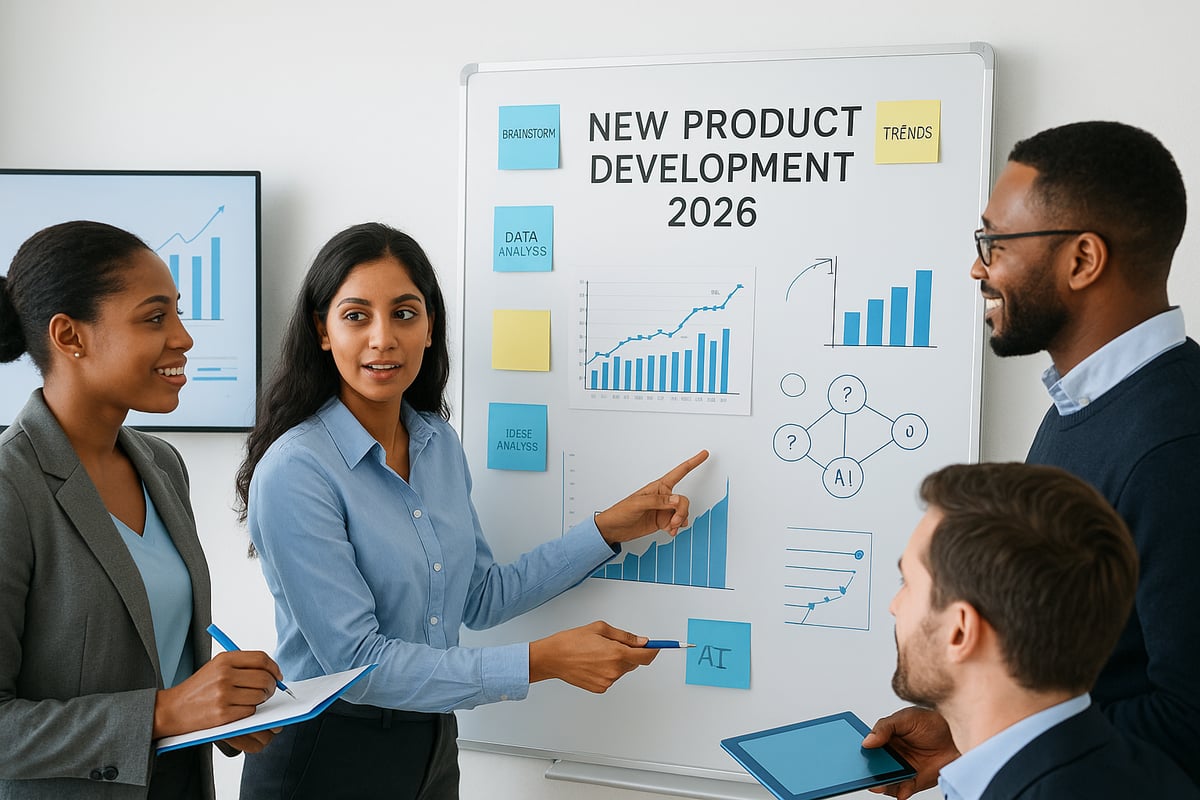
Several trends are redefining how organizations develop new products. Artificial intelligence and automation are streamlining processes from ideation to prototyping. Digital transformation enables real-time collaboration and faster decision-making, while sustainability and ESG criteria are no longer optional but expected by customers and regulators.
Shorter product life cycles mean businesses must adopt agile development to iterate quickly and respond to feedback. Customer co-creation, crowdsourcing, and open innovation platforms are becoming essential for generating breakthrough ideas. Data-driven decision-making, powered by predictive analytics, helps teams align features with real market demands.
Supply chain resilience and risk management have also come to the forefront, as global disruptions highlight the need for flexibility. For example, leading companies are leveraging AI to accelerate prototyping and iteration, reducing time-to-market and improving product quality.
To explore these trends in depth, visit Product Development Trends 2026, which outlines how forward-thinking organizations develop new products by embracing IoT, sustainability, and data-driven innovation.
Challenges and Opportunities
Despite these advances, companies face significant challenges as they develop new products. Common pitfalls include high failure rates, often caused by misaligned teams or underestimating market needs. In fact, industry sources estimate that over 30 percent of new products fail due to insufficient market research and lack of customer validation.
Opportunities for differentiation are abundant. Organizations that focus on unique value propositions and put customer-centricity at the core of their strategy can stand out. By using robust research methods and aligning cross-functional teams, businesses increase their chances of success.
Data shows that companies prioritizing customer needs and adapting quickly to change are more likely to develop new products that achieve lasting market impact. As the landscape continues to evolve, those who invest in agility and insight-driven innovation will seize the greatest opportunities.
Step 1: Market and Customer Research
Understanding your market and customers is the cornerstone of any effort to develop new products in 2026. In a landscape defined by rapid change and heightened competition, robust research minimizes risk and maximizes the potential for market success.

Defining Your Target Market and Customer Segments
To successfully develop new products, precise segmentation and clear persona development are essential. The 2026 marketplace demands a deeper understanding of evolving customer needs, preferences, and behaviors. Advanced analytics and AI-powered tools now enable businesses to uncover patterns in large datasets, revealing insights that were previously hidden.
Popular data collection methods include:
- Online surveys and polls
- In-depth interviews
- Focus groups
- Social media analysis
Competitor benchmarking is equally crucial. By analyzing the strengths and weaknesses of rival offerings, you can identify market gaps where your products can excel. Additionally, keeping track of regulatory, cultural, and technological trends in your target regions ensures your innovation is both relevant and compliant.
Consider the costly lesson of a wearable tech startup that skipped thorough research and launched a product in a market saturated with similar features. The result was a failed launch, as they underestimated both customer expectations and regulatory barriers.
A table summarizing research essentials:
| Research Method | Benefit | 2026 Relevance |
|---|---|---|
| AI Analytics | Deep behavioral insights | Identifies emerging trends |
| Focus Groups | Qualitative feedback | Tests early concepts |
| Competitor Analysis | Market gap discovery | Informs differentiation |
| Social Listening | Real-time sentiment tracking | Spots shifting preferences |
According to recent studies, 60% of successful product launches from 2023 to 2025 attributed their achievements to robust customer research. For organizations seeking expert guidance, Market Research and Consulting Firms can provide tailored strategies to strengthen your approach and develop new products with confidence.
Validating Unmet Needs and Pain Points
Moving beyond surface-level data is key if you want to develop new products that truly solve customer problems. Start by identifying real pain points through customer interviews, user journey mapping, and direct observation. These methods help reveal issues customers may not even articulate.
Social listening and sentiment analysis tools are invaluable for tracking conversations and trends across online platforms. By analyzing what customers are saying in real time, you can spot emerging needs and gaps competitors have missed. This proactive approach enables you to validate whether the problem is urgent and if customers are willing to pay for a solution.
A practical example is using journey mapping to uncover friction points during the onboarding process for a new SaaS product. Often, these hidden barriers can make or break adoption rates, influencing the overall success as you develop new products.
When evaluating opportunities, consider:
- The scale and urgency of the customer problem
- Existing alternatives or workarounds
- Willingness of target users to invest in a new solution
Thorough validation at this stage ensures your innovation addresses genuine needs, setting a strong foundation for the next steps in the product development process.
Step 2: Ideation and Concept Development
Turning great ideas into successful products starts with effective ideation and concept development. In 2026, organizations that consistently develop new products are those that empower teams to think creatively, collaborate widely, and validate concepts early. This phase is where innovation transforms from possibility to actionable opportunity.

Generating Innovative Product Ideas
Organizations aiming to develop new products in 2026 must focus on structured creativity. Methods such as SCAMPER, mind mapping, and design thinking workshops help teams break out of routine patterns and challenge assumptions. These techniques encourage participants to see connections others might miss and unlock fresh solutions.
Fostering a culture of creativity is essential. This means creating spaces where team members from marketing, engineering, sales, and support feel comfortable sharing bold ideas. Cross-functional collaboration ensures that different perspectives shape the ideation process, leading to more robust concepts.
Involving customers early is a game-changer. By integrating feedback from surveys, interviews, and online communities, organizations can align their ideas with real market needs. Crowdsourcing and open innovation platforms broaden the pool of ideas, inviting contributions from external experts and customers alike.
For example, many leading firms now use design sprints to rapidly iterate concepts. In just a few days, teams can move from a broad challenge to a tested prototype, significantly accelerating efforts to develop new products. For more inspiration on creative approaches, see Innovative Ideas for Business Growth.
Screening and Selecting the Best Ideas
Once you have a pool of ideas, the next step is evaluation. Not every idea is worth pursuing, and a disciplined approach ensures that resources are invested wisely. The goal is to select concepts with the greatest potential to develop new products that will succeed in a competitive marketplace.
Key criteria for screening include:
- Feasibility: Can the idea be built with available technology and resources?
- Desirability: Does it solve a real customer problem or fulfill an unmet need?
- Viability: Will the solution generate sustainable value for the business?
Many teams use scoring models and prioritization frameworks to compare options. A simple table can help clarify the process:
| Idea | Feasibility | Desirability | Viability | Score |
|---|---|---|---|---|
| Concept A | High | Medium | High | 8/10 |
| Concept B | Medium | High | Medium | 7/10 |
Early prototyping and concept testing with real users are crucial. By building quick mockups and gathering feedback, teams reduce the risk of investing in ideas that do not resonate. Only about 1 in 7 ideas typically advance to development, highlighting the importance of rigorous screening when you develop new products.
By combining structured ideation with disciplined selection, organizations set themselves up to develop new products that are both innovative and aligned with market demand.
Step 3: Feasibility Analysis and Business Case Development
Thorough feasibility analysis and a strong business case are essential if you want to develop new products that succeed in 2026. These steps ensure your concept is practical, aligned with business goals, and ready to move forward with confidence. By systematically examining operational realities and financial projections, you minimize costly surprises and build stakeholder trust.

Assessing Technical and Operational Feasibility
To successfully develop new products, start by evaluating if your idea can be built and scaled. Consider technology readiness: do you have access to the right tools, software, and expertise? Assess your team's capacity and identify any resource gaps.
Key feasibility factors include:
- Technology readiness: Is the core tech proven and reliable?
- Resource requirements: Do you have the skills, budget, and time?
- Scalability: Can you expand production without major obstacles?
- Supply chain: Are your suppliers stable, and can they meet demand?
- Manufacturing and regulations: Are there industry standards or legal requirements that could impact development?
Risk assessment is crucial when you develop new products. List potential risks, from supply chain disruptions to regulatory delays. Create mitigation plans for each. Use tools like risk matrices or SWOT analyses to visualize and prioritize challenges.
Remember, skipping thorough feasibility checks can lead to costly setbacks. For example, a tech startup in 2025 underestimated manufacturing complexity and faced year-long delays, ultimately losing market share to faster competitors.
Building a Compelling Business Case
Once technical feasibility is clear, focus on building a business case that justifies investment to develop new products. Start with market sizing: estimate the total addressable market for 2026 and beyond. Use current data and industry reports to ground your projections.
Next, outline revenue potential and cost estimates. Include development, launch, and ongoing support costs. Identify key performance indicators (KPIs) such as time-to-market, adoption rates, and profitability.
A robust business case also details stakeholder benefits and aligns with strategic goals. To structure your approach, consider using proven frameworks from industry leaders. For a comprehensive overview of best practices, explore New Product Development and Innovation, which covers all critical steps from feasibility to launch.
Finally, secure stakeholder buy-in by presenting clear data, anticipated ROI, and a realistic timeline. Use visuals such as tables or charts to summarize your case. A sample business case might compare projected returns against investment, highlight risk mitigation, and outline measurable milestones.
A well-prepared business case increases your chances to develop new products that attract funding, align teams, and deliver lasting value.
Step 4: Design, Prototyping, and Validation
Designing, prototyping, and validation are pivotal steps to develop new products that truly stand out in 2026. At this stage, transforming ideas into tangible solutions requires a blend of creativity, technology, and customer insight. The process is not just about making something functional, but ensuring it delights users and aligns with sustainability goals.

Designing for User Experience and Sustainability
To successfully develop new products, prioritizing user experience and sustainability is essential. User-centered design ensures that every feature, interface, and interaction is tailored to real customer needs. Teams must gather feedback early and often, using persona maps and journey mapping to guide decisions.
Modern design also integrates sustainability from the outset. This includes selecting eco-friendly materials, designing for recyclability, and minimizing the environmental footprint throughout the product lifecycle. Collaboration between design, engineering, and marketing teams is crucial to balance usability, aesthetics, and environmental impact.
Leveraging methodologies like Design Thinking and Innovation Consulting can accelerate the process. These approaches foster empathy, creativity, and iterative learning, helping organizations develop new products that are both innovative and responsible.
Key considerations for design success:
- Engage end-users in co-creation workshops
- Apply inclusive design to reach broader audiences
- Evaluate supply chain sustainability and compliance
By embedding these practices, organizations are better equipped to develop new products that resonate with customers while supporting ESG objectives.
Rapid Prototyping and Iterative Testing
Prototyping is where ideas become reality. To develop new products effectively, teams must adopt rapid prototyping techniques such as digital twins, 3D printing, and advanced simulation tools. These methods reduce time-to-market by allowing fast iteration and early detection of design flaws.
A structured approach to prototyping typically involves:
- Building low- and high-fidelity prototypes
- Conducting usability testing with target users
- Collecting actionable feedback after each iteration
Iterative testing is essential for refining both function and form. Real-world data guides improvements, ensuring the final product meets user expectations and technical standards.
| Prototyping Tool | Use Case | Benefit |
|---|---|---|
| 3D Printing | Physical product models | Fast, cost-effective iteration |
| Digital Twins | Virtual simulations | Risk mitigation, scalability |
| CAD Software | Detailed design | Precise engineering validation |
By integrating these tools and processes, teams can develop new products with reduced risk and greater confidence in market readiness.
Pilot Testing and Validation
The final step before a full-scale launch is pilot testing, which validates product-market fit and ensures readiness. Organizations develop new products more successfully when they launch controlled pilots or beta programs, targeting a select group of users.
During pilot testing, it's important to:
- Monitor key usage metrics and Net Promoter Scores (NPS)
- Gather qualitative feedback through interviews and surveys
- Track customer reviews for early identification of issues
Iterative validation enables teams to make informed go or no-go decisions. For example, a SaaS company in 2025 used MVP launches to test core features, rapidly collecting data and pivoting based on user responses.
Continuous feedback loops help refine the offering and set the stage for a successful market entry. By following these steps, organizations position themselves to develop new products that not only meet but exceed customer expectations.
Step 5: Development, Project Management, and Go-to-Market Planning
Turning a promising concept into a market-ready product requires precision and coordination. To successfully develop new products in 2026, organizations must blend agile development, strategic resource management, and robust go-to-market strategies. Each element plays a crucial role in transforming ideas into profitable realities.
Agile Development and Cross-Functional Teamwork
Agile methodologies are at the core for companies aiming to develop new products efficiently. Structuring teams cross-functionally enables seamless collaboration between engineering, marketing, and sales.
Scrum, Kanban, or hybrid models empower teams to adapt quickly as requirements shift. Daily stand-ups, sprint planning, and continuous feedback loops keep everyone aligned.
- Organize teams for rapid iteration.
- Foster open communication to resolve issues promptly.
- Encourage knowledge sharing across departments.
Leveraging AI-driven design and digital twins, as discussed in Innovative Trends Reshaping Product Engineering in 2026, supports faster prototyping and validation. This integration helps organizations develop new products that are both innovative and market-ready.
Managing Budgets, Timelines, and Risks
Effective management of budgets and timelines is critical when you develop new products. Adopting project management tools aids in tracking progress, allocating resources, and identifying bottlenecks.
Stage-gate and phased investment approaches minimize risk by breaking down development into measurable milestones. This allows for early detection of issues and informed decision-making.
- Monitor key performance indicators throughout the project.
- Use phased investment to control spending.
- Adjust timelines based on real-time feedback.
For example, a consumer electronics firm avoided costly overruns by halting a project during the second investment phase after early market signals indicated low demand. This disciplined approach preserves capital and ensures focus on winning ideas.
Go-to-Market Strategy and Launch Preparation
A strong go-to-market strategy is essential to successfully develop new products. Begin by crafting a compelling value proposition that clearly communicates what sets your product apart.
Select the right pricing strategy, whether value-based, penetration, or skimming, to maximize early adoption. Choose distribution channels—direct, indirect, digital, or hybrid—based on customer preferences and reach.
- Build pre-launch buzz through influencer marketing and early access programs.
- Coordinate with sales and operations for a smooth rollout.
- Set up monitoring for launch KPIs such as sales velocity and adoption rates.
Recent data shows that 80 percent of successful launches in 2024-2025 used multi-channel go-to-market approaches, underlining the importance of diversification when you develop new products.
AI-Powered Innovation Consulting: How Six Paths Consulting Accelerates Product Success
Six Paths Consulting specializes in guiding organizations to develop new products with speed and precision. Their team leverages AI-driven insights and proven innovation frameworks to uncover market opportunities and reduce risk.
Services include business model innovation, design thinking workshops, and Blue Ocean Strategy training. By equipping teams with advanced tools and methodologies, Six Paths helps clients accelerate time-to-market and maximize profitability.
- Discover untapped market segments using predictive analytics.
- Train teams in customer-centric design for breakthrough results.
- Integrate AI frameworks to streamline product validation.
For example, Six Paths Consulting’s approach to combining AI and customer feedback has enabled clients to develop new products that consistently outperform market averages.
Step 6: Launch Execution and Post-Launch Optimization
Launching a new product is a pivotal moment in your journey to develop new products, demanding precision, cross-team alignment, and real-time adaptation. A successful launch can set the stage for long-term growth, while missteps may undermine months or even years of hard work. Companies that master both launch execution and post-launch optimization maximize their chances of market success.
Coordinating a Successful Product Launch
Bringing a new product to market in 2026 requires seamless coordination across marketing, sales, operations, and supply chain teams. To successfully develop new products, it is crucial to synchronize your launch activities and ensure all stakeholders are prepared.
Start with a detailed launch checklist:
- Confirm product readiness and inventory levels
- Align messaging across channels
- Train sales and customer support teams
- Prepare contingency plans for supply chain disruptions
Modern supply chains are increasingly intelligent, with AI-driven logistics and predictive analytics minimizing delays. Staying informed about Manufacturing Trends 2026 is essential. Trends like generative design and industrial AI agents are transforming how companies develop new products and deliver them efficiently to market.
Monitor key launch KPIs, such as sales velocity, adoption rates, and customer engagement. Real-time dashboards allow teams to quickly spot issues and pivot strategies. Early feedback from initial customers provides valuable insight for immediate improvements. By leveraging these approaches, you build a strong foundation for your product’s success.
Post-Launch Monitoring and Continuous Improvement
The work does not end at launch. To truly develop new products that endure, continuous monitoring and rapid optimization are vital. Collect real-time feedback through customer surveys, usage analytics, and social media listening tools.
Set up systems to capture:
- Product usage data and feature adoption rates
- Customer support tickets and reviews
- Net Promoter Score (NPS) trends
When issues arise, respond quickly with updates or fixes. Agile release cycles enable you to roll out enhancements, address bugs, and introduce new features in response to real-world use. This approach builds customer trust and extends product longevity.
Continuous improvement is a mindset. Teams that prioritize learning from each release iteration can adapt to shifting market needs. Regularly review performance against KPIs, and celebrate incremental wins to keep momentum high as you develop new products for evolving markets.
Measuring Success and Scaling Up
Once your product gains traction, it is time to measure success and plan for growth. Analyze the return on investment (ROI), customer retention rates, and market share gains to assess the impact of your efforts to develop new products.
Use a table to track key metrics:
| Metric | Target Value | Actual Value |
|---|---|---|
| Sales Growth (%) | 20 | [Insert Data] |
| Customer Retention (%) | 85 | [Insert Data] |
| Market Share (%) | 10 | [Insert Data] |
| ROI | 2.5x | [Insert Data] |
Scaling strategies may include:
- Expanding production or distribution capacity
- Entering new geographic markets
- Targeting additional customer segments
Products that benefit from active post-launch optimization often see up to 35% higher long-term profitability. By embedding a culture of measurement and agile scaling, you ensure your efforts to develop new products continue to drive sustained business growth.
Future-Proofing Your Product Development Process
In the race to develop new products that stand the test of time, future-proofing your process is essential. The landscape is evolving rapidly, and organizations that anticipate change will thrive. Let us explore how to build resilience, adaptability, and ongoing innovation into your product development strategy.
Building an Innovation-Ready Organization
To consistently develop new products that succeed, organizations must foster a culture of innovation. This means encouraging experimentation, learning from failures, and empowering teams to share ideas openly. Leaders should invest in ongoing training, focusing on skills such as design thinking, agile methodologies, and data analytics.
Building an innovation-ready environment also involves leveraging AI and advanced analytics to identify opportunities and streamline decision-making. By equipping teams with the right tools and mindsets, companies can respond more effectively to changing customer needs and market dynamics.
A few key steps to strengthen your organization's innovation capability include:
- Embedding innovation in core values and performance metrics
- Providing access to continuous learning resources
- Encouraging cross-functional collaboration
Companies that prioritize these strategies are better positioned to develop new products that match future market demands.
Adapting to Emerging Trends and Technologies
Staying ahead in product development requires a keen awareness of emerging trends and technologies. Markets are influenced by new regulations, shifting consumer behaviors, and rapid advancements in digital and connectivity solutions. Organizations that remain flexible and ready to pivot can seize new opportunities before competitors do.
Investing in technology scouting, market intelligence, and scenario planning helps teams anticipate disruptions. For example, those who understood the rise of AI and sustainability early were able to develop new products that outperformed peers. To deepen your understanding of what is coming next, explore Technology Trends for 2026 and Beyond, which highlights connectivity and digital transformation shifts that will shape the future.
By integrating trend monitoring into your standard operating procedures, you ensure your ability to develop new products that remain relevant as markets evolve.
Creating a Balanced Product Portfolio
Managing a balanced product portfolio is critical for long-term success. Companies must oversee products at every stage of the lifecycle, from introduction to maturity and eventual decline. This approach allows for efficient resource allocation and maximizes returns from each product segment.
Effective strategies for portfolio management include:
- Regularly reviewing product performance metrics
- Using extension strategies to refresh existing products
- Maintaining a steady pipeline of breakthrough ideas
A well-balanced portfolio enables you to develop new products while supporting established ones. It also reduces risk by offsetting declines with new growth opportunities.
| Lifecycle Stage | Key Action | Success Metric |
|---|---|---|
| Introduction | Rapid market entry | Adoption rate |
| Growth | Scale production | Revenue growth |
| Maturity | Refresh/extend | Market share |
| Decline | Reposition or retire | Profit margins |
This process ensures your organization is always ready to develop new products for evolving markets.
Key Takeaways for 2026 and Beyond
To develop new products successfully in 2026, focus on agility, customer centricity, and data-driven decision-making. Organizations that embrace continuous innovation are more resilient and better equipped to navigate uncertainty.
Critical success factors include:
- Building an adaptable, innovation-driven culture
- Investing in technology and talent development
- Monitoring market trends and customer feedback continuously
Remember, the journey to develop new products is ongoing. Companies that treat innovation as a core competency—not a one-off project—will secure sustainable growth and maintain relevance in the years ahead.
As you look ahead to developing standout products in 2026, remember that success depends on making informed, strategic decisions at every stage—from market research through launch and beyond. You don’t have to navigate this fast-changing landscape alone. If you’re ready to uncover new growth opportunities, validate your ideas, or strengthen your team’s innovation skills, let’s take the next step together. I invite you to Book a Free Opportunity Assessment to explore how AI-powered insights and proven frameworks can accelerate your product development journey and position your business for long-term success.