

Organizations today face relentless pressure to innovate or risk obsolescence. While many companies chase external partnerships and acquisitions, the most sustainable competitive advantages often emerge from within. Internal innovation harnesses the collective intelligence, creativity, and operational insights of existing employees to develop breakthrough products, services, and business models. This approach transforms organizations from passive market followers into proactive market shapers, creating value that competitors cannot easily replicate.
Understanding the Foundation of Internal Innovation
Internal innovation represents a systematic approach to leveraging organizational resources, talent, and knowledge to generate new value propositions. Unlike external innovation strategies that depend on partnerships, acquisitions, or open innovation networks, this approach focuses on cultivating creative capabilities within existing teams and structures.
The power of internal innovation lies in its authenticity and alignment with organizational DNA. Employees possess deep contextual knowledge about customer pain points, operational inefficiencies, and market opportunities that external consultants might overlook. When companies establish frameworks to capture and develop these insights, they create innovation pipelines that fuel sustained growth.
Three Pillars Supporting Innovation from Within
Cultural Foundation: Organizations must establish psychological safety where employees feel empowered to experiment, fail, and iterate. This requires leadership commitment that goes beyond lip service to genuine resource allocation and risk tolerance.
Structural Systems: Dedicated innovation teams, cross-functional guilds, and innovation frameworks provide the scaffolding for systematic idea generation, evaluation, and implementation.
Resource Allocation: Time, budget, and talent must be strategically deployed to support innovation initiatives without starving core business operations.
Research on internal open-source practices demonstrates how organizations can apply collaborative development models internally to accelerate innovation while maintaining competitive advantages. This approach combines the benefits of open innovation with proprietary control over intellectual property.
Hidden Sources of Innovation Within Your Organization
Most companies sit on untapped innovation goldmines without realizing it. These seven sources represent strategic opportunities for organizations committed to internal innovation excellence.
| Innovation Source | Primary Contribution | Implementation Complexity |
|---|---|---|
| Centralized R&D | Breakthrough technologies | High |
| Cross-functional teams | Process improvements | Medium |
| Customer-facing employees | Experience innovations | Low |
| Data analytics teams | Insight-driven innovations | Medium |
| Operations departments | Efficiency innovations | Low |
| Middle management | Strategic innovations | Medium |
| Executive leadership | Business model innovations | High |

Centralized research and development departments remain critical for technological breakthroughs, but they represent just one piece of the puzzle. Frontline employees who interact with customers daily possess invaluable insights about unmet needs and emerging trends. Companies with successful internal innovation programs actively harvest these frontline observations and channel them into formal innovation processes.
Middle managers occupy a unique position in the innovation ecosystem. They bridge strategic vision from executives with operational realities on the ground. When organizations empower middle managers to champion innovation initiatives, they create distributed innovation capacity that scales across the enterprise.
The Role of Intrapreneurship
Intrapreneurship transforms employees into internal entrepreneurs who drive innovation while leveraging organizational resources. This approach combines entrepreneurial mindset with corporate scale and stability.
Successful intrapreneurship programs provide:
- Protected time for exploration and experimentation
- Access to seed funding for promising concepts
- Mentorship from senior leaders and innovation experts
- Clear pathways from concept to commercialization
- Recognition and rewards for innovation contributions
Organizations implementing robust intrapreneurship frameworks report higher employee engagement, improved retention of top talent, and accelerated innovation cycles compared to traditional top-down innovation approaches.
Building Your Internal Innovation Team
Creating a dedicated internal innovation team represents a strategic investment in organizational capability. Seven essential steps guide this process, starting with clearly defined objectives and ending with measurable impact on business outcomes.
Step One: Define Your Innovation Mandate
Begin by articulating what internal innovation means for your organization. Does it focus on incremental improvements to existing products, adjacent market expansion, or transformational business model innovation? This clarity prevents scope creep and ensures alignment with corporate strategy.
Your mandate should specify:
- Primary innovation objectives and success metrics
- Resource commitments and budget allocations
- Decision-making authority and governance structures
- Timeline expectations and milestone definitions
- Integration points with existing business units
Step Two: Recruit the Right Talent Mix
Effective innovation teams require diverse skill sets and cognitive styles. Pure creativity without execution capability produces interesting ideas that never reach market. Conversely, execution focus without creative spark yields optimized mediocrity.
Build teams combining:
- Design thinkers who empathize with customer needs and envision novel solutions
- Technical experts who assess feasibility and architect implementation paths
- Business strategists who evaluate market potential and competitive positioning
- Project managers who orchestrate resources and maintain momentum
- Change agents who navigate organizational politics and secure buy-in
Design thinking methodologies provide valuable frameworks for internal innovation teams, enabling structured approaches to ambiguous challenges while maintaining creative flexibility.
Step Three: Establish Innovation Infrastructure
Teams need more than good intentions to drive internal innovation successfully. Physical and digital infrastructure supports the innovation workflow from ideation through commercialization.
| Infrastructure Element | Purpose | Key Features |
|---|---|---|
| Collaboration spaces | Facilitate creative workshops | Flexible furniture, whiteboards, prototyping materials |
| Innovation platforms | Manage idea pipelines | Submission portals, evaluation workflows, analytics |
| Prototyping labs | Test concepts rapidly | 3D printers, development tools, user testing facilities |
| Knowledge repositories | Share learnings | Case studies, best practices, failure analyses |
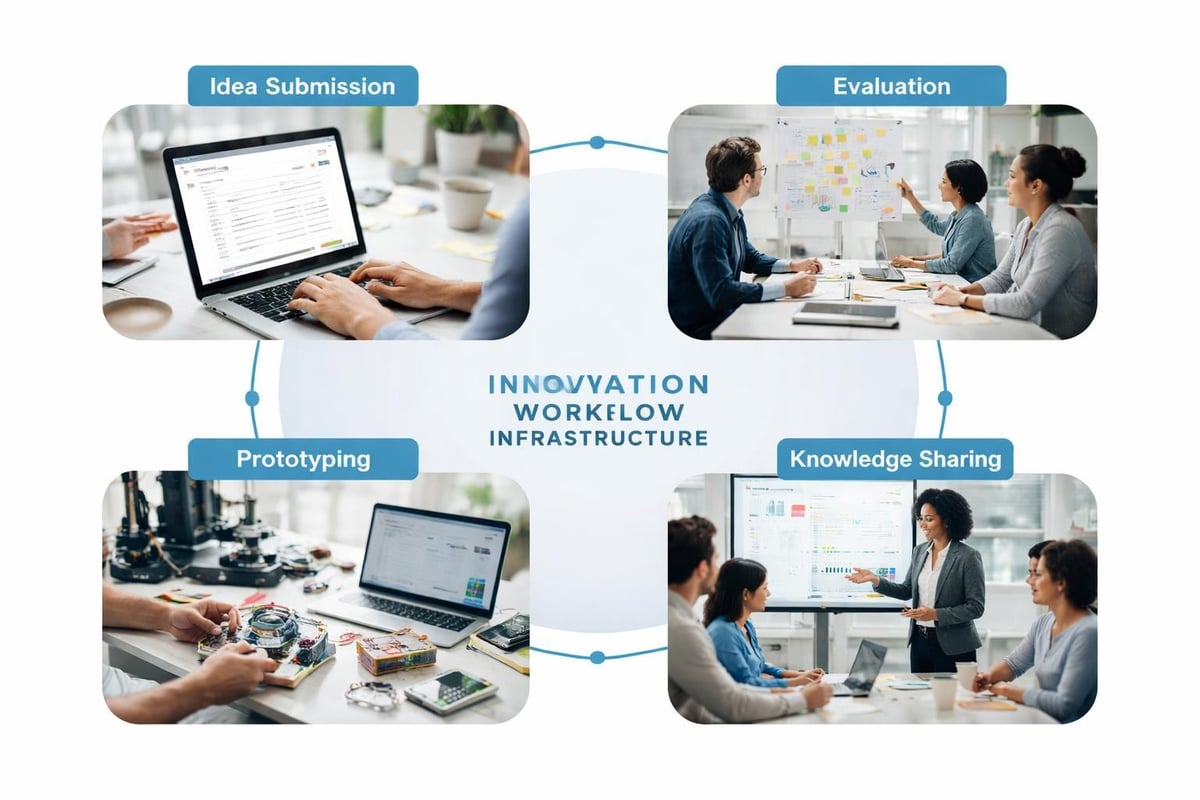
Digital platforms democratize internal innovation by enabling every employee to contribute ideas, vote on promising concepts, and track implementation progress. Transparency around how ideas get evaluated and why certain projects receive funding builds trust and encourages continued participation.
Balancing Internal and External Innovation Approaches
Smart organizations recognize that internal innovation and external collaboration are complementary rather than competing strategies. Expert insights on balancing these approaches emphasize building strong internal capabilities as the foundation for successful external partnerships.
Internal innovation provides several distinct advantages. Teams understand organizational culture, legacy systems, and political dynamics that external partners must learn. This contextual knowledge accelerates implementation and increases adoption rates. Additionally, innovations developed internally strengthen organizational capabilities and employee skills, creating lasting competitive advantages.
However, internal innovation faces limitations. Organizations can become insular, missing trends visible to external observers. Resource constraints and competing priorities may slow innovation cycles compared to focused startups. Cognitive biases and "not invented here" syndrome can blind teams to superior external solutions.
Creating a Hybrid Innovation Portfolio
The optimal approach blends internal and external innovation based on strategic priorities, capability gaps, and market dynamics. A balanced portfolio might allocate:
- 60% to internal innovation: Core product improvements, process optimizations, adjacent market opportunities where organizational expertise provides advantages
- 25% to partnered innovation: Strategic alliances that combine internal strengths with external capabilities for breakthrough innovations
- 15% to external innovation: Acquisitions, licensing, or investments that rapidly fill critical capability gaps
This distribution varies by industry, organizational maturity, and competitive dynamics. Technology companies might weight external innovation higher to access emerging capabilities, while manufacturing firms may emphasize internal process innovations.
Fostering an Innovation-Friendly Culture
Culture determines whether internal innovation initiatives thrive or wither. Strategies for building innovation-friendly business culture emphasize leadership behaviors, incentive structures, and organizational norms that either encourage or suppress creative risk-taking.
Leadership sets the cultural tone through actions more than words. When executives personally sponsor innovation projects, celebrate intelligent failures, and allocate meaningful resources to experimentation, they signal organizational commitment. Conversely, punishing failures or starving innovation budgets during downturns signals that innovation represents a luxury rather than strategic necessity.
Nine Best Practices for Sustained Innovation Excellence
Organizations achieving consistent internal innovation success implement these proven best practices:
- Multi-modal ideation: Combine individual brainstorming, group workshops, customer observations, and data analytics to generate diverse ideas
- Effective filtering: Establish clear evaluation criteria that assess market potential, strategic fit, and implementation feasibility
- Rapid prototyping: Build minimum viable products quickly to test assumptions before major investments
- Customer co-creation: Involve customers in the innovation process to ensure solutions address real needs
- Cross-functional collaboration: Break down silos through guilds and communities of practice
- Portfolio management: Balance incremental, adjacent, and transformational innovations
- Learning systems: Capture insights from both successes and failures to improve future initiatives
- Resource flexibility: Maintain pools of funding and talent that can pivot to promising opportunities
- Continuous improvement: Treat the innovation process itself as something to innovate and optimize
Research on using guilds to support internal startups demonstrates how communities of practice accelerate innovation through knowledge sharing and collective problem-solving. These self-organizing groups provide peer support that complements formal innovation programs.
Measuring Internal Innovation Impact
What gets measured gets managed. Effective internal innovation programs establish comprehensive metrics spanning inputs, processes, outputs, and outcomes.
Input Metrics: Track innovation investment as percentage of revenue, number of employees engaged in innovation activities, and hours dedicated to experimentation versus operational work.
Process Metrics: Monitor idea submission rates, evaluation cycle times, prototype development speed, and innovation funnel conversion rates from concept to launch.
Output Metrics: Count new products launched, patents filed, process improvements implemented, and revenue from innovations less than three years old.
Outcome Metrics: Assess market share gains from innovations, customer satisfaction improvements, operational cost reductions, and employee engagement scores.
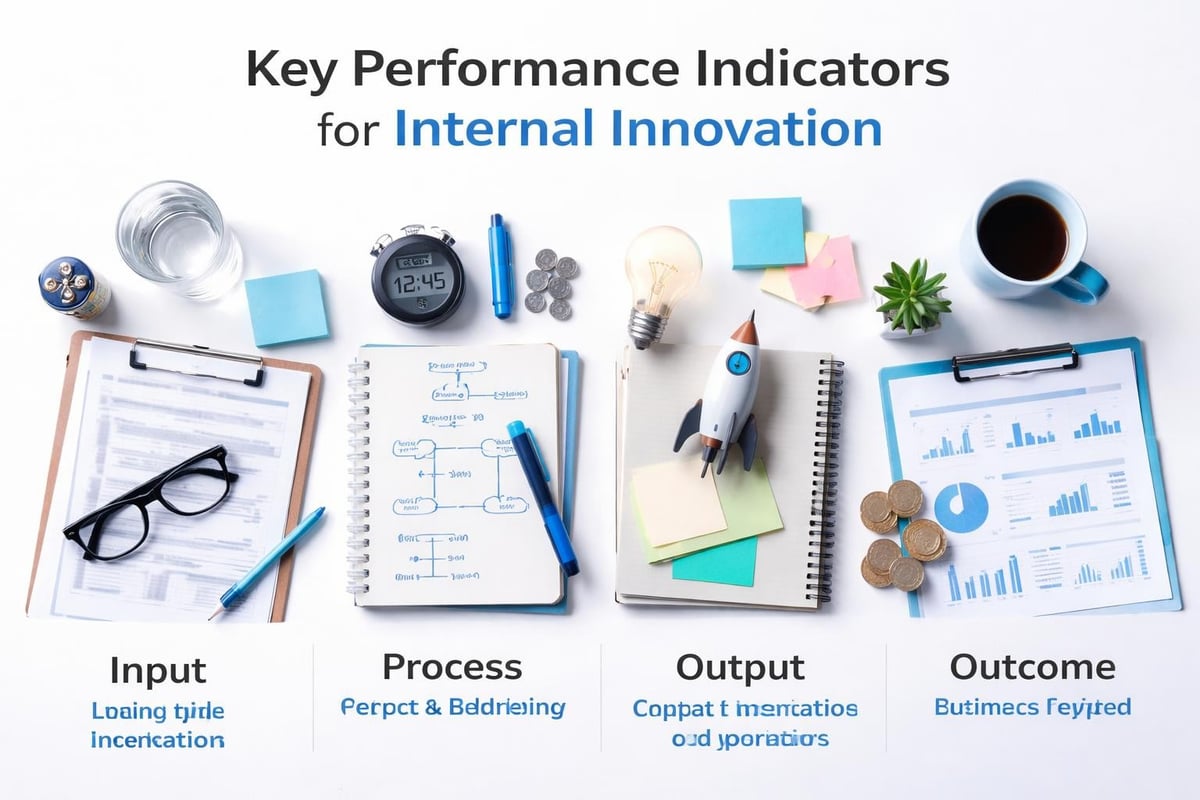
Leading organizations establish innovation scorecards reviewed quarterly by executive leadership. These dashboards create accountability while providing early warning signs when innovation pipelines weaken or resource allocation drifts from strategic priorities.
Connecting Innovation to Business Strategy
Internal innovation must align with broader business strategy to deliver meaningful impact. Strategic frameworks help organizations identify where innovation can create the most value based on competitive positioning, market dynamics, and organizational capabilities.
Some companies pursue innovation primarily for revenue growth through new products and markets. Others focus on operational excellence, using innovation to reduce costs and improve efficiency. Still others emphasize customer experience innovations that strengthen loyalty and pricing power.
Strategic clarity prevents innovation teams from pursuing interesting ideas that fail to move business needles. It also helps prioritize limited resources toward opportunities with the greatest strategic importance rather than the loudest internal advocates.
Implementing AI-Powered Internal Innovation
Artificial intelligence transforms internal innovation by augmenting human creativity with data-driven insights and automated experimentation. Organizations integrating AI strategy and implementation into innovation processes accelerate discovery while reducing risk.
AI applications for internal innovation include:
- Trend analysis: Machine learning algorithms identify emerging patterns in customer behavior, market dynamics, and competitive moves
- Ideation support: Natural language processing tools analyze vast knowledge bases to suggest novel concept combinations
- Prototype optimization: Generative design algorithms explore thousands of design variations to identify optimal solutions
- Predictive analytics: Statistical models forecast innovation success probability based on historical data and market conditions
- Automated experimentation: AI systems run multiple tests simultaneously to rapidly validate assumptions
The most sophisticated organizations create feedback loops where AI systems learn from innovation outcomes to improve future recommendations. This creates a virtuous cycle where internal innovation capability compounds over time.
Maintaining the Human Element
Despite AI's power, human judgment remains essential for internal innovation success. Machines excel at pattern recognition and optimization but lack contextual understanding, ethical reasoning, and creative intuition that humans bring to complex strategic decisions.
The optimal approach positions AI as a creative partner that handles data-intensive analysis while humans focus on synthesis, strategic judgment, and stakeholder engagement. This human-AI collaboration produces superior results compared to either working alone.
Scaling Internal Innovation Across the Enterprise
Pilot programs demonstrate feasibility, but true competitive advantage requires scaling internal innovation across the entire organization. This transition challenges companies to move from centralized innovation teams to distributed innovation capabilities embedded throughout business units.
Scaling strategies include:
Innovation champions network: Identify and train enthusiastic employees in every department to serve as local innovation advocates who encourage participation and support initiatives
Standardized playbooks: Document proven innovation methodologies and make them accessible to teams across the organization through training and templates
Shared services model: Maintain central expertise in areas like customer research, prototyping, and intellectual property while embedding innovation practitioners in business units
Recognition programs: Celebrate innovation successes publicly to reinforce desired behaviors and motivate broader participation
Leadership development: Incorporate innovation leadership skills into management training to ensure future leaders champion creative problem-solving
Organizations scaling internal innovation successfully report that the challenge shifts from generating ideas to managing abundance. Governance processes become critical for filtering concepts, allocating resources, and preventing innovation theater that consumes energy without producing results.
Building sustainable internal innovation capabilities requires strategic vision, systematic processes, and cultural commitment that extends throughout the organization. By leveraging existing talent, embedding innovation frameworks, and measuring impact rigorously, companies transform creative potential into competitive advantage and profitable growth. Six Paths Consulting partners with ambitious leaders to develop robust internal innovation capabilities through AI-powered strategic frameworks, hands-on training programs, and proven methodologies that accelerate your journey from good ideas to market-leading innovations.