

Organizations today face mounting pressure to operate with greater efficiency, agility, and precision while simultaneously pursuing innovation and growth. Business process management consulting services provide the strategic framework and expertise needed to transform operational complexity into competitive advantage. These specialized consulting engagements help companies identify inefficiencies, redesign workflows, and implement sustainable process improvements that drive measurable business outcomes. For ambitious leaders seeking to balance operational excellence with strategic innovation, understanding how business process management consulting services deliver value has become essential to maintaining market relevance in 2026.
Understanding Business Process Management Consulting
Business process management consulting services focus on analyzing, optimizing, and transforming the core workflows that define how organizations operate. Unlike traditional efficiency projects, modern BPM consulting integrates strategic thinking with operational execution to create processes that support broader business objectives.
Professional consultants bring structured methodologies, proven frameworks, and objective perspectives to process improvement initiatives. They work collaboratively with leadership teams and operational staff to map current-state processes, identify bottlenecks, and design future-state workflows that eliminate waste while enhancing value creation. This comprehensive approach addresses not only the technical aspects of process design but also the organizational change management required for successful implementation.
The Strategic Value Proposition
The value of business process management consulting services extends far beyond simple cost reduction. These engagements create strategic advantages through:
- Enhanced operational agility that enables faster response to market changes
- Improved customer experience through streamlined service delivery
- Data-driven decision-making supported by process visibility and metrics
- Reduced risk exposure through standardized, controlled workflows
- Scalability foundations that support sustainable growth
Organizations that invest in comprehensive process management consulting often discover opportunities for innovation that weren't visible within existing operational frameworks. By examining workflows through a strategic lens, consultants help businesses identify new pathways for innovation and business growth that align process improvements with market opportunities.
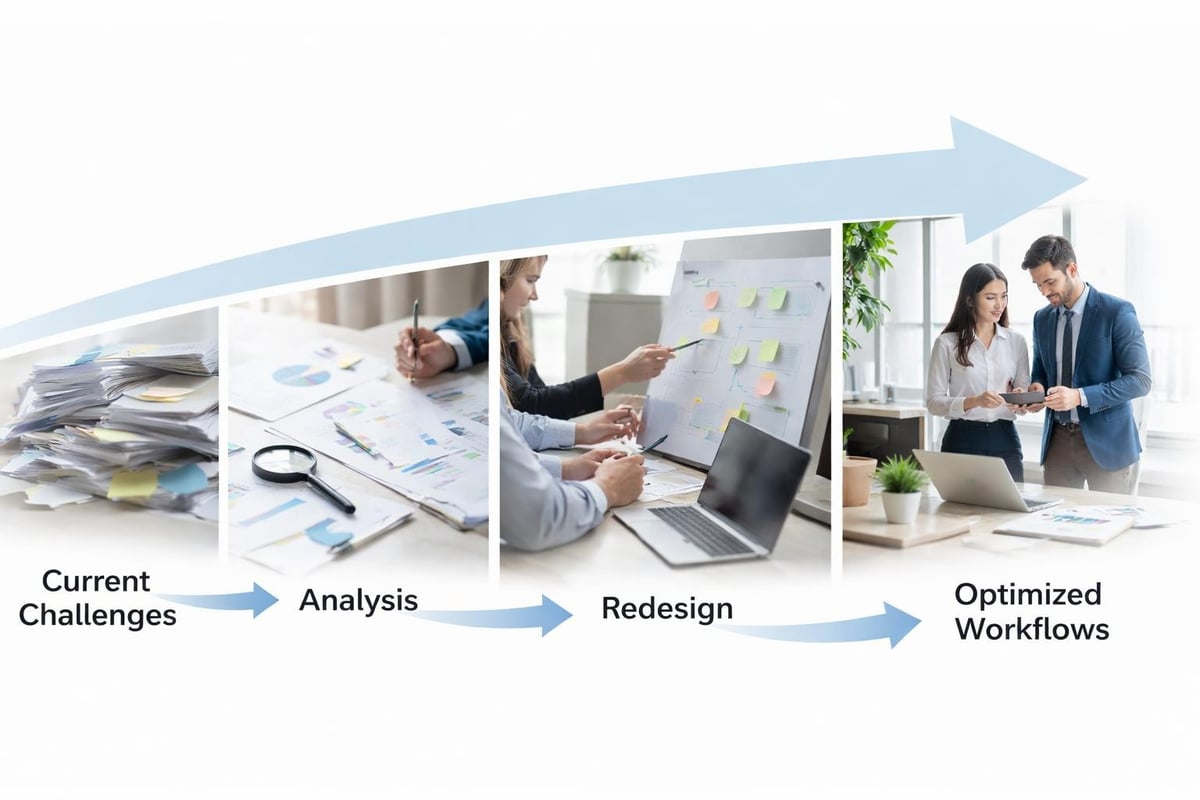
Core Components of BPM Consulting Engagements
Effective business process management consulting services follow structured approaches that ensure comprehensive analysis and sustainable results. Understanding these components helps organizations evaluate consulting partners and set appropriate expectations.
Discovery and Process Mapping
The foundation of any BPM engagement involves thorough discovery work. Consultants employ various techniques to understand how work actually flows through the organization, often revealing significant gaps between documented procedures and actual practice. This phase typically includes stakeholder interviews, process observation, data collection, and workflow documentation.
Process discovery and modeling services create visual representations of workflows that make complexity visible and manageable. These maps become critical tools for identifying redundancies, bottlenecks, handoff failures, and opportunities for automation or elimination.
Analysis and Opportunity Identification
Once current-state processes are documented, consultants apply analytical frameworks to evaluate performance against industry benchmarks and strategic objectives. This analysis examines multiple dimensions:
| Analysis Dimension | Key Questions | Typical Metrics |
|---|---|---|
| Efficiency | How much time and resources does this process consume? | Cycle time, cost per transaction, resource utilization |
| Effectiveness | Does this process achieve desired outcomes? | Quality rates, error frequency, customer satisfaction |
| Compliance | Does this process meet regulatory requirements? | Audit findings, control effectiveness, policy adherence |
| Strategic Alignment | Does this process support business objectives? | Revenue impact, competitive positioning, innovation enablement |
This rigorous evaluation creates a prioritized opportunity portfolio that balances quick wins with transformational changes. Consultants help leadership teams understand trade-offs and make informed decisions about where to focus improvement efforts.
Redesign and Optimization
The redesign phase transforms insights into actionable process improvements. Leading consultants bring expertise in management consulting tools and methodologies that enable systematic optimization while maintaining alignment with strategic goals.
Process redesign considers multiple optimization levers:
- Elimination of non-value-adding steps and redundant activities
- Simplification of overly complex workflows and decision points
- Automation of repetitive tasks through technology integration
- Standardization of variable processes to improve consistency
- Resequencing of activities to improve flow and reduce delays
Effective redesign balances efficiency gains with practical implementation considerations. Consultants evaluate organizational readiness, change management requirements, and technology capabilities to ensure proposed solutions are achievable within existing constraints.
Technology Integration in Modern BPM Consulting
Contemporary business process management consulting services increasingly integrate technology solutions to enable sustainable process improvements. The convergence of artificial intelligence, automation platforms, and analytics tools has fundamentally transformed what's possible in process optimization.
AI-Powered Process Intelligence
Artificial intelligence brings new capabilities to process analysis and optimization. Machine learning algorithms can analyze process execution data to identify patterns, predict bottlenecks, and recommend improvements based on actual performance rather than theoretical models. AI strategy and implementation has become an essential component of forward-thinking BPM initiatives.
Process mining technology uses event logs from existing systems to automatically construct process maps and identify deviations from standard workflows. This data-driven approach reveals the true complexity of operations and highlights improvement opportunities that manual analysis might miss.
Automation and Integration Solutions
Modern BPM consulting frequently includes planning and integration of business process automation solutions that eliminate manual work and reduce error rates. Robotic process automation (RPA), workflow engines, and integration platforms create seamless connections between systems and automate routine tasks.
The key to successful automation lies in selecting the right processes for technology investment. Consultants evaluate automation candidates based on:
- Volume and frequency of transactions
- Rule-based nature of decision-making
- Stability of underlying business requirements
- ROI potential considering implementation costs
- Strategic importance to business objectives

Methodologies and Frameworks in BPM Consulting
Professional business process management consulting services leverage established methodologies that provide structure and rigor to improvement initiatives. Understanding these frameworks helps organizations evaluate consulting approaches and select partners aligned with their needs.
Lean and Six Sigma Approaches
Lean methodologies focus on eliminating waste and maximizing value flow, while Six Sigma emphasizes reducing variation and defects through statistical analysis. Many consultants combine these approaches in Lean Six Sigma frameworks that address both efficiency and quality dimensions.
These methodologies provide structured problem-solving tools including value stream mapping, root cause analysis, statistical process control, and DMAIC (Define, Measure, Analyze, Improve, Control) project frameworks. The disciplined nature of these approaches creates measurable results and sustainable improvements.
Employee-Centric Process Management
Progressive consulting firms recognize that sustainable process improvement requires employee engagement and ownership. Methodologies that empower employees to lead change by identifying and controlling strategic processes create stronger buy-in and better long-term results.
This approach transforms process management from a top-down directive into a collaborative capability. Consultants facilitate workshops, train internal process owners, and build organizational capacity for continuous improvement rather than creating dependency on external expertise.
Integrated Management Systems
Organizations managing multiple compliance frameworks, quality standards, and operational methodologies benefit from integrated management systems approaches that consolidate processes, documentation, and controls. This integration reduces duplication, simplifies governance, and creates a unified view of organizational operations.
BPM consultants help design integrated systems that satisfy regulatory requirements while supporting operational efficiency. The goal is creating a single source of truth for process documentation and performance metrics rather than maintaining separate systems for each standard or framework.
Measuring Success in Process Improvement Initiatives
Business process management consulting services deliver value only when improvements translate into measurable business outcomes. Establishing clear success metrics before engagement begins ensures accountability and enables objective evaluation of results.
Financial Impact Metrics
The most compelling measures of BPM success involve financial performance improvements. Organizations typically track:
- Cost reduction through efficiency gains and resource optimization
- Revenue enhancement from improved customer experience and faster cycle times
- Working capital improvements through inventory reduction and payment optimization
- Avoidance costs from reduced errors, rework, and compliance failures
Leading consultants establish baseline measurements during discovery and create tracking mechanisms that attribute improvements to specific process changes. This rigor supports ROI calculations and builds credibility for future improvement initiatives.
Operational Performance Indicators
Beyond financial metrics, operational KPIs demonstrate process health and continuous improvement. These measures vary by process type but commonly include cycle time reduction, throughput increases, quality improvements, and capacity utilization gains.
| Process Type | Key Performance Indicators | Target Improvement Range |
|---|---|---|
| Customer Service | Response time, first-call resolution, satisfaction scores | 15-30% improvement |
| Order Fulfillment | Order-to-delivery time, perfect order rate, inventory turns | 20-40% improvement |
| Product Development | Time-to-market, development cost, innovation success rate | 25-50% improvement |
| Financial Close | Close cycle time, error rates, audit findings | 30-60% improvement |
Strategic Capability Development
The most valuable outcomes from business process management consulting services often involve building internal capabilities that support ongoing innovation and adaptation. Success metrics in this dimension include:
- Number of employees trained in process improvement methodologies
- Internal process improvement projects initiated post-engagement
- Process documentation coverage and currency
- Cross-functional collaboration effectiveness
- Speed of process adaptation to market changes
These capability metrics reflect whether consulting engagements create lasting organizational strength or simply deliver one-time improvements that decay over time.
Selecting the Right BPM Consulting Partner
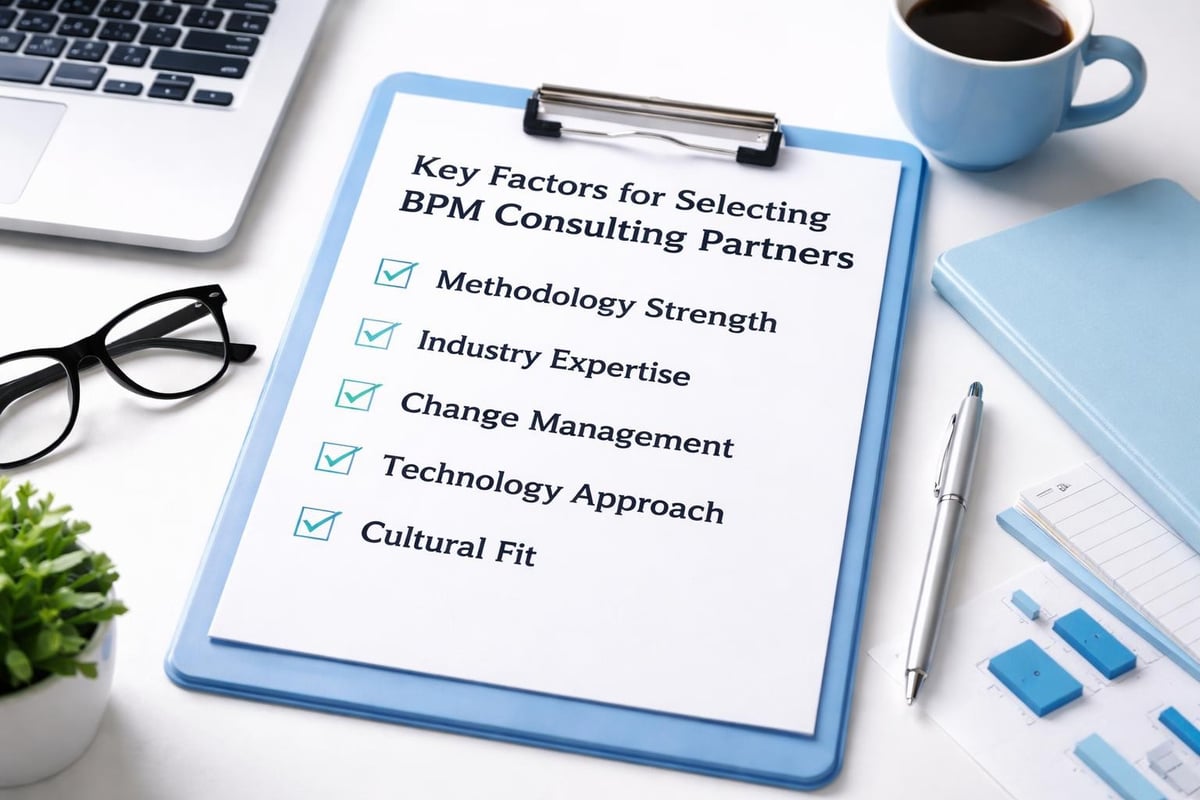
The quality of business process management consulting services varies significantly across providers. Organizations seeking to maximize their investment should evaluate potential partners across multiple dimensions.
Industry Expertise and Methodology
Consultants with deep industry knowledge bring valuable context about regulatory requirements, competitive dynamics, and industry-specific best practices. However, cross-industry experience can also provide fresh perspectives and transferable innovations that pure industry specialists might miss.
Equally important is the consultant's methodology and approach to optimizing business processes using proven frameworks. Ask potential partners to explain their process improvement methodology, describe typical engagement structures, and provide examples of how they've adapted their approach to different client situations.
Change Management Capabilities
Process improvements fail when organizations cannot execute the human side of transformation. Effective BPM consultants integrate change management into their engagements, addressing stakeholder resistance, communication needs, training requirements, and organizational culture considerations.
Evaluate how consultants approach employee engagement, leadership alignment, and sustaining improvements after implementation. Partners who focus exclusively on technical process design without addressing adoption challenges rarely deliver lasting value.
Technology Partnership and Independence
Some BPM consultants maintain partnerships with specific technology vendors, while others remain platform-agnostic. Each approach has advantages. Vendor-affiliated consultants may offer implementation discounts and deep product expertise, but potentially bias recommendations toward their partner platforms.
Independent consultants provide objective technology selection advice but may lack deep implementation experience with specific platforms. Consider whether your organization has already committed to particular technology platforms or needs unbiased guidance on solution selection.
Integration with Strategic Innovation Initiatives
Forward-thinking organizations recognize that business process management consulting services should support rather than constrain innovation. The most valuable BPM engagements create operational foundations that enable strategic experimentation and rapid adaptation to market opportunities.
Process Optimization as Innovation Enabler
Efficient, well-documented processes free resources and management attention for innovation activities. When operational execution becomes predictable and reliable, leadership teams can focus on strategy and transformation consulting initiatives that create new value rather than constantly firefighting operational problems.
Process improvements also accelerate innovation cycles by reducing the time required to test, iterate, and scale new business models. Organizations with mature process management capabilities can experiment more rapidly because they understand how to integrate new approaches into existing operations.
Building Innovation into Process DNA
Rather than treating efficiency and innovation as separate initiatives, leading organizations embed innovation mechanisms into their core processes. This might include:
- Structured experimentation protocols within customer-facing processes
- Continuous feedback loops that capture improvement ideas from frontline employees
- Flexible process architectures that accommodate variation and learning
- Cross-functional collaboration mechanisms that break down functional silos
- Performance metrics that reward both efficiency and innovation outcomes
Business process management consulting services that incorporate innovation principles help organizations develop this dual capability. Consultants who understand how to balance transformation with operational stability deliver solutions that support both current performance and future growth.
Common Pitfalls and How to Avoid Them
Even well-intentioned process improvement initiatives encounter predictable challenges. Understanding these pitfalls helps organizations structure BPM consulting engagements for success.
Overengineering Solutions
The temptation to design perfect processes with elaborate controls and detailed procedures often backfires. Overly complex solutions become difficult to implement, expensive to maintain, and resistant to necessary adaptation. Effective consultants balance process discipline with practical simplicity.
Start with minimum viable process designs that address the most critical pain points, then iterate based on actual implementation experience. This agile approach reduces risk and builds organizational confidence before tackling more complex optimizations.
Ignoring Organizational Culture
Processes that conflict with organizational culture face persistent resistance regardless of their technical merits. Consultants must assess cultural readiness and design solutions that align with how the organization actually operates while gradually moving toward desired behaviors.
Understanding innovation and organizational change dynamics helps consultants navigate cultural considerations effectively. The best solutions work with cultural strengths rather than fighting against established patterns.
Neglecting Continuous Improvement
Viewing process optimization as a one-time project rather than an ongoing capability leads to gradual degradation as market conditions, technologies, and business requirements evolve. Sustainable success requires building internal capabilities for continuous process refinement.
Ensure consulting engagements include knowledge transfer, capability building, and governance structures that support ongoing improvement. The goal should be developing internal expertise rather than creating consultant dependency.
Measurement Without Action
Some organizations invest heavily in process measurement and monitoring without establishing clear mechanisms for acting on insights. Dashboards full of metrics provide little value unless they trigger specific improvement actions and accountability.
Effective BPM implementations connect measurement to decision rights, improvement workflows, and accountability structures. Consultants should help design not just what to measure but how measurement insights drive action.
The Future of Business Process Management Consulting
Business process management consulting services continue evolving as new technologies, methodologies, and market pressures reshape organizational operations. Several trends are defining the next generation of BPM consulting.
Intelligent Process Automation
The convergence of AI, machine learning, and process automation creates opportunities for intelligent workflows that adapt in real-time to changing conditions. Next-generation BPM solutions incorporate predictive analytics, natural language processing, and autonomous decision-making that dramatically expand what's possible in process optimization.
Consultants who combine deep process expertise with AI strategy capabilities help organizations navigate this technological transformation effectively. The challenge lies not in deploying technology but in redesigning work to fully exploit intelligent automation capabilities.
Ecosystem Process Management
Traditional BPM focused on optimizing processes within organizational boundaries. Modern businesses increasingly operate within complex ecosystems involving partners, suppliers, platforms, and customers. Process consulting solutions addressing cross-organizational workflows become essential as value creation spans multiple entities.
This ecosystem perspective requires different tools, governance models, and optimization approaches than conventional BPM. Consultants must help organizations design collaborative processes that create value across organizational boundaries while managing complexity and coordination costs.
Process-Centric Digital Transformation
Many digital transformation initiatives fail because they focus on technology deployment without addressing underlying process improvements. Forward-thinking organizations recognize that successful digital transformation requires analyzing and redesigning business workflows before implementing new technologies.
Business process management consulting services provide the foundational work that enables successful technology adoption. By redesigning processes for digital execution before selecting and implementing platforms, organizations achieve better outcomes and avoid expensive technology investments that don't deliver expected value.
Resilience and Adaptability Focus
The volatility and uncertainty of modern business environments demand processes that can rapidly adapt to changing conditions. Static, rigid workflows that optimize for efficiency under stable conditions become liabilities when markets shift quickly.
Next-generation BPM consulting emphasizes building adaptive capacity alongside operational efficiency. This includes designing processes with built-in flexibility points, establishing rapid response protocols, and creating monitoring systems that provide early warning of needed adaptations. Organizations need processes that support both current performance and future evolution.
Business process management consulting services transform operational complexity into strategic advantage when approached thoughtfully and executed effectively. The most successful engagements integrate process excellence with innovation capabilities, creating organizational foundations that support both current efficiency and future growth. Six Paths Consulting helps ambitious leaders balance operational optimization with strategic innovation, combining AI-powered insights with proven methodologies to discover new market opportunities while building the process capabilities needed to execute effectively. Connect with our team to explore how strategic process innovation can accelerate your growth trajectory.