

Organizations struggling to innovate in today's rapidly evolving marketplace often lack a structured approach to creative problem-solving. Design thinking training has emerged as a critical capability-building tool that equips teams with human-centered methodologies to tackle complex challenges, develop innovative solutions, and create exceptional customer experiences. As businesses face increasing pressure to differentiate themselves and discover new growth opportunities, investing in comprehensive design thinking training programs has become essential for building sustainable competitive advantage.
Understanding the Foundation of Design Thinking Methodology
Design thinking represents a systematic approach to innovation that places human needs at the center of problem-solving. Unlike traditional business methodologies that start with technical capabilities or market analysis, design thinking begins with deep empathy for the end user.
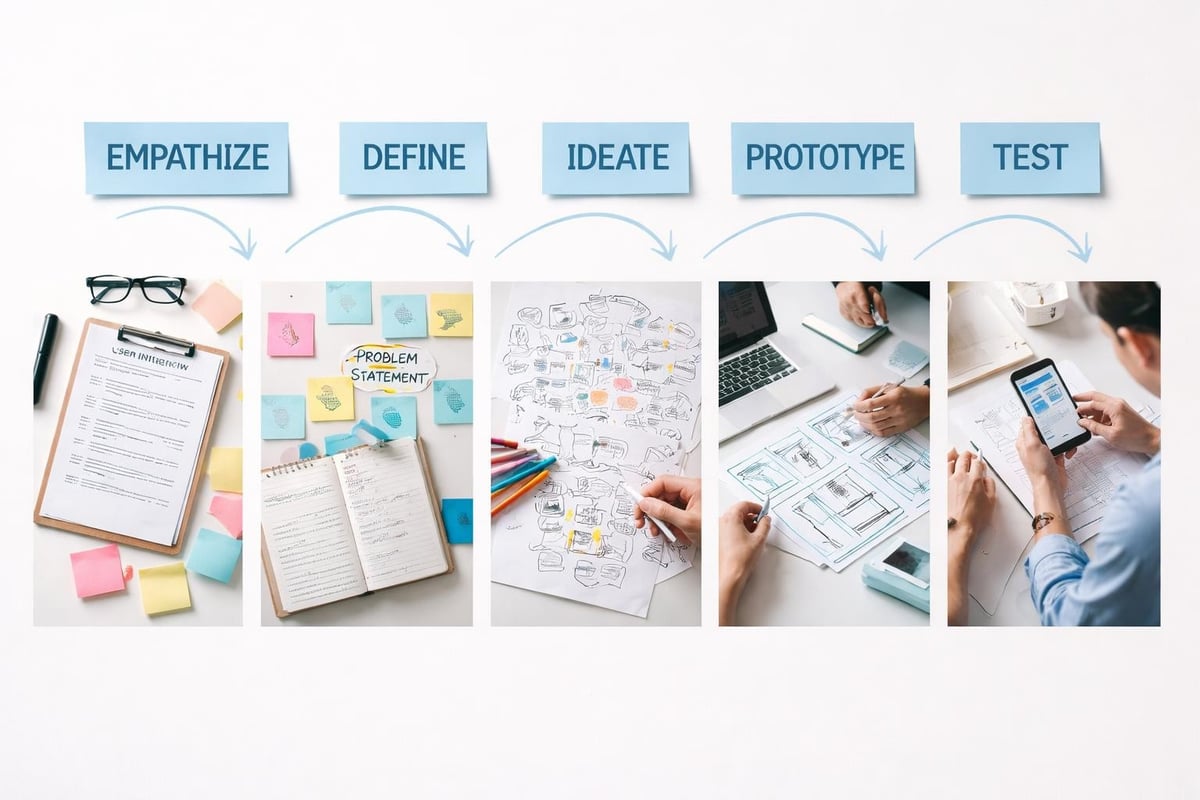
The methodology follows five distinct phases that create a structured framework for innovation. These stages include empathize, define, ideate, prototype, and test. Each phase builds upon the previous one, creating a comprehensive process that transforms ambiguous challenges into actionable solutions.
The core principles that underpin effective design thinking include:
- Human-centered focus that prioritizes user needs and experiences
- Collaborative ideation that leverages diverse perspectives
- Bias toward action through rapid prototyping and testing
- Iterative refinement based on continuous feedback
- Tolerance for failure as a learning mechanism
Research from the University of Texas at Austin on evidence-based design thinking pedagogy emphasizes the importance of building self-efficacy in non-designers, demonstrating that effective training programs must address both methodology and mindset.
Business Value Created Through Structured Training Programs
Organizations that implement design thinking training experience measurable improvements across multiple dimensions of business performance. Teams develop enhanced problem-solving capabilities that translate into faster time-to-market for new products, improved customer satisfaction scores, and increased employee engagement.
The financial impact extends beyond immediate innovation outcomes. Companies building internal design thinking capabilities reduce their reliance on external consultants while creating sustainable innovation competencies. This strategic shift enables continuous improvement and adaptation as market conditions evolve.
Quantifiable Outcomes from Investment
| Metric | Typical Improvement | Timeline |
|---|---|---|
| Time to prototype | 40-60% reduction | 3-6 months |
| Customer satisfaction | 25-35% increase | 6-12 months |
| Innovation pipeline | 3x more viable concepts | 12-18 months |
| Employee engagement | 30-45% improvement | 6-9 months |
The methodology proves particularly valuable when organizations integrate it with frameworks for innovation that provide structured approaches to identifying growth opportunities. This combination creates a powerful toolkit for strategic innovation.
An empirical study on design thinking’s influence on creativity demonstrates that the methodology enhances innovation processes across different experience levels, validating the universality of the approach when properly taught.
Designing Effective Training Curricula for Teams
Successful design thinking training requires careful curriculum design that balances theoretical understanding with practical application. The most effective programs integrate real business challenges into the learning experience, allowing participants to develop solutions for actual organizational problems while mastering the methodology.
Training architects must consider participant experience levels, organizational context, and specific business objectives when structuring programs. A technology startup pursuing rapid product innovation requires different emphasis than an established enterprise seeking to revitalize customer experience.
Essential components of comprehensive training programs include:
- Foundational workshops introducing core concepts and mindsets
- Hands-on practice sessions applying tools to real challenges
- Facilitation training for internal innovation champions
- Integration modules connecting design thinking to existing processes
- Advanced masterclasses for experienced practitioners
The best programs extend beyond initial training sessions to include ongoing support, coaching, and community building. This sustained engagement ensures that teams successfully transition from learning the methodology to embedding it within daily operations.
Similar to creativity workshops for teams, design thinking training must create psychologically safe environments where participants feel comfortable experimenting, sharing unconventional ideas, and learning from failure.

Building Internal Facilitation Capability
Organizations achieve maximum value from design thinking training when they develop internal facilitation capabilities rather than depending on external experts. Training selected employees to become design thinking facilitators creates sustainable innovation capacity while reducing long-term costs.
Internal facilitators bring intimate knowledge of organizational culture, business challenges, and stakeholder relationships. These insights enable them to customize methodologies, navigate political complexities, and drive adoption more effectively than external consultants.
Facilitator Development Pathway
The journey from participant to skilled facilitator requires progressive skill building across multiple dimensions. Organizations should select facilitators based on criteria including passion for innovation, collaborative mindset, and credibility within the organization.
Training programs for facilitators must address both technical competencies and soft skills. Technical elements include mastering individual design thinking tools, understanding when to apply specific techniques, and managing the end-to-end process. Soft skills encompass group facilitation, conflict resolution, and stakeholder management.
Critical facilitator competencies include:
- Deep methodology expertise across all design thinking phases
- Group dynamics management and workshop facilitation
- Coaching skills to guide teams through ambiguity
- Organizational change management capabilities
- Measurement and evaluation of innovation outcomes
Organizations pursuing this approach should examine business frameworks that support systematic capability building, ensuring facilitator development aligns with broader strategic objectives.
Integrating Design Thinking with Strategic Innovation
Design thinking training delivers maximum impact when integrated with comprehensive strategic innovation approaches. The methodology provides tactical tools for problem-solving, but organizations must connect these capabilities to broader innovation strategies addressing market opportunities and business model evolution.
Forward-thinking companies combine design thinking with additional innovation methodologies including lean startup principles, agile development, and business model innovation frameworks. This integrated approach creates robust innovation systems capable of addressing challenges at multiple levels.
The connection between design thinking and artificial intelligence represents a particularly powerful combination for 2026. Teams trained in design thinking methodologies can more effectively identify valuable AI applications, design intuitive AI-powered experiences, and ensure technology implementations truly address human needs.
| Integration Area | Design Thinking Contribution | Strategic Outcome |
|---|---|---|
| New Product Development | User-centered feature prioritization | Products that solve real problems |
| Customer Experience | Journey mapping and pain point identification | Seamless, delightful interactions |
| Business Model Innovation | Rapid testing of value propositions | Validated new revenue streams |
| Digital Transformation | Human-centered technology adoption | Higher implementation success rates |
Organizations exploring innovative ideas for business growth benefit from design thinking's ability to validate assumptions quickly and cheaply before committing significant resources.
Research on design principles for data analysis illustrates how design thinking integrates with analytical disciplines, creating more comprehensive approaches to complex business challenges.
Measuring Training Effectiveness and ROI
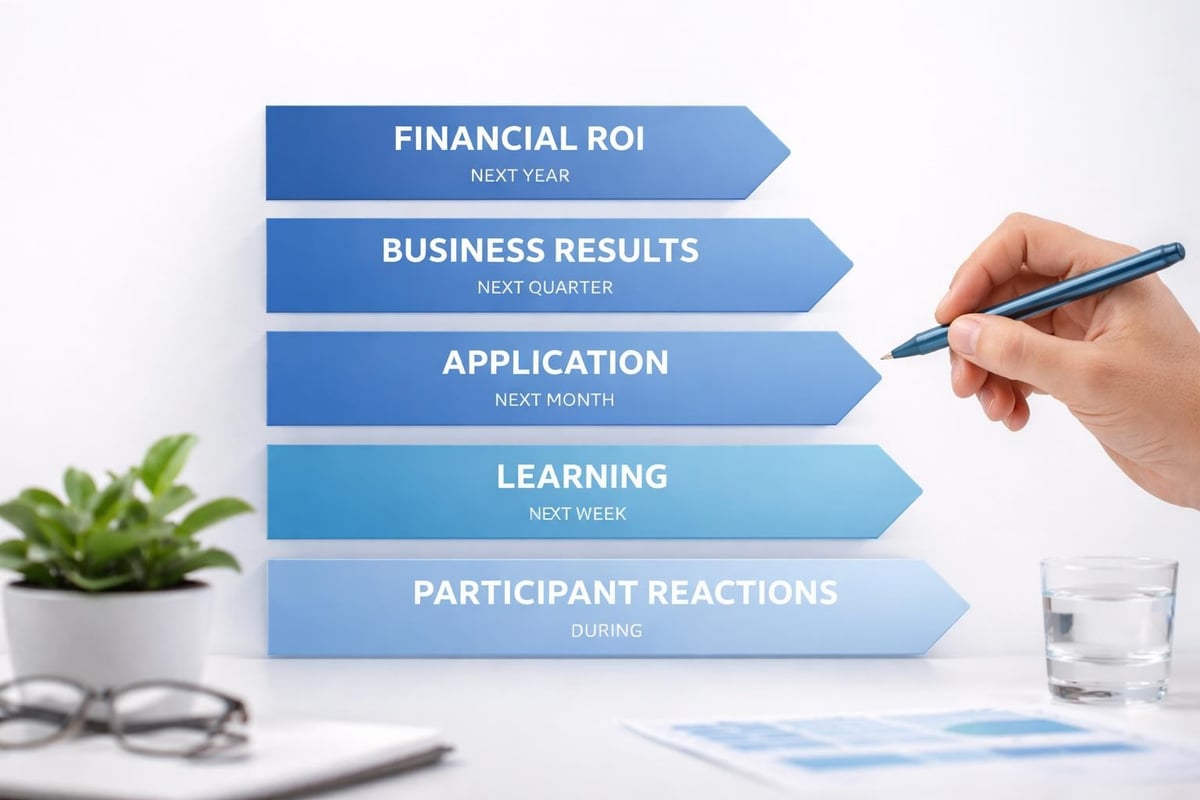
Evaluating design thinking training requires both qualitative and quantitative metrics that capture short-term skill development and long-term business impact. Organizations should establish baseline measurements before training begins, enabling accurate assessment of improvement.
Immediate post-training assessments measure methodology comprehension, tool proficiency, and participant confidence. These metrics indicate whether the training successfully transferred knowledge and skills. However, they represent only the beginning of the evaluation process.
Multi-level evaluation framework includes:
- Reaction metrics measuring participant satisfaction and engagement
- Learning assessments testing methodology knowledge and tool application
- Behavior change observing methodology adoption in daily work
- Business results tracking innovation outcomes and performance improvements
- Return on investment calculating financial impact versus training costs
The most valuable insights emerge from tracking innovation pipeline metrics over 12 to 18 months following training. These measurements reveal whether teams successfully apply design thinking to generate, develop, and launch valuable innovations.
Organizations should also monitor cultural indicators including psychological safety, collaboration quality, and willingness to experiment. These factors determine whether design thinking becomes embedded in organizational DNA or remains an isolated skill set.
Overcoming Common Implementation Challenges
Even well-designed design thinking training programs encounter obstacles during implementation and adoption. Recognizing common challenges enables organizations to proactively address them, increasing the likelihood of successful methodology integration.
Resistance from traditional management layers represents one of the most significant barriers. Leaders accustomed to linear planning processes and predictable outcomes often struggle with design thinking's emphasis on iteration, experimentation, and tolerance for failure. Overcoming this resistance requires executive education, early wins demonstrating value, and patient change management.
Navigating Organizational Barriers
Time constraints create another common challenge. Team members juggling operational responsibilities struggle to dedicate sufficient time to design thinking projects. Organizations must explicitly allocate time for innovation activities, protecting teams from competing priorities that inevitably arise.
Cultural misalignment between design thinking principles and existing organizational norms requires careful navigation. Hierarchical cultures that discourage questioning assumptions or sharing unconventional ideas inherently conflict with design thinking's collaborative, experimental nature.
Proven strategies for overcoming implementation barriers include:
- Securing executive sponsorship and visible leadership support
- Starting with voluntary pilot programs that attract enthusiastic participants
- Celebrating and communicating early successes across the organization
- Integrating design thinking into existing processes rather than creating separate tracks
- Providing ongoing coaching and support beyond initial training
Resources like those available from the DesignThinkers Academy offer practical guidance for addressing common implementation challenges through their global training programs.
Selecting the Right Training Partner or Approach
Organizations face critical decisions when choosing between internal program development, external training partners, or hybrid approaches. Each option presents distinct advantages and tradeoffs that depend on organizational context, existing capabilities, and strategic objectives.
Internal program development offers maximum customization and ownership but requires significant investment in curriculum design, facilitator training, and methodology expertise. This approach works best for large organizations with dedicated innovation teams and long-term commitment to capability building.
External training partners bring proven methodologies, experienced facilitators, and cross-industry insights. They accelerate capability development but may require adaptation to fit specific organizational contexts. The most effective partnerships combine standardized methodology training with customized application workshops addressing real business challenges.
Evaluation Criteria for Training Partners
| Criterion | Questions to Ask | Importance Level |
|---|---|---|
| Methodology Depth | Do they teach comprehensive design thinking or simplified versions? | Critical |
| Business Focus | Can they connect methodology to strategic outcomes? | High |
| Practical Application | Will teams work on real challenges during training? | Critical |
| Facilitator Quality | What credentials and experience do trainers possess? | High |
| Post-Training Support | What resources and coaching continue after workshops? | Medium |
| Customization Capability | Can they adapt content to industry and organizational needs? | High |
Organizations should examine training partners' track records with similar companies, request detailed curriculum outlines, and interview potential facilitators before committing to partnerships.
Future Trends Shaping Design Thinking Training
The design thinking landscape continues evolving as new technologies, methodologies, and business challenges emerge. Training programs in 2026 must address these developments to remain relevant and valuable.
Artificial intelligence integration represents the most significant trend reshaping design thinking practice. Teams now use AI tools to analyze user research data, generate ideation prompts, create rapid prototypes, and test concepts with simulated users. Effective training programs teach practitioners to leverage these capabilities while maintaining human-centered focus.
Virtual and hybrid training delivery has permanently altered how organizations build design thinking capabilities. Digital collaboration tools enable distributed teams to participate in workshops, creating new possibilities for global capability building while presenting unique facilitation challenges.
Emerging focus areas in advanced training include:
- Designing AI-powered products and services with ethical considerations
- Applying design thinking to organizational transformation and culture change
- Integrating sustainability and circular economy principles into innovation processes
- Developing inclusive design practices that serve diverse user populations
- Connecting design thinking to data science and advanced analytics
Research on creating accessibility guidance through design thinking demonstrates how the methodology evolves to address contemporary challenges like inclusive design.
Organizations building long-term innovation capabilities should ensure their training programs incorporate these emerging trends while maintaining focus on fundamental design thinking principles that remain constant.
Scaling Design Thinking Across Large Organizations
Extending design thinking capabilities beyond initial trained cohorts to enterprise-wide adoption requires systematic approaches to scaling. Organizations must balance consistency in methodology application with necessary adaptation to different business units and functional areas.
The scaling challenge involves both breadth and depth. Breadth refers to reaching more teams across the organization, while depth involves advancing capabilities from basic methodology application to sophisticated facilitation and innovation leadership.
Successful scaling strategies typically follow a hub-and-spoke model where central innovation teams provide methodology expertise, training, coaching, and quality standards while empowering distributed teams to apply design thinking to their specific contexts. This structure maintains consistency while enabling customization.
Scaling success factors include:
- Creating communities of practice connecting design thinking practitioners
- Developing internal certification programs recognizing capability levels
- Integrating methodology into formal processes like product development
- Building executive fluency enabling informed leadership support
- Measuring and communicating innovation outcomes attributable to design thinking
Organizations pursuing innovation training at scale benefit from structured approaches that systematically build capabilities while adapting to diverse organizational contexts and challenges.
Design thinking training represents a strategic investment in organizational capability that pays dividends through enhanced innovation outcomes, improved customer experiences, and sustainable competitive advantage. Success requires comprehensive programs that build both methodology expertise and cultural mindsets, supported by committed leadership and systematic implementation approaches. Six Paths Consulting helps ambitious organizations develop robust innovation capabilities through customized training programs that combine design thinking methodologies with AI-powered strategic innovation frameworks, empowering teams to discover breakthrough opportunities and accelerate profitable growth.