

The relationship between innovation and business has evolved dramatically in recent years, becoming the cornerstone of sustainable competitive advantage. Organizations that successfully integrate innovation into their core business strategies consistently outperform their competitors, capturing new market opportunities and driving substantial revenue growth. As we navigate 2026, the imperative for structured innovation has never been more critical, with artificial intelligence and emerging technologies reshaping how companies discover opportunities, develop products, and deliver exceptional customer experiences.
The Strategic Foundation of Innovation and Business Growth
Innovation and business strategy represent two sides of the same coin. While many organizations view innovation as a separate function relegated to R&D departments, leading companies recognize that innovation must permeate every aspect of business operations. This holistic approach transforms how businesses identify market gaps, develop solutions, and scale new ventures.
Strategic innovation requires a systematic framework that aligns creative thinking with business objectives. Organizations employing frameworks for innovation demonstrate higher success rates in converting innovative ideas into profitable ventures. These frameworks provide structure without stifling creativity, enabling teams to explore possibilities while maintaining focus on commercial viability.
Building Innovation Capabilities
The most successful businesses don't rely on external consultants alone. They invest in building internal innovation capabilities that create sustainable competitive advantages. This approach involves:
- Training programs that equip employees with innovation methodologies and tools
- Cross-functional teams that break down silos and encourage collaborative problem-solving
- Innovation metrics that track progress and link innovation efforts to business outcomes
- Leadership commitment that signals innovation as a strategic priority
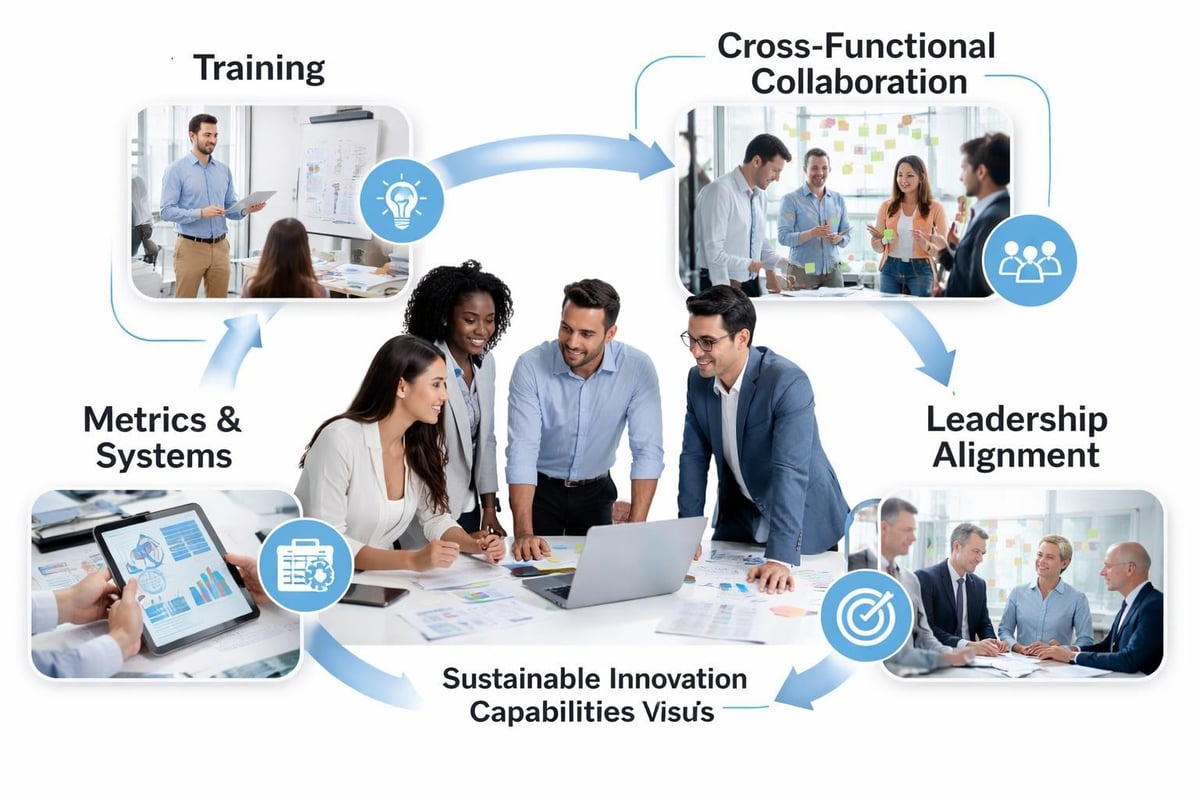
Companies that prioritize innovation training create cultures where experimentation becomes routine and failure transforms into learning opportunities. This cultural shift accelerates the pace of innovation while reducing the risks associated with new venture development.
AI-Powered Strategic Innovation
Artificial intelligence has fundamentally altered the innovation landscape. The transformative impact of Generative AI on business models extends beyond automation, enabling organizations to discover patterns, predict market shifts, and generate novel solutions at unprecedented speeds. AI-powered innovation tools analyze vast datasets to identify emerging customer needs before they become obvious to competitors.
Practical Applications of AI in Innovation
| Application Area | Business Impact | Implementation Complexity |
|---|---|---|
| Market Opportunity Identification | High | Medium |
| Customer Experience Personalization | Very High | High |
| Product Development Acceleration | High | Medium |
| Business Model Optimization | Very High | High |
| Competitive Intelligence | Medium | Low |
The integration of AI into innovation processes enables businesses to move from intuition-based decision-making to data-informed strategy development. This shift significantly reduces the time required to validate ideas and brings products to market faster than traditional approaches.
Organizations leveraging strategy and transformation consulting with AI capabilities gain access to sophisticated analytical tools that identify profitable growth opportunities. These technologies complement human creativity, providing insights that inform strategic decisions while preserving the essential human elements of innovation.
Discovering and Capturing New Market Opportunities
Innovation and business success increasingly depend on the ability to identify and capture untapped market opportunities. Traditional market analysis often focuses on existing customer segments and established competitors, missing the white space where breakthrough growth occurs.
The Blue Ocean Strategy approach exemplifies systematic opportunity discovery. Rather than competing in crowded markets, innovative businesses create new market space by reconstructing market boundaries and challenging industry assumptions. This methodology has helped numerous organizations discover faster, smarter ways to grow by making competition irrelevant.
Six Paths Framework for Opportunity Discovery
Strategic opportunity discovery requires examining markets through multiple lenses:
- Alternative Industries: Look across substitute industries to identify unmet needs
- Strategic Groups: Examine different strategic groups within your industry
- Buyer Chain: Explore different buyer groups and decision-makers
- Complementary Offerings: Consider complementary products and services
- Functional-Emotional Orientation: Challenge industry assumptions about value delivery
- Time Trends: Anticipate and shape future market evolution
This comprehensive approach reveals opportunities that remain invisible to competitors focused solely on incremental improvements. Businesses that systematically apply these discovery methods consistently identify breakthrough innovation opportunities.
Innovation in Business Models and Revenue Streams
Understanding what innovation means in business contexts requires examining how companies create, deliver, and capture value. Business model innovation often generates more substantial returns than product innovation alone, as it fundamentally reshapes competitive dynamics and creates barriers to imitation.
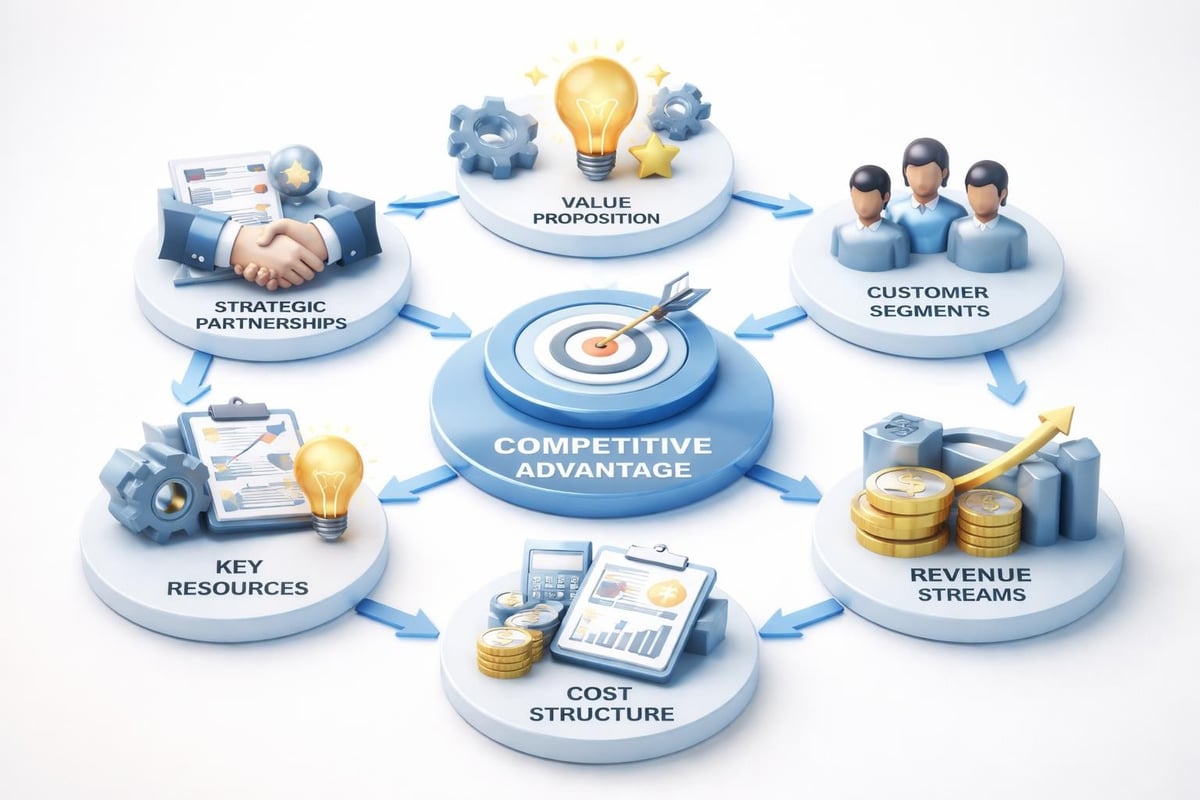
Successful business model innovation addresses three critical questions:
Who is the customer? Identifying underserved or entirely new customer segments opens pathways to growth unavailable through traditional market penetration.
What value do we deliver? Redefining value propositions based on customer jobs-to-be-done rather than product features creates differentiation.
How do we profitably deliver that value? Innovative delivery mechanisms, revenue models, and cost structures enable profitable growth in new markets.
Types of Business Model Innovation
Different innovation types serve distinct strategic purposes. Product and service innovation focuses on what companies offer, while process innovation improves how companies operate. Organizational innovation restructures how teams collaborate and make decisions.
The most powerful innovations often combine multiple types. Consider subscription models that transform one-time purchases into recurring revenue streams while simultaneously changing customer relationships and operational processes. These multi-dimensional innovations create sustainable competitive advantages that competitors struggle to replicate.
| Innovation Type | Strategic Focus | Revenue Impact | Time to Implement |
|---|---|---|---|
| Product Innovation | Customer offerings | Medium-High | 6-18 months |
| Service Innovation | Customer experience | Medium | 3-12 months |
| Process Innovation | Operational efficiency | Medium | 6-24 months |
| Business Model Innovation | Value creation/capture | Very High | 12-36 months |
| Organizational Innovation | Structure and culture | High | 18-48 months |
Developing Innovation Through Strategic Partnerships
Innovation and business growth accelerate when organizations leverage external expertise strategically. Rather than developing all capabilities internally, forward-thinking companies collaborate with specialized partners who bring complementary skills and fresh perspectives.
Strategic consulting partnerships provide several advantages. They introduce proven methodologies that reduce innovation risks, offer objective viewpoints unclouded by internal politics, and transfer knowledge that builds long-term organizational capabilities. The importance of innovation in business extends beyond individual projects to building sustainable innovation systems.
Selecting the Right Innovation Partners
Choosing innovation partners requires careful consideration of several factors:
- Proven Methodologies: Partners should demonstrate systematic approaches backed by successful case studies
- Industry Expertise: Deep understanding of industry dynamics accelerates time-to-value
- Capability Transfer: The best partnerships build internal capabilities rather than creating dependency
- Cultural Alignment: Shared values and working styles ensure smooth collaboration
- Measurable Results: Clear metrics and accountability mechanisms drive performance
Organizations working with top strategy consulting firms benefit from accumulated knowledge across industries while maintaining focus on their unique challenges and opportunities.
Transforming Organizations to Innovate Independently
While external partnerships accelerate initial innovation efforts, sustainable success requires building internal innovation capabilities. Organizations must transform to innovate independently, developing systems and cultures that generate continuous innovation without constant external support.
This transformation involves multiple dimensions. Leadership must model innovation behaviors, reward experimentation, and tolerate intelligent failures. Processes need redesigning to accommodate rapid prototyping and iterative development. Organizational structures should facilitate cross-functional collaboration and knowledge sharing.
Building a Culture of Continuous Innovation
Cultural transformation represents the most challenging aspect of innovation capability development:
Psychological Safety: Teams must feel safe proposing unconventional ideas without fear of ridicule or punishment.
Resource Allocation: Innovation requires dedicated time and budget, not just leftover resources from operational activities.
Recognition Systems: Organizations should celebrate innovation efforts, not just successful outcomes, to encourage continued experimentation.
Learning Orientation: Post-project reviews should focus on extracting lessons rather than assigning blame.
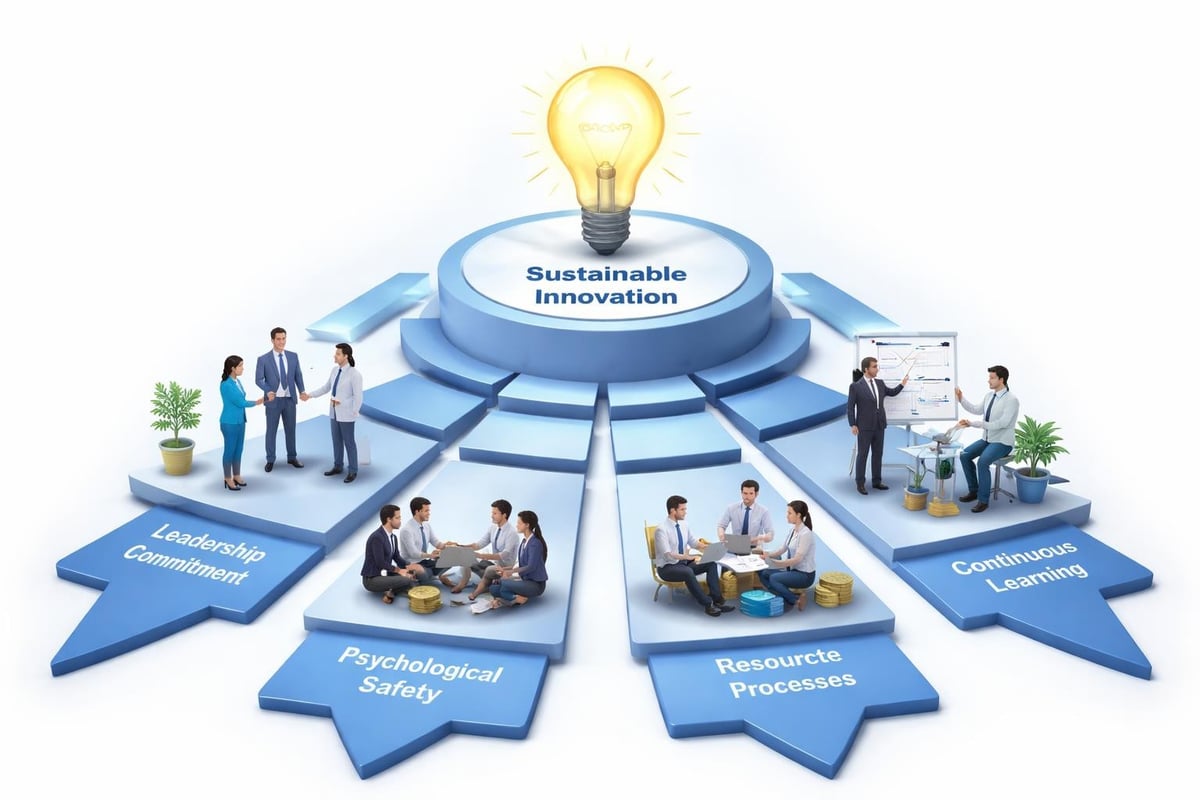
Companies that successfully embed these cultural elements create self-reinforcing innovation systems that generate competitive advantages over extended periods. Research on transforming bold ideas into scalable businesses demonstrates that cultural factors often determine innovation success more than technical capabilities.
Measuring Innovation Impact and ROI
Innovation and business performance connect through carefully designed metrics that track both leading and lagging indicators. Many organizations struggle with innovation measurement, defaulting to easily quantifiable metrics that miss critical value drivers.
Effective innovation metrics balance multiple dimensions:
Input Metrics: Resources allocated to innovation activities, including budget, headcount, and time investments.
Process Metrics: Innovation velocity, project pipeline health, time-to-market, and conversion rates from ideation to implementation.
Output Metrics: New revenue from innovative products or services, cost savings from process improvements, and market share gains in new segments.
Outcome Metrics: Overall business impact, including revenue growth, profitability improvement, and customer satisfaction changes attributable to innovation.
Innovation Metrics Dashboard
| Metric Category | Example Metrics | Measurement Frequency |
|---|---|---|
| Input | Innovation budget as % of revenue | Quarterly |
| Process | Ideas in pipeline, Time-to-prototype | Monthly |
| Output | New product revenue, Process improvements | Quarterly |
| Outcome | Revenue growth from new offerings | Annually |
| Cultural | Employee engagement in innovation | Bi-annually |
Organizations employing comprehensive measurement systems make data-informed decisions about innovation investments, identifying which initiatives deserve additional resources and which require pivoting or termination.
Innovation in Customer Experience and Value Delivery
Customer experience innovation represents a powerful yet often overlooked opportunity. While many businesses focus on product features, exceptional companies recognize that how customers experience their offerings matters as much as what those offerings include.
Developing targeted products your customers will love requires deep customer understanding that extends beyond traditional market research. Innovative businesses employ ethnographic research, jobs-to-be-done analysis, and continuous customer feedback loops to uncover unmet needs and pain points.
Customer experience innovation encompasses:
- Journey mapping that identifies friction points and opportunities for delight
- Omnichannel integration that creates seamless experiences across touchpoints
- Personalization that delivers relevant value to individual customer segments
- Proactive service that anticipates and addresses needs before customers recognize them
Organizations that stand out with exceptional customer experience create emotional connections that transcend functional benefits, building loyalty that withstands competitive pressure and price sensitivity.
Accelerating Innovation Through Agile Methodologies
Speed matters in innovation. Markets shift rapidly, customer preferences evolve, and competitive threats emerge unexpectedly. Organizations that iterate quickly and learn faster than competitors gain significant advantages in capturing market opportunities.
Agile innovation methodologies adapted from software development provide frameworks for rapid experimentation. These approaches emphasize:
- Minimum Viable Products (MVPs) that test core assumptions with minimal investment
- Sprint-based development that delivers incremental value in short cycles
- Continuous feedback that informs ongoing refinement and pivoting decisions
- Cross-functional teams that accelerate decision-making and reduce handoff delays
The ability to launch new businesses quicker creates first-mover advantages in emerging markets while reducing the resources consumed by failed initiatives. Speed combined with learning orientation enables efficient innovation portfolios that balance breakthrough opportunities with incremental improvements.
Sustainability as Innovation Driver
Innovation and business strategy increasingly incorporate environmental, social, and governance considerations. Forward-thinking organizations recognize that sustainability represents an innovation opportunity rather than merely a compliance requirement. Companies that make sustainability their competitive advantage discover new markets, attract values-aligned customers, and reduce operational costs.
Sustainability-driven innovation manifests across multiple domains:
Circular business models that eliminate waste and create new revenue streams from previously discarded materials.
Green products and services that meet customer needs while minimizing environmental impact.
Social innovation that addresses societal challenges while generating commercial returns.
Governance innovation that enhances transparency, accountability, and stakeholder trust.
These innovations often require reconceiving fundamental business assumptions, challenging organizations to think creatively about value creation and capture in resource-constrained environments.
Leadership's Role in Driving Innovation
Innovation and business transformation require committed leadership that goes beyond verbal support. Leaders must actively model innovation behaviors, allocate resources to innovation initiatives, and create organizational conditions that enable experimentation and learning.
Effective innovation leadership involves several critical behaviors:
Strategic clarity: Leaders articulate how innovation connects to overall business strategy, helping teams prioritize opportunities.
Resource commitment: Dedicated budgets and protected time signal that innovation represents a genuine priority rather than an aspirational goal.
Risk tolerance: Leaders who appropriately tolerate intelligent failures encourage the experimentation necessary for breakthrough innovation.
Boundary spanning: Leadership that connects different parts of the organization facilitates knowledge transfer and cross-pollination of ideas.
Organizations implementing specialized approaches like Blue Ocean Strategy workshops benefit from leadership teams aligned around systematic innovation methodologies that guide strategic decisions.
Innovation and business success are inextricably linked in 2026's competitive landscape, requiring systematic approaches that balance creativity with commercial discipline. Organizations that build internal innovation capabilities, leverage AI-powered insights, and maintain customer-centric focus position themselves for sustainable growth in evolving markets. Six Paths Consulting helps ambitious leaders transform innovation aspirations into measurable business results through proven methodologies, AI-powered strategic insights, and comprehensive training programs that build lasting organizational capabilities. Whether you're seeking to discover new market opportunities, develop innovative business models, or accelerate revenue growth, our specialized expertise empowers your team to innovate independently and compete successfully in dynamic markets.