
The landscape of business leadership continues to evolve at an unprecedented pace in 2026, demanding a sophisticated approach to organizational growth and competitive positioning. Organizations that excel understand that innovation and strategic planning are not separate disciplines but interconnected forces that drive sustainable revenue growth and market differentiation. The challenge for ambitious leaders lies in creating systems that nurture both strategic rigor and creative exploration while maintaining alignment with core business objectives and market realities.
The Changing Nature of Strategic Innovation
Innovation and strategic planning have fundamentally shifted from periodic exercises to continuous organizational capabilities. Traditional planning cycles that separated strategy formulation from innovation execution no longer match the velocity of market change. Modern organizations require integrated approaches where strategic thinking informs innovation direction and innovation insights reshape strategic assumptions.
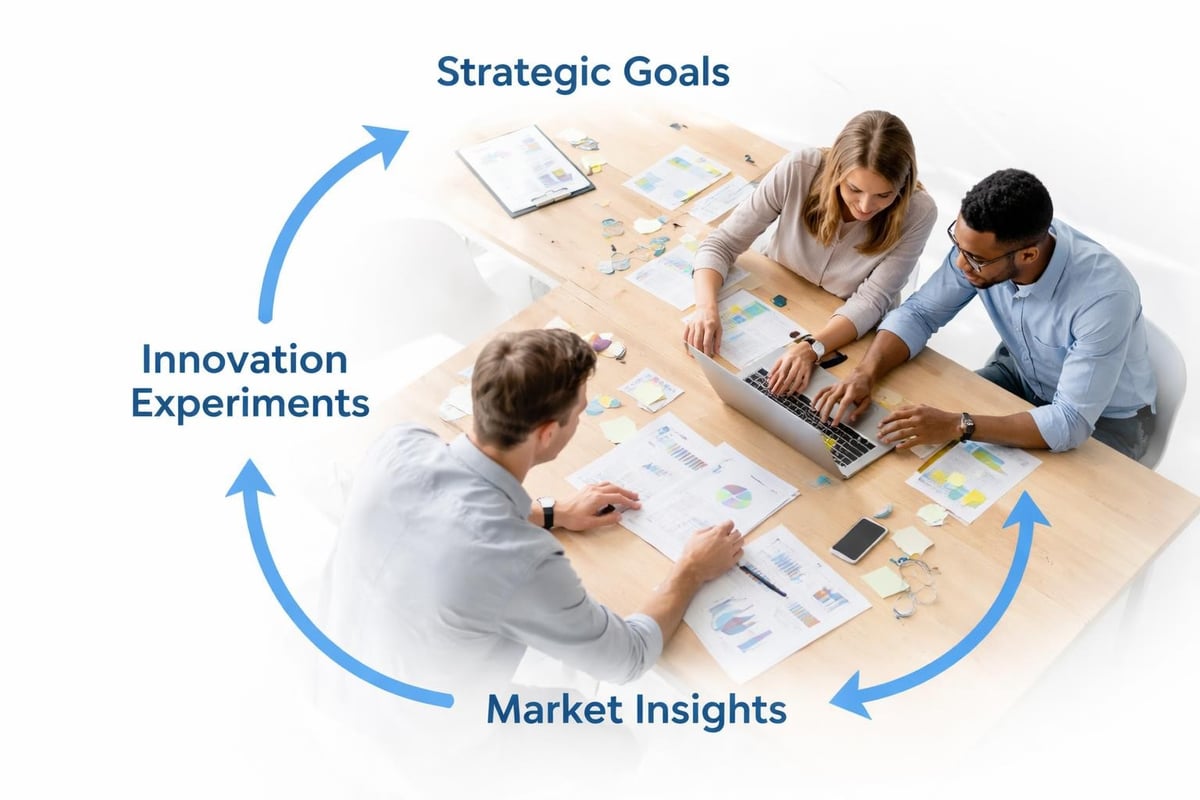
The most successful organizations treat strategic innovation as an ongoing discipline rather than a quarterly planning event. This requires establishing frameworks that enable teams to identify emerging opportunities, evaluate strategic fit, and execute with speed. Leaders must balance the discipline of strategic planning with the flexibility to adapt as new information emerges from innovation experiments and market feedback.
Building Strategic Alignment Across Innovation Initiatives
Alignment represents the critical bridge between ambitious innovation goals and executable strategic plans. Organizations struggle when innovation teams pursue interesting ideas disconnected from strategic priorities or when strategic plans ignore innovation capabilities. Effective innovation on business requires clear frameworks that connect vision to execution.
Key alignment mechanisms include:
- Strategic filters that evaluate innovation opportunities against defined growth objectives
- Portfolio management approaches balancing incremental improvements with breakthrough innovations
- Resource allocation processes linking innovation funding to strategic impact potential
- Performance metrics measuring both innovation outputs and strategic outcomes
Organizations benefit from creating innovation charters that explicitly define how innovation efforts support strategic goals. These charters establish boundaries for exploration while providing teams sufficient freedom to discover unexpected opportunities. The charter becomes a living document that evolves as strategic priorities shift and innovation capabilities mature.
Sources of Innovation Inspiration Within Strategic Context
Strategic innovation requires systematic approaches to opportunity identification. Organizations cannot rely solely on random creativity or isolated brainstorming sessions. Three strategic sources for innovation inspiration provide structured pathways: leadership alignment on growth priorities, exploration of underserved customer personas, and addressing persistent organizational or market problems.
Leadership alignment ensures innovation efforts target the most valuable opportunities. When executive teams clearly articulate growth ambitions and strategic constraints, innovation teams can focus exploration on high-impact areas. This alignment prevents wasted effort on innovations that may be technically impressive but strategically irrelevant.
Exploring New Market Opportunities
Identifying underserved personas or market segments reveals innovation opportunities with strategic significance. Many organizations focus innovation on existing customers, missing entirely new market spaces. Systematic exploration of adjacent markets, emerging customer needs, and underutilized capabilities uncovers growth paths that competitors overlook.
The process involves structured analysis rather than guesswork:
- Map the current market landscape identifying served and underserved segments
- Analyze capability gaps and strengths relative to potential opportunities
- Evaluate strategic fit against growth objectives and competitive positioning
- Prioritize opportunities based on impact potential and execution feasibility
- Design validation experiments to test assumptions before full commitment
Organizations developing innovative ideas for business growth benefit from balancing internal capability assessment with external market analysis. The intersection reveals opportunities where organizational strengths align with unmet market needs, creating strategic advantage.
Frameworks for Integration
Innovation and strategic planning integration requires deliberate frameworks that structure thinking and decision-making. Multiple methodologies exist, each offering different perspectives on connecting strategy with innovation execution. Organizations often benefit from combining elements across frameworks rather than adopting a single approach rigidly.
| Framework | Primary Focus | Strategic Benefit | Innovation Application |
|---|---|---|---|
| Blue Ocean Strategy | Uncontested market space | Differentiation through value innovation | Creating new market categories |
| Design Thinking | Customer-centered solutions | Deep needs understanding | Human-centered product development |
| Business Model Innovation | Revenue and value creation | New profit mechanisms | Transforming how value is delivered |
| AI-Powered Innovation | Technology-enabled transformation | Efficiency and insight generation | Accelerating opportunity identification |
The Blue Ocean Strategy framework particularly demonstrates how innovation and strategic planning converge. By systematically reconstructing market boundaries, organizations discover innovation opportunities that create new demand rather than competing for existing customers. This strategic approach to innovation emphasizes value innovation over technological innovation alone.
Implementing Cross-Functional Collaboration
Strategic innovation fails when confined to isolated departments. Breakthrough opportunities emerge from diverse perspectives combining market insights, technical capabilities, customer understanding, and operational realities. Cross-functional teams become essential for translating strategic intent into innovative solutions.
Effective collaboration structures include:
- Innovation councils with representation across functions reviewing strategic fit
- Project teams combining strategic planners, innovators, and operational experts
- Communities of practice sharing insights and building organizational capability
- Steering committees ensuring alignment between innovation projects and strategic priorities
Organizations must design collaboration processes that respect functional expertise while creating space for integrated thinking. This balance prevents either strategic planning becoming divorced from practical innovation realities or innovation pursuing ideas without strategic grounding.
The Role of Leadership in Driving Strategic Innovation
Leadership commitment determines whether innovation and strategic planning truly integrate or remain separate organizational activities. Leaders shape culture, allocate resources, and model behaviors that either enable or constrain strategic innovation. Their role extends beyond endorsing innovation to actively participating in connecting strategic direction with innovation execution.
Effective leaders in 2026:
- Communicate clear strategic priorities that guide innovation focus
- Protect resources for both exploitation and exploration activities
- Celebrate learning from intelligent failures alongside successful outcomes
- Challenge assumptions embedded in existing strategic plans
- Connect innovation initiatives to broader organizational purpose
Leadership’s role in fostering an innovative environment includes creating psychological safety for experimentation while maintaining accountability for strategic impact. This dual responsibility requires sophisticated judgment about when to persevere with challenging innovations and when to redirect resources toward more promising opportunities.
Building Innovation Capabilities
Sustainable competitive advantage comes from organizational capabilities rather than individual innovations. Leaders must invest in developing systems, skills, and mindsets that enable continuous strategic innovation. This capability-building approach treats innovation and strategic planning as learnable disciplines requiring deliberate practice and refinement.
Organizations benefit from structured training programs that build innovation literacy across leadership levels. These programs teach frameworks for opportunity identification, methodologies for validating assumptions, and processes for scaling successful innovations. The investment in capability development pays dividends as strategic innovation becomes embedded in organizational DNA rather than dependent on external consultants.
Balancing Planning Rigor with Innovation Flexibility
The tension between strategic planning discipline and innovation flexibility represents a central challenge. Plans provide direction and alignment but can become constraints that prevent organizations from pursuing unexpected opportunities. Innovation requires experimentation and adaptation but without strategic grounding can waste resources on interesting ideas lacking business impact.
Successful organizations implement five-step approaches to strategic planning that incorporate flexibility mechanisms:
- Define aspirational vision while acknowledging uncertainty
- Conduct rigorous environmental analysis including weak signals
- Set strategic goals with decision points for reassessment
- Establish innovation portfolios balancing certainty and experimentation
- Create feedback loops connecting innovation learning to strategic adjustment
This approach recognizes that strategic plans represent hypotheses about future value creation rather than predetermined paths. Innovation experiments test these hypotheses, generating insights that inform strategic evolution.
Managing Innovation Portfolios Strategically
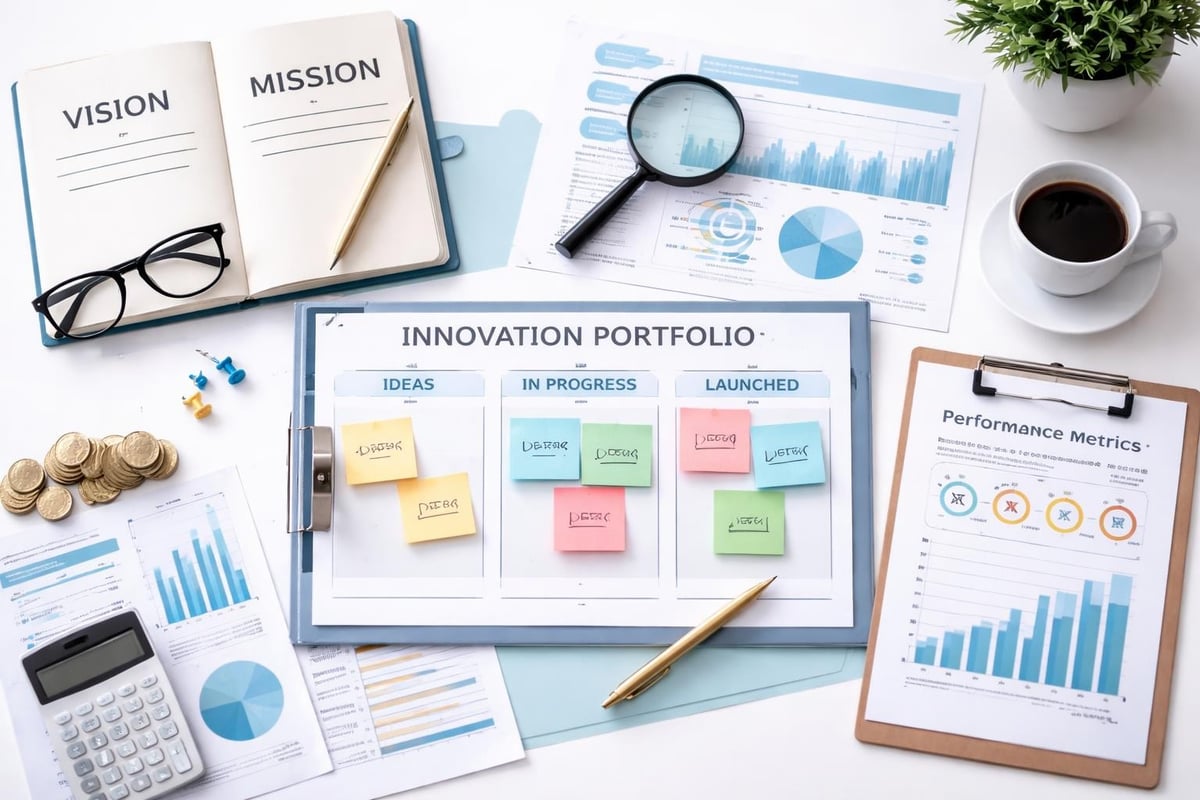
Portfolio management connects innovation and strategic planning by organizing initiatives across risk, timeline, and strategic impact dimensions. Organizations need balanced portfolios including core innovations improving existing offerings, adjacent innovations expanding into new markets or capabilities, and transformational innovations creating entirely new business models.
| Portfolio Type | Strategic Purpose | Risk Level | Time Horizon | Resource Allocation |
|---|---|---|---|---|
| Core Innovation | Operational excellence | Low | 6-18 months | 70% |
| Adjacent Innovation | Market expansion | Medium | 1-3 years | 20% |
| Transformational Innovation | Future positioning | High | 3-5+ years | 10% |
These allocations represent starting points rather than rigid formulas. Organizations adjust based on competitive dynamics, market maturity, and strategic ambitions. The key insight involves consciously managing the portfolio rather than allowing it to emerge accidentally from competing project proposals.

Measuring Strategic Innovation Performance
Performance measurement connects innovation activities to strategic outcomes, enabling leaders to assess whether innovation investments generate expected strategic value. Traditional metrics focusing exclusively on innovation outputs miss the strategic impact question. Effective measurement systems track both innovation health indicators and strategic contribution metrics.
Innovation health metrics include:
- Number of experiments launched relative to strategic priorities
- Cycle time from opportunity identification to validation
- Resource efficiency in innovation development
- Learning capture and application across initiatives
Strategic impact metrics focus on:
- Revenue contribution from innovations aligned with strategic goals
- Market share gains in targeted segments
- Capability development supporting future strategic options
- Competitive positioning improvements through differentiation
Organizations implementing business model transformation require metrics spanning financial performance, customer value creation, and organizational capability development. This balanced scorecard approach prevents optimizing for short-term financial returns while sacrificing strategic positioning.
Adapting Measurement to Innovation Maturity
Early-stage innovations require different metrics than mature offerings. Applying traditional financial metrics to exploratory innovations kills potentially valuable opportunities before they demonstrate market traction. Progressive organizations use stage-appropriate metrics that balance learning and performance expectations.
Exploration-stage innovations focus on:
- Assumption validation speed and quality
- Customer engagement intensity and feedback
- Pivot frequency and strategic relevance
- Team learning and capability building
Growth-stage innovations emphasize:
- Market traction and customer acquisition
- Unit economics and path to profitability
- Scalability potential and resource requirements
- Strategic alignment and competitive positioning
This staged approach recognizes that innovation and strategic planning operate across different time horizons, requiring measurement systems sophisticated enough to accommodate both short-term experiments and long-term strategic bets.
Overcoming Common Integration Challenges
Organizations encounter predictable obstacles when integrating innovation and strategic planning. Recognizing these challenges enables proactive mitigation rather than reactive firefighting. The most common barriers involve organizational structure, resource allocation, culture, and capability gaps.
Structural challenges emerge when innovation teams operate separately from strategic planning functions. This separation creates communication gaps, misaligned incentives, and duplicated efforts. Solutions involve creating formal linkages through shared governance, cross-functional participation, and integrated planning cycles.
Resource allocation conflicts arise when innovation initiatives compete with operational demands for limited capital and talent. Short-term operational pressures often overwhelm longer-term innovation investments unless leaders establish protected resources specifically allocated to strategic innovation. This protection ensures innovation survives quarterly performance pressures.
Cultural Barriers to Strategic Innovation
Cultural resistance represents perhaps the most difficult challenge. Organizations historically successful through operational excellence often struggle embracing the experimentation and uncertainty inherent in innovation. Creating a culture that encourages innovation requires deliberate effort to shift mindsets, behaviors, and systems.
Cultural transformation involves:
- Celebrating intelligent failures that generate strategic learning
- Rewarding collaboration across traditional functional boundaries
- Providing time and resources for exploration beyond immediate deliverables
- Modeling senior leadership engagement with innovation initiatives
- Embedding innovation language and concepts throughout strategic planning
Organizations partnering with top management consulting firms often accelerate cultural transformation through external facilitation, bringing fresh perspectives and proven methodologies that overcome internal resistance.
AI-Powered Strategic Innovation
Artificial intelligence fundamentally transforms how organizations approach innovation and strategic planning in 2026. AI capabilities enable analyzing vast datasets to identify patterns, testing strategic scenarios at unprecedented speed, and personalizing customer experiences at scale. Organizations integrating AI into strategic innovation processes gain significant competitive advantages.
AI applications in strategic innovation include:
- Opportunity identification through market signal analysis and trend detection
- Scenario planning simulating multiple strategic futures and innovation outcomes
- Customer insight generation uncovering unmet needs through behavioral analysis
- Innovation portfolio optimization balancing risk and return across initiatives
- Competitive intelligence tracking competitor moves and market shifts
The key involves treating AI as an enabler of human judgment rather than a replacement. Strategic decisions still require human wisdom, ethical considerations, and contextual understanding. AI augments these capabilities by processing information beyond human capacity and highlighting opportunities or risks that might otherwise remain invisible.
Implementing AI in Innovation Processes
Organizations adopting AI for strategic innovation benefit from systematic implementation approaches. Starting with clearly defined use cases aligned with strategic priorities prevents technology adoption for its own sake. Successful implementations focus on specific problems where AI capabilities address real limitations in current processes.
AI-powered strategic innovation requires investment in data infrastructure, analytical capabilities, and human skills to interpret and apply AI-generated insights. Organizations must also address ethical considerations around data usage, algorithmic bias, and decision transparency. These investments pay dividends as AI becomes embedded in continuous strategic innovation cycles.
Translating Strategy into Innovation Action
The bridge from strategic planning to innovation execution determines ultimate success. Organizations produce impressive strategic plans that fail to translate into tangible innovation outcomes when this translation mechanism is weak. Effective translation requires clear processes, defined roles, and accountability structures connecting strategic intent with innovation action.
Critical translation elements include:
- Strategic themes that organize innovation efforts around key growth priorities
- Innovation challenges framing specific problems or opportunities for exploration
- Resource commitment allocating budget, talent, and leadership attention
- Decision rights clarifying who approves progression through innovation stages
- Timeline expectations balancing urgency with realistic innovation development cycles
Organizations benefit from formal processes like innovation project management methodologies that structure how strategic priorities become innovation initiatives. These methodologies provide templates, governance models, and best practices that reduce ambiguity in the translation process.
Accelerating Time to Market
Speed matters in competitive markets where first-mover advantages create sustainable positions. Innovation and strategic planning integration should accelerate rather than delay market entry. Organizations achieve speed through parallel processing, staged commitments, and bias toward action over analysis paralysis.
Rapid innovation cycles involve:
- Quick assumption testing before full development commitment
- Minimum viable product launches gathering real market feedback
- Agile development methodologies enabling iterative refinement
- Cross-functional collaboration reducing handoff delays
- Strategic frameworks providing decision shortcuts
Organizations developing capabilities to launch new businesses quicker gain competitive advantages by capitalizing on market opportunities before competitors. This speed capability becomes a strategic asset itself, enabling responsiveness to emerging opportunities that slower organizations miss.
Integrating innovation and strategic planning creates sustainable competitive advantage in today's dynamic business environment, requiring deliberate frameworks, leadership commitment, and organizational capabilities that connect strategic intent with innovation execution. Organizations that master this integration discover new market opportunities, develop differentiated business models, and achieve profitable growth that purely operational excellence cannot deliver. Six Paths Consulting specializes in helping ambitious leaders build these strategic innovation capabilities through AI-powered methodologies, proven frameworks, and hands-on training that transforms how organizations identify opportunities and execute growth strategies. Partner with experts who understand both the strategic discipline and innovation creativity required for breakthrough performance.