

Organizations face unprecedented pressure to evolve, adapt, and innovate in 2026's rapidly changing business landscape. Traditional approaches to growth and market positioning no longer guarantee success. Innovation services have emerged as a critical resource for ambitious leaders seeking to navigate complexity, discover untapped opportunities, and build sustainable competitive advantages. These specialized consulting offerings combine strategic expertise, technological capabilities, and proven methodologies to transform how businesses create value and serve their customers.
Understanding the Scope of Innovation Services
Innovation services encompass a comprehensive range of consulting offerings designed to accelerate organizational growth and transformation. These services extend far beyond simple product development, addressing fundamental questions about business models, market positioning, and customer value creation.
Professional innovation consulting firms deliver structured frameworks and methodologies that guide organizations through complex change initiatives. The scope typically includes market analysis, opportunity identification, concept development, prototyping, and implementation support. Each component builds upon the others to create a cohesive innovation strategy.
Core Components of Modern Innovation Offerings
Today's innovation services integrate multiple disciplines to deliver measurable business outcomes:
- Strategic market assessment to identify white space opportunities and emerging trends
- Business model innovation that reshapes how organizations capture and deliver value
- Customer experience design focused on creating differentiated interactions
- AI-powered analytics that reveal hidden patterns and predict market shifts
- Capability building programs that develop internal innovation expertise
Organizations partnering with firms that specialize in strategy and transformation consulting gain access to proven methodologies and experienced practitioners. This combination accelerates the innovation journey while reducing execution risks.

The Evolution of Innovation Consulting in 2026
The innovation consulting landscape has transformed dramatically over the past five years. Traditional consulting models focused heavily on analysis and recommendations have given way to more collaborative, implementation-oriented approaches. Modern innovation services emphasize partnership, co-creation, and tangible results.
Artificial intelligence has become central to how innovation services deliver value. Machine learning algorithms analyze vast datasets to identify market patterns, predict customer behavior, and simulate business scenarios. This technological foundation enables faster, more informed decision-making throughout the innovation process.
| Traditional Approach | Modern Innovation Services |
|---|---|
| Analysis-heavy reports | Action-oriented roadmaps |
| Isolated projects | Integrated transformation |
| Limited technology use | AI-powered insights |
| External expertise only | Capability transfer |
| Quarterly engagements | Ongoing partnerships |
The shift toward AI-driven learning platforms reflects growing recognition that sustainable innovation requires internal capability development. Organizations must build the skills and knowledge necessary to maintain innovation momentum long after external consultants depart.
Strategic Benefits for Revenue Growth
Innovation services directly impact top-line revenue growth through multiple mechanisms. By identifying new market opportunities and developing differentiated offerings, organizations expand their addressable market and attract new customer segments.
The revenue impact manifests across several dimensions. First, innovative products and services command premium pricing, improving profit margins. Second, differentiated customer experiences increase loyalty and lifetime value. Third, new business models open previously inaccessible revenue streams.
Measuring Innovation ROI
Leading organizations track specific metrics to quantify the impact of their innovation investments:
- Revenue from new offerings launched within the past 24 months
- Market share gains in targeted segments or categories
- Customer acquisition costs compared to traditional approaches
- Time to market for new products and services
- Innovation pipeline value based on projected returns
These measurements provide concrete evidence of innovation effectiveness and justify continued investment. Organizations working with specialized firms often see accelerated returns compared to internal-only efforts. The external perspective and proven methodologies reduce trial-and-error cycles that consume time and resources.
Building Innovation Capabilities Internally
While external expertise drives initial momentum, sustainable innovation requires developing internal capabilities. Innovation services increasingly emphasize knowledge transfer and skill building alongside strategic guidance.
Training programs form a crucial component of comprehensive innovation engagements. These initiatives equip teams with frameworks, tools, and techniques they can apply independently. The goal extends beyond completing a single project to establishing permanent innovation capacity.
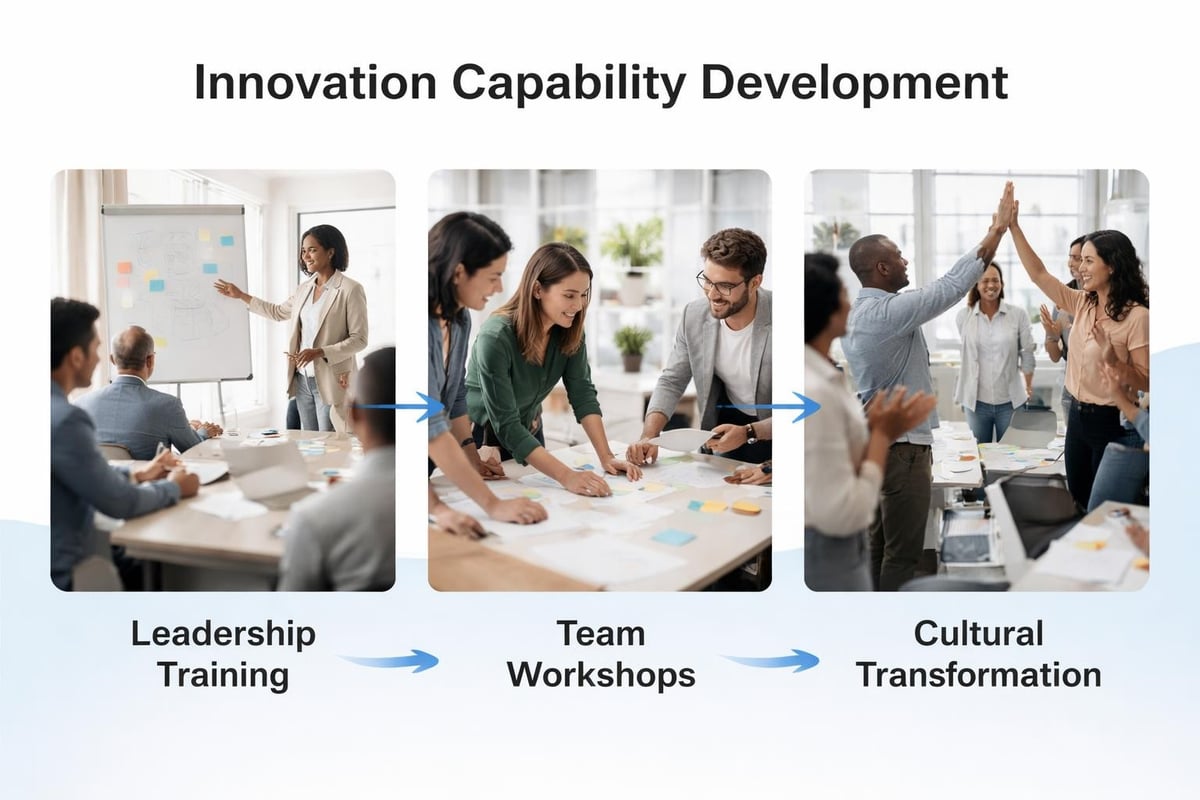
Effective capability building addresses multiple organizational levels:
- Leadership training on innovation strategy and portfolio management
- Team workshops covering design thinking, rapid prototyping, and experimentation
- Specialist development in areas like customer research, business modeling, and technology integration
- Cultural transformation initiatives that reinforce innovative behaviors and risk-taking
Organizations that invest in sales training workshops alongside innovation programs often achieve superior results. The combination ensures that innovative offerings reach the market effectively and sales teams can articulate new value propositions convincingly.
Selecting the Right Innovation Partner
Choosing an innovation consulting partner represents a critical strategic decision. The right partnership accelerates growth, while the wrong choice wastes resources and creates organizational frustration. Several factors distinguish exceptional providers from mediocre alternatives.
Experience across relevant industries provides crucial context and credibility. Consultants who understand specific sector dynamics, regulatory environments, and competitive landscapes deliver more actionable insights. They recognize which approaches translate effectively and which require adaptation.
Evaluation Criteria for Innovation Firms
| Criterion | Key Considerations |
|---|---|
| Industry Expertise | Relevant case studies, sector knowledge, regulatory understanding |
| Methodology | Structured frameworks, proven processes, adaptable approaches |
| Technology Capabilities | AI integration, analytics platforms, digital tools |
| Implementation Focus | Hands-on support, deliverable quality, results orientation |
| Capability Transfer | Training programs, knowledge sharing, skill development |
The best innovation services providers function as innovation intermediaries, bridging knowledge gaps and facilitating connections between organizations and emerging opportunities. This brokering role proves especially valuable when exploring unfamiliar markets or technologies.
Research into top innovation consulting firms reveals common characteristics among industry leaders. These include commitment to measurable outcomes, investment in proprietary tools and frameworks, and emphasis on collaborative client relationships.
Integrating AI Into Innovation Processes
Artificial intelligence has transformed how innovation services identify opportunities, develop concepts, and validate approaches. AI-powered tools analyze market data, customer feedback, and competitive intelligence at scales impossible for human analysts alone.
Machine learning algorithms excel at pattern recognition across disparate data sources. They identify correlations between seemingly unrelated factors, revealing insights that spark innovative concepts. Natural language processing extracts themes from customer conversations, reviews, and social media, highlighting unmet needs and emerging preferences.
The practical applications extend throughout the innovation lifecycle:
- Opportunity scanning using AI to monitor thousands of market signals simultaneously
- Concept testing through simulation models that predict customer adoption and revenue potential
- Prototyping assistance with generative AI tools that accelerate design iterations
- Launch optimization leveraging predictive analytics to refine timing and positioning
Organizations exploring these capabilities benefit from partnerships with specialists who understand both innovation strategy and technological implementation. The intersection of these domains creates powerful competitive advantages.
Customer-Centric Innovation Approaches
Modern innovation services prioritize customer understanding as the foundation for all strategic initiatives. Deep customer insight separates breakthrough innovations from incremental improvements that fail to generate meaningful market impact.
Effective customer research extends beyond traditional surveys and focus groups. Leading approaches include ethnographic observation, behavioral analysis, journey mapping, and predictive modeling. These techniques reveal unarticulated needs and latent opportunities that customers themselves might not recognize or express.
Value proposition design plays a central role in translating customer insights into compelling offerings. This discipline ensures that innovations address genuine customer jobs-to-be-done while delivering measurable benefits that justify switching costs or premium pricing.
Customer Research Methods in 2026
The toolkit for customer understanding has expanded significantly with technological advancement:
- Digital ethnography analyzing online behavior patterns and digital footprints
- Sentiment analysis processing vast volumes of customer feedback automatically
- Predictive modeling forecasting how different segments will respond to new offerings
- Virtual prototyping testing concepts through immersive simulations before physical development
- Continuous feedback loops gathering real-time input throughout development cycles
These methods generate richer, more actionable insights than traditional research alone. They also accelerate the innovation process by reducing dependence on slow, expensive studies.

Business Model Innovation Strategies
Product and service innovations deliver limited impact when constrained by outdated business models. The most significant value creation opportunities often emerge from reimagining how organizations generate, deliver, and capture value.
Business model innovation addresses fundamental questions about customer segments, value propositions, channels, revenue streams, and cost structures. Small adjustments to these elements can produce dramatic performance improvements and competitive differentiation.
Innovation services focused on business model transformation help organizations explore alternatives systematically. This includes analyzing successful models from adjacent industries, evaluating emerging technologies that enable new approaches, and testing hypotheses through rapid experimentation.
Business model transformation initiatives typically examine multiple dimensions simultaneously:
- Revenue model alternatives beyond traditional sales, including subscriptions, platforms, and outcome-based pricing
- Channel innovations that leverage digital technologies to reach customers more efficiently
- Partnership ecosystems that extend capabilities without corresponding capital investment
- Cost structure optimization through automation, outsourcing, or shared resources
Organizations that excel at business model innovation regularly outperform competitors focused solely on product development. The strategic leverage from business model changes often exceeds what product improvements alone can achieve.
Implementation and Execution Excellence
Even brilliant strategies fail without disciplined execution. Innovation services increasingly emphasize implementation support to bridge the gap between planning and results. This practical focus ensures that strategic insights translate into operational reality.
Execution challenges vary by organization size, industry, and innovation type. Common obstacles include resource constraints, competing priorities, organizational resistance, and capability gaps. Experienced innovation partners anticipate these barriers and develop mitigation strategies proactively.
Effective implementation requires structured project management, clear accountability, and regular progress monitoring. Leading innovation services establish governance frameworks that balance speed with risk management, ensuring rapid progress without reckless mistakes.
The success factors for innovation execution include:
- Executive sponsorship providing visible support and removing organizational barriers
- Dedicated resources committed exclusively to innovation initiatives rather than split across multiple priorities
- Agile methodologies enabling rapid iteration and course correction based on emerging learnings
- Performance metrics tracking progress against specific milestones and outcome targets
- Communication cadence keeping stakeholders informed and engaged throughout the journey
Organizations benefit from consulting partners who remain engaged through implementation, not just strategy development. This continuity ensures that strategies adapt to real-world conditions and execution challenges receive expert guidance. Resources like My Heart Studio demonstrate how digital marketing expertise supports innovation launch and customer engagement, particularly for service-based organizations.
Industry-Specific Innovation Approaches
While core innovation principles apply universally, effective implementation requires industry-specific adaptation. Regulatory requirements, competitive dynamics, customer expectations, and technology maturity vary dramatically across sectors. Innovation services deliver maximum value when they combine methodological expertise with deep industry knowledge.
Professional services firms face different innovation challenges than manufacturing companies or technology startups. Service innovation emphasizes intangible value creation, customer experience design, and delivery process optimization. Research into managing innovation in service industries provides valuable frameworks for navigating these unique considerations.
Financial services organizations must balance innovation with regulatory compliance and risk management. Healthcare innovation requires navigating complex stakeholder ecosystems and evidence requirements. Manufacturing innovation integrates digital technologies with physical production processes.
| Industry | Primary Innovation Focus | Key Challenges |
|---|---|---|
| Professional Services | Experience design, delivery models | Scalability, consistency |
| Financial Services | Digital transformation, fintech integration | Regulation, security |
| Healthcare | Clinical outcomes, patient experience | Evidence requirements, compliance |
| Manufacturing | Smart production, IoT integration | Legacy systems, capital intensity |
| Retail | Omnichannel experience, personalization | Margin pressure, competition |
Consulting firms with expertise across various industries for consulting bring valuable cross-pollination opportunities. They identify successful approaches from one sector that can be adapted to create competitive advantage in another.
Measuring and Optimizing Innovation Performance
Sustainable innovation requires rigorous performance measurement and continuous optimization. Organizations must track both leading indicators that predict future success and lagging metrics that confirm actual results. This balanced approach enables proactive adjustments before small issues become major setbacks.
Leading indicators include pipeline metrics, experimentation velocity, and capability development progress. These forward-looking measures reveal whether innovation processes are functioning effectively and generating sufficient opportunities. Lagging indicators capture revenue impact, market share changes, and profitability improvements from innovation initiatives.
Effective innovation dashboards present information at multiple organizational levels:
- Executive scorecards highlighting strategic outcomes and portfolio-level performance
- Program metrics tracking individual initiative progress against milestones and budgets
- Team dashboards showing activity levels, experiment results, and learning velocity
- Financial analytics connecting innovation investments to revenue and profit outcomes
Regular review cycles ensure that measurement drives decision-making rather than simply documenting history. Monthly or quarterly innovation reviews create opportunities to reallocate resources, terminate underperforming initiatives, and double down on promising opportunities.
Future Trends Shaping Innovation Services
The innovation consulting landscape continues evolving rapidly as technologies mature and market conditions shift. Several trends will reshape how innovation services operate and deliver value through the remainder of 2026 and beyond.
Generative AI capabilities are expanding the boundaries of what's possible in concept development, prototyping, and testing. These tools enable exploration of far more alternatives than traditional processes, improving the quality of final solutions. However, human judgment remains essential for strategic direction and evaluation.
Sustainability considerations increasingly influence innovation priorities across industries. Organizations recognize that environmental and social responsibility create competitive advantages rather than simply imposing costs. Innovation services help identify opportunities where sustainability drives differentiation and profitability simultaneously.
The democratization of innovation tools and knowledge reduces barriers to entry while raising performance expectations. Organizations can access sophisticated frameworks and technologies that were previously exclusive to large enterprises. This accessibility creates pressure for innovation services to deliver increasingly sophisticated insights and implementation support.
Platform business models continue proliferating across industries, creating new innovation imperatives. Organizations must decide whether to build proprietary platforms, participate in existing ecosystems, or maintain traditional linear value chains. These strategic choices require careful analysis of competitive positioning, capability requirements, and long-term sustainability.
Creating Organizational Innovation Culture
Technology and strategy matter, but culture ultimately determines innovation success. Organizations with strong innovation cultures generate superior ideas, move faster from concept to market, and sustain innovation momentum across economic cycles. Innovation services increasingly address cultural transformation alongside strategic and technical dimensions.
Cultural change begins with leadership behavior and reinforcement systems. Leaders must model curiosity, experimentation, and constructive failure analysis. Reward structures should recognize innovation contributions, not just execution of established processes. Communication should celebrate learning from experiments regardless of outcome.
Practical steps for building innovation culture include:
- Establishing protected time for exploration and learning activities
- Creating cross-functional teams that bring diverse perspectives to challenges
- Implementing rapid experimentation processes that test ideas quickly and inexpensively
- Sharing failure stories to normalize risk-taking and learning
- Providing resources for pursuing promising opportunities that emerge organically
Organizations developing innovation capabilities benefit from structured programs that combine skill development with cultural reinforcement. Design thinking workshops provide practical frameworks while demonstrating cultural values like customer empathy and collaborative problem-solving.
The combination of strategic clarity, technological capability, and cultural support creates sustainable competitive advantage. Innovation becomes embedded in organizational DNA rather than depending on external consultants or special initiatives. This transformation represents the ultimate success metric for comprehensive innovation services.
Organizations that master innovation create sustainable competitive advantages and drive superior financial performance. Innovation services provide the expertise, methodologies, and support necessary to accelerate this journey while building internal capabilities for long-term success. Whether you're exploring new markets, developing breakthrough offerings, or transforming business models, strategic guidance makes the difference between mediocre results and exceptional outcomes. Six Paths Consulting combines AI-powered analytics with proven innovation frameworks to help ambitious leaders discover opportunities and execute transformative strategies that drive measurable revenue growth.