

Business model innovation represents one of the most powerful yet underutilized levers for driving sustainable competitive advantage in today's rapidly evolving marketplace. While companies invest heavily in product development and operational efficiency, the most significant breakthroughs often come from reimagining how value is created, delivered, and captured. This strategic approach transcends incremental improvements, instead focusing on fundamental shifts in how organizations generate revenue and serve customers. For ambitious leaders seeking transformative growth, understanding and implementing business model innovation has become essential to staying relevant in an AI-driven economy.
Understanding the Fundamentals of Business Model Innovation
Business model innovation involves fundamentally rethinking the architecture of value creation within an organization. Unlike product innovation, which focuses on what you sell, or process innovation, which optimizes how you make it, business model innovation examines the entire system of how your organization operates and generates profit.
At its core, a business model consists of several interconnected components: the value proposition offered to customers, the revenue streams generated, the cost structure required, key resources and activities, customer segments served, and the channels through which value is delivered. When organizations pursue business model innovation, they strategically reconfigure one or more of these elements to unlock new sources of competitive advantage.
The Strategic Imperative for Innovation
The urgency for business model innovation has intensified as digital transformation reshapes entire industries. Companies that once dominated their markets have found themselves displaced by competitors who reimagined the fundamental rules of value creation. Netflix transformed entertainment distribution, Uber revolutionized transportation, and companies across sectors demonstrate the power of business model innovation to disrupt established players.
Research demonstrates that business model innovation delivers superior returns compared to product or process innovation alone. Organizations that successfully innovate their business models achieve higher profit margins, stronger customer loyalty, and more defensible competitive positions. The key lies in creating value systems that competitors cannot easily replicate.

Frameworks for Driving Business Model Innovation
Strategic frameworks provide structured approaches to identifying and developing innovative business models. These tools help organizations systematically explore possibilities and assess viability before committing significant resources.
The Business Model Canvas Approach
The Business Model Canvas, developed by Alexander Osterwalder, has become the industry standard for visualizing and designing business models. This framework maps nine building blocks across a single page: customer segments, value propositions, channels, customer relationships, revenue streams, key resources, key activities, key partnerships, and cost structure. Organizations can use this tool to analyze current models and experiment with alternatives.
When applying the canvas to business model innovation, focus on challenging assumptions within each block. Ask provocative questions: What if we served an entirely different customer segment? Could we deliver value through a completely different channel? What revenue model would align better with customer preferences? These inquiries often reveal opportunities for innovation that weren't previously apparent.
Leveraging AI for Strategic Innovation
Artificial intelligence has emerged as a powerful enabler of business model innovation in 2026. AI capabilities allow organizations to personalize offerings at scale, optimize pricing dynamically, predict customer needs, and automate complex processes. These technologies fundamentally change what's possible within business models.
Organizations integrating AI into their business models can achieve capabilities that create entirely new value propositions. Predictive analytics enable subscription models that anticipate customer needs before they arise. Machine learning algorithms optimize resource allocation in ways that dramatically reduce costs. Natural language processing creates customer experiences that scale personal touch across millions of interactions.
| Innovation Type | Traditional Approach | AI-Enhanced Approach | Value Created |
|---|---|---|---|
| Pricing | Fixed or manual tiers | Dynamic optimization | 15-25% revenue increase |
| Customer Service | Human-only support | AI-augmented assistance | 60% cost reduction |
| Product Development | Linear process | Predictive insights | 40% faster time-to-market |
| Resource Allocation | Historical patterns | Real-time optimization | 30% efficiency gain |
Identifying Innovation Opportunities in Your Organization
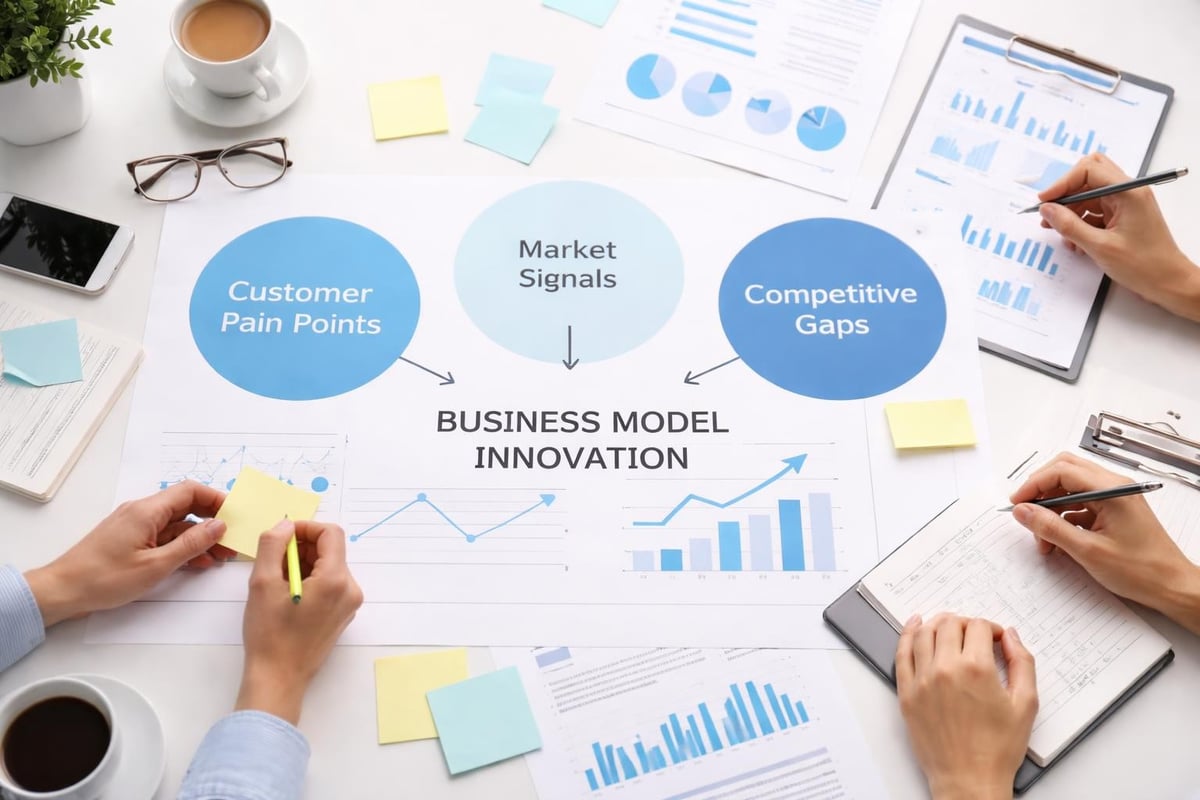
Recognizing where business model innovation can create the most value requires systematic analysis of your current model and market context. Several diagnostic approaches help pinpoint high-potential opportunities.
Start by mapping your existing business model comprehensively. Document how value flows through your organization, where revenue is generated, what resources are consumed, and how customer relationships function. This baseline understanding reveals inefficiencies, vulnerabilities, and untapped potential within your current approach.
Next, analyze customer pain points that your current model fails to address. Many breakthrough business model innovations emerge from solving problems that existing models create. Subscription models arose partly because customers wanted predictable costs instead of large upfront purchases. Platform models succeeded by reducing transaction friction between buyers and sellers.
Market Signals and Competitive Dynamics
External market forces often signal opportunities for business model innovation. Regulatory changes, technological breakthroughs, shifting customer preferences, and competitive disruptions all create openings for new approaches. Organizations monitoring these signals position themselves to act quickly when opportunities emerge.
Research on sustainable business models demonstrates how environmental and social concerns are driving innovation across industries. Companies that integrate sustainability into their core business models rather than treating it as an add-on create competitive advantages while addressing stakeholder concerns.
Competition analysis reveals gaps in the market and validates innovative approaches. When competitors cluster around similar business models, opportunities exist for differentiation through model innovation. Conversely, when a new model gains traction in your industry, understanding its mechanics becomes critical for strategic response.
Implementation Strategies for Business Model Innovation
Successfully implementing business model innovation requires different approaches than traditional product development. The systemic nature of business models means changes ripple through the entire organization, affecting operations, culture, incentives, and capabilities.
Piloting and Experimentation
Smart organizations test business model innovations through controlled experiments rather than full-scale launches. Create small-scale pilots that validate key assumptions about customer acceptance, operational feasibility, and economic viability. This approach reduces risk while generating learning that informs broader implementation.
Structure experiments to answer specific questions about your innovation:
- Will customers adopt the new value proposition at the proposed price point?
- Can operations deliver the model profitably at scale?
- Do partners and suppliers support the new approach?
- What unintended consequences emerge during implementation?
Design pilots with clear success metrics and decision criteria. Establish in advance what outcomes would justify scaling, what would require model adjustments, and what would indicate the need to pivot or abandon the approach.
Organizational Capabilities and Culture
Business model innovation often requires capabilities that don't exist in the current organization. Subscription models demand expertise in customer retention analytics. Platform models require network effect management. Freemium approaches need sophisticated conversion optimization.
Building frameworks for innovation within your organization creates the foundation for sustained business model evolution. This includes developing innovation processes, establishing governance structures, training teams, and creating incentive systems that reward experimentation and learning.
Cultural barriers frequently impede business model innovation more than technical or market challenges. Organizations optimized around existing models resist changes that threaten established power structures, performance metrics, or ways of working. Leaders must actively cultivate cultures that embrace experimentation, tolerate intelligent failure, and challenge conventional wisdom.
Industry-Specific Applications and Examples
Business model innovation manifests differently across industries, shaped by sector-specific constraints, customer behaviors, and competitive dynamics. Understanding these patterns helps organizations identify relevant approaches for their context.
Manufacturing and Physical Products
Manufacturing companies have embraced servitization, shifting from selling products to selling outcomes. Equipment manufacturers now offer "power by the hour" instead of selling engines. Chemical companies provide "chemistry management services" rather than just selling chemicals. These models align incentives around performance and efficiency while creating recurring revenue streams.
Studies on business model innovations in food supply chains reveal how companies are addressing sustainability and efficiency through model innovation. Direct-to-consumer models eliminate intermediaries, reducing costs and environmental impact. Circular economy models design for product recovery and reuse, creating value from what was previously waste.
Software and Technology Sectors
The software industry has experienced dramatic business model evolution over the past two decades. Traditional perpetual licensing gave way to subscription Software-as-a-Service models, which are now evolving toward usage-based pricing and platform ecosystems. Research on innovation initiatives in large software companies identifies patterns and challenges in implementing these transitions.
Technology companies increasingly adopt platform models that create value by facilitating interactions between multiple user groups. These models exhibit powerful network effects where value increases exponentially as more participants join, creating highly defensible competitive positions.
Professional Services Evolution
Professional services firms are innovating beyond the traditional billable hour model. Outcome-based pricing ties fees to results rather than inputs. Subscription advisory models provide ongoing access to expertise rather than project-based engagements. Mid-size management consulting firms are increasingly differentiating through innovative service delivery models.
Hybrid models combine technology platforms with human expertise, allowing firms to scale knowledge and serve clients more efficiently. AI-powered diagnostic tools, knowledge management systems, and collaboration platforms enable new service configurations that weren't economically viable under traditional models.
| Industry Sector | Traditional Model | Innovative Model | Key Benefits |
|---|---|---|---|
| Manufacturing | Product sales | Outcome-as-a-Service | Recurring revenue, deeper customer relationships |
| Software | Perpetual licenses | Usage-based pricing | Alignment with customer value, reduced barriers |
| Healthcare | Fee-for-service | Value-based care | Improved outcomes, cost efficiency |
| Education | Degree programs | Skill-based credentials | Accessibility, relevance, affordability |

Overcoming Common Implementation Challenges
Organizations pursuing business model innovation encounter predictable obstacles. Recognizing these challenges and preparing responses increases the likelihood of successful implementation.
Managing Cannibalization Concerns
Existing business lines often face potential cannibalization from innovative models. This creates resistance from teams whose performance metrics and compensation depend on legacy revenue streams. Address this through thoughtful transition planning that acknowledges concerns while maintaining innovation momentum.
Separate governance for new business models can reduce conflict. Create dedicated teams with distinct performance metrics that don't penalize cannibalizing legacy revenue. As the new model proves itself, gradually integrate it into mainstream operations with appropriately adjusted incentive structures.
Resource Allocation and Investment
Business model innovation competes with established businesses for resources and leadership attention. Legacy models generate today's cash flow, creating pressure to prioritize their optimization over uncertain innovations. Establish explicit allocation mechanisms that ensure innovation initiatives receive adequate investment regardless of short-term performance pressures.
Design thinking for strategy provides methodologies for balancing exploration and exploitation. Organizations need both, but traditional planning processes favor the latter. Build portfolio approaches that allocate resources across horizons, ensuring near-term performance doesn't starve long-term innovation.
Stakeholder Alignment and Communication
Business model innovation affects multiple stakeholders: customers, employees, partners, investors, and regulators. Each group may have concerns about proposed changes. Investors might worry about revenue disruption. Employees may fear role changes. Partners could see relationship alterations as threatening.
Proactive communication that acknowledges concerns and articulates the strategic rationale for innovation builds crucial support. Share the competitive threats driving change, the opportunities being pursued, and how stakeholders benefit from successful innovation. Transparency about risks and mitigation strategies builds credibility.
Measuring Success and Scaling Innovation
Defining appropriate success metrics for business model innovation differs from traditional product development KPIs. Early-stage metrics focus on validation and learning rather than financial performance.
Validation Metrics
Initial success indicators center on assumption testing:
- Customer validation: Are target customers willing to engage with the new model?
- Value validation: Do customers perceive sufficient value to pay the proposed price?
- Growth validation: Does the model demonstrate sustainable customer acquisition?
- Operational validation: Can the organization deliver profitably at scale?
Track these through experiments designed to provide clear evidence for or against key hypotheses. Use techniques like minimum viable products, landing page tests, and pilot programs to gather data efficiently before committing to full-scale implementation.
Scaling Indicators
As innovations prove viable, metrics shift toward scalability and financial performance. Monitor unit economics closely: customer acquisition cost, lifetime value, contribution margin, and payback period. These indicators reveal whether the model can scale profitably.
Network effects, switching costs, and brand strength determine long-term defensibility. Track metrics that indicate whether your innovation creates sustainable advantages: user engagement depth, retention rates, ecosystem participation, and competitive differentiation measures.
Enabling Continuous Business Model Evolution
Leading organizations view business model innovation not as a one-time event but as an ongoing capability. Building systems for continuous evolution creates resilience and sustained competitive advantage.
Establish scanning mechanisms that monitor emerging business models in adjacent industries. Often, innovations that prove successful in one sector can be adapted to others. Financial services learned from media streaming, manufacturing borrowed from software subscriptions, and healthcare adapted retail convenience models.
Business frameworks provide structure for ongoing innovation initiatives. Regular business model reviews, innovation pipeline management, and capability development programs institutionalize evolution. These practices ensure innovation remains central to strategy rather than becoming an occasional special project.
Create learning loops that capture insights from experiments, implementations, and market feedback. Document what works, what doesn't, and why. This organizational knowledge compounds over time, accelerating future innovation cycles and improving success rates.
The methodology for model-driven business innovation demonstrates how systematic approaches enable non-technical stakeholders to participate in innovation processes. Democratizing innovation beyond specialized teams builds broader organizational capability and engagement.
Business model innovation represents the highest-leverage approach to creating sustainable competitive advantage and driving transformative growth in today's dynamic marketplace. The organizations that master this capability position themselves to thrive regardless of how markets, technologies, and customer preferences evolve. Six Paths Consulting helps ambitious leaders discover new market opportunities and develop innovative business models through AI-powered strategic innovation, combining expert guidance with practical frameworks that build lasting innovation capabilities within your organization.