

The landscape of business services and consulting has undergone a radical transformation in recent years, evolving from traditional advisory models to sophisticated, technology-driven partnerships that fundamentally reshape how organizations compete and grow. As companies face unprecedented market volatility, technological disruption, and shifting customer expectations, the role of strategic consulting has never been more critical. Today's consulting engagements go far beyond implementing best practices-they focus on discovering entirely new value propositions, developing innovative business models, and building internal capabilities that sustain competitive advantage long after consultants leave the building.
The Evolution of Business Services and Consulting
The consulting industry has matured dramatically since its early days of efficiency studies and process optimization. Modern business services and consulting firms now serve as strategic partners in innovation, helping organizations navigate complex transformations that span technology, operations, customer experience, and business model design.
According to projections, the technology consulting market is expected to surpass $400 billion in global revenue in 2026, driven by accelerating demand for digital transformation, AI integration, and strategic innovation capabilities. This growth reflects a fundamental shift in how businesses view consulting partnerships-not as occasional interventions, but as ongoing relationships that fuel continuous adaptation and growth.
Three key factors distinguish modern consulting:
- Integration of artificial intelligence and advanced analytics into strategic planning
- Focus on building internal innovation capabilities rather than creating dependency
- Emphasis on measurable outcomes tied directly to revenue growth and profitability
The transition from traditional advisory services to innovation-focused partnerships represents more than a change in methodology. It reflects a recognition that competitive advantage in 2026 comes not from executing existing strategies more efficiently, but from discovering entirely new ways to create and capture value.
Core Components of Strategic Business Services
Understanding the full spectrum of business services and consulting requires examining the distinct yet interconnected components that drive organizational transformation. Each element plays a specific role in helping companies achieve sustainable growth.
Strategy Development and Market Analysis
Strategic consulting begins with deep market analysis and opportunity identification. Rather than simply analyzing current market position, innovation consulting explores uncontested market spaces where companies can create new demand and escape competitive battles based solely on price.
This approach draws from frameworks that systematically examine industry boundaries, strategic groups, buyer chains, complementary offerings, functional-emotional appeals, and time-based trends. The goal is identifying where value innovation can occur-simultaneous pursuit of differentiation and low cost that makes competition irrelevant.
| Strategic Component | Traditional Approach | Innovation Approach |
|---|---|---|
| Market Analysis | Competitive positioning | Blue ocean identification |
| Value Creation | Incremental improvements | Radical value innovation |
| Customer Focus | Existing segments | Non-customers and new segments |
| Timeframe | Annual planning cycles | Continuous discovery |
Business Model Innovation
The most transformative consulting engagements focus on business model innovation rather than product or service improvements alone. A superior business model can create more defensible competitive advantages than any single product feature.
Key business model innovation areas include:
- Revenue model transformation (subscription, usage-based, outcome-based pricing)
- Value chain reconfiguration to eliminate cost while increasing value
- Customer relationship redesign for deeper engagement and lifetime value
- Strategic partnership development to access new capabilities and markets
Business model innovation requires systematic exploration of alternative configurations, rigorous testing of assumptions, and willingness to cannibalize existing revenue streams in pursuit of larger opportunities. The most successful consulting engagements help leadership teams overcome organizational resistance to business model change.
Operational Excellence and Capability Building
While strategy and innovation capture attention, operational excellence remains foundational to business services and consulting impact. However, modern operational consulting differs significantly from traditional process improvement.
Today's approach emphasizes building internal capabilities that enable organizations to continuously improve and innovate independently. Rather than implementing solutions that require ongoing consultant involvement, effective consulting transforms organizations to innovate independently.
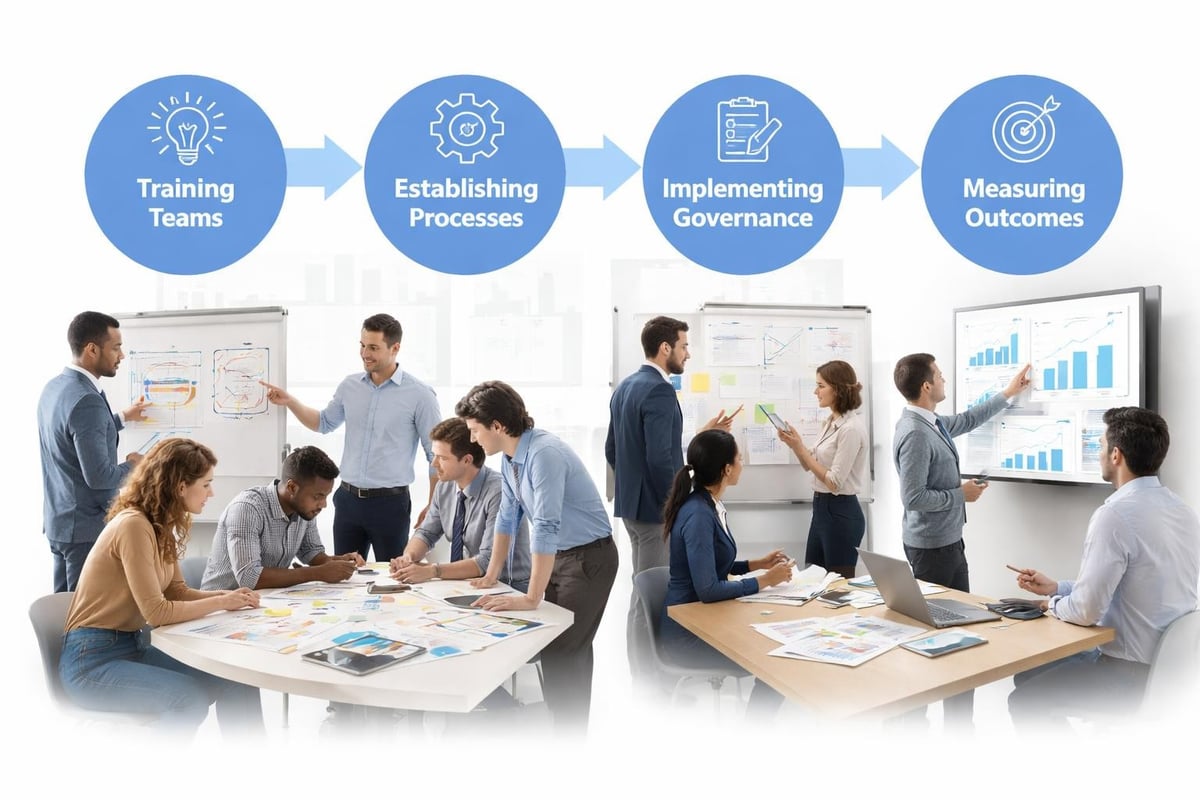
This capability-building focus includes:
- Training teams in innovation methodologies and strategic frameworks
- Establishing innovation processes and governance structures
- Creating measurement systems that track both efficiency and innovation metrics
- Developing leadership skills specific to managing innovation and transformation
Technology Integration and AI-Powered Consulting
The integration of artificial intelligence into business services and consulting represents one of the most significant developments in the field. AI technologies enable analysis, pattern recognition, and scenario planning at scales previously impossible, while also creating entirely new service categories and business models.
AI Applications in Strategic Innovation
Modern consulting firms leverage AI across multiple dimensions of their engagements. AI consulting companies apply machine learning algorithms to identify market patterns, customer behavior trends, and competitive dynamics that human analysts might miss.
Specific AI applications include:
- Predictive analytics for market opportunity assessment
- Natural language processing to analyze customer feedback at scale
- Generative AI for rapid prototyping of value propositions and messaging
- Machine learning models to optimize pricing, resource allocation, and customer targeting
The power of AI-powered consulting lies not in replacing human judgment but in augmenting it-processing vast data sets to surface insights, testing hypotheses rapidly, and simulating strategic scenarios before committing resources.
Digital Transformation Consulting
Digital transformation has evolved from a buzzword to a fundamental requirement for competitive survival. However, successful digital transformation requires more than technology implementation-it demands rethinking entire operating models, customer experiences, and value creation mechanisms.
Effective digital transformation consulting addresses three interdependent dimensions:
- Technology infrastructure: Cloud architecture, data platforms, integration systems, and security frameworks
- Process redesign: Reimagining workflows to leverage digital capabilities fully
- Cultural transformation: Developing digital mindsets, skills, and ways of working across the organization
Research indicates that business consulting services focused on digital transformation represent one of the fastest-growing segments within the industry, reflecting the critical importance organizations place on digital capabilities.
Revenue Growth and Profitability Focus
While many consulting engagements focus on operational efficiency or risk management, the most valuable business services and consulting partnerships drive measurable revenue growth and profitability improvement. This outcome orientation distinguishes transformative consulting from merely advisory relationships.
Growth Strategy Development
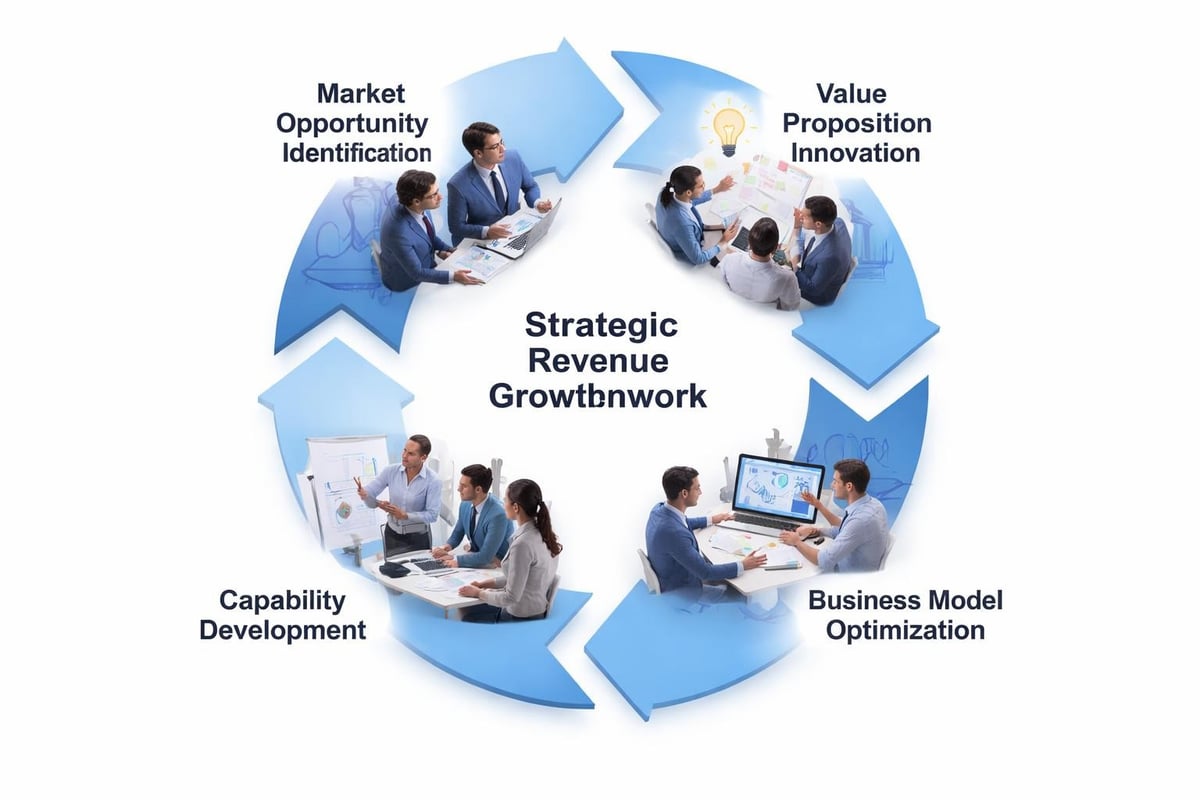
Revenue consulting systematically identifies and captures growth opportunities through multiple levers: market expansion, customer value optimization, pricing strategy, and new offering development. Rather than pursuing growth through acquisition or market share battles, innovative approaches focus on creating new demand in uncontested market spaces.
This growth strategy methodology involves:
- Systematic analysis of where value innovation opportunities exist
- Development of offerings that attract non-customers and underserved segments
- Design of business models that capture value while delivering exceptional customer outcomes
- Creation of barriers to imitation through strategic positioning and capability building
Product and Service Innovation
Product and service innovation remains central to business services and consulting focused on growth. However, effective innovation consulting goes beyond brainstorming sessions or design thinking workshops-it implements systematic processes for discovering customer needs, developing solutions, and bringing them to market rapidly.
| Innovation Stage | Key Activities | Consulting Support |
|---|---|---|
| Discovery | Customer research, trend analysis, opportunity identification | Frameworks, research methods, insight synthesis |
| Development | Concept design, prototyping, business case creation | Design facilitation, financial modeling, risk assessment |
| Launch | Go-to-market strategy, channel development, pricing | Market strategy, sales enablement, launch planning |
| Scale | Performance tracking, optimization, expansion | Metrics design, continuous improvement, scaling strategy |
The most effective consulting engagements establish innovation as an ongoing capability rather than a one-time project, ensuring organizations can sustain growth momentum independently.
Industry-Specific Consulting Approaches
While foundational consulting principles apply across sectors, effective business services and consulting requires deep industry expertise to navigate sector-specific dynamics, regulations, and competitive realities. Understanding these nuances separates generic advice from truly transformative guidance.
Financial Services Innovation
Financial services firms face unique challenges balancing innovation with regulatory compliance, risk management, and customer trust. Consulting engagements in this sector focus on developing new service models, leveraging fintech partnerships, and building innovation capabilities within conservative organizational cultures.
Successful financial services consulting addresses digital transformation, customer experience redesign, and business model innovation while maintaining rigorous risk controls and regulatory compliance. This requires consultants who understand both innovation methodologies and financial services regulations.
Manufacturing and Industrial Services
Manufacturing firms increasingly seek business services and consulting support for transforming from product-centric to service-oriented business models. This shift, often called servitization, requires fundamental changes in operations, sales approaches, and customer relationships.
Channel innovation for manufacturers represents a particularly valuable consulting focus, helping industrial companies reach new customer segments, reduce distribution costs, and create recurring revenue streams through service contracts and subscription models.
Professional Services Firms
Even professional services firms themselves benefit from specialized consulting focused on their unique challenges. Firms like Accountability Now, which provides business coaching and consulting services, demonstrate how specialized expertise in sales, operations, and accountability systems can transform service delivery and client outcomes.
The professional services sector particularly benefits from consulting that addresses differentiation, value-based pricing, service productization, and client engagement models that move beyond billable hours to outcome-based relationships.
Selecting and Working with Consulting Partners
The effectiveness of business services and consulting engagements depends significantly on selecting the right partners and structuring productive working relationships. Not all consulting firms deliver equivalent value, and fit matters enormously.
Evaluation Criteria for Consulting Firms
When evaluating potential consulting partners, organizations should assess multiple dimensions beyond brand recognition and pricing. Statistics on the business consulting industry reveal significant variation in outcomes, with some engagements delivering substantial return on investment while others fail to produce meaningful change.
Critical evaluation factors include:
- Relevant industry experience: Demonstrated success in your sector with comparable challenges
- Methodology and frameworks: Systematic approaches rather than generic advice
- Capability building focus: Emphasis on knowledge transfer and internal skill development
- Outcome orientation: Willingness to tie fees to measurable business results
- Cultural fit: Compatibility with your organization's values and working style
Research into leading management consulting firms can provide benchmarks for evaluating potential partners, though the largest firms aren't always the best fit for every organization's needs.
Structuring Effective Engagements
The structure of consulting engagements significantly impacts their success. Traditional models often create misaligned incentives, with consultants benefiting from extended timelines while clients seek rapid transformation.
Alternative engagement models include:
- Outcome-based pricing: Linking fees to achievement of specific business metrics
- Capability transfer agreements: Focusing deliverables on knowledge transfer and skill building
- Phased approaches: Starting with discovery and strategy before committing to implementation
- Hybrid models: Combining consulting expertise with training and coaching for sustainability
The most successful business services and consulting relationships involve genuine partnership, with consultants and client teams working collaboratively rather than consultants developing recommendations in isolation.
Building Internal Innovation Capabilities
While external consulting provides valuable expertise and perspectives, sustainable competitive advantage requires building robust internal innovation capabilities. The goal of transformative consulting should be making itself unnecessary by empowering organizations to innovate independently.
Training and Development Programs
Innovation training programs equip teams with frameworks, tools, and mindsets necessary for continuous innovation. Effective training goes beyond theoretical knowledge to include practical application, coaching, and reinforcement over time.
Key training components include:
- Strategic frameworks for opportunity identification and value innovation
- Design thinking methodologies for customer-centered solution development
- Business model design and financial modeling skills
- Change management capabilities to overcome organizational resistance
- Leadership development specific to innovation contexts
Organizations that invest in building these internal capabilities reduce dependence on external consultants while accelerating their innovation cycles and responsiveness to market changes.
Establishing Innovation Processes and Governance
Beyond individual skills, sustainable innovation requires organizational processes and governance structures that enable systematic opportunity identification, evaluation, development, and scaling. Business services and consulting engagements should help establish these systems, not just execute individual projects.
Critical process elements include:
- Regular opportunity scanning and trend analysis routines
- Stage-gate processes for evaluating and advancing innovation initiatives
- Resource allocation mechanisms that balance core business and innovation investments
- Metrics and dashboards that track both innovation activities and business outcomes
- Learning systems that capture insights from both successes and failures
Measuring Consulting Impact and ROI
The value of business services and consulting ultimately comes down to measurable business impact. While some benefits, like capability building and cultural transformation, may take time to materialize, effective consulting should produce clear, quantifiable results.
Key Performance Indicators
Appropriate metrics for consulting engagements vary based on objectives, but should always connect to fundamental business outcomes rather than activity measures.
| Objective Category | Example Metrics | Measurement Approach |
|---|---|---|
| Revenue Growth | New revenue from innovations, market share gains, customer lifetime value | Tracked quarterly against baseline |
| Profitability | Margin improvement, cost reduction, pricing optimization impact | Financial statement analysis |
| Innovation Capability | Ideas generated, projects launched, time-to-market reduction | Innovation pipeline tracking |
| Market Position | Brand perception, competitive differentiation, customer satisfaction | Surveys and market research |
Establishing clear success metrics at engagement outset ensures alignment between consulting teams and clients on priorities and enables objective evaluation of outcomes.
Long-Term Value Creation
The most valuable consulting relationships create lasting organizational capabilities and competitive advantages that continue generating returns long after engagements end. This sustainability distinguishes transformative consulting from temporary fixes or recommendations that gather dust.
Long-term value indicators include:
- Sustained innovation output without ongoing consultant involvement
- Internal teams successfully applying frameworks and methodologies independently
- Cultural shifts toward experimentation, customer focus, and continuous improvement
- Organizational structures and processes that enable ongoing adaptation
- Leadership capabilities for managing innovation and transformation
Organizations should evaluate potential consulting partners partly on their commitment to sustainable value creation rather than creating consultant dependency.
Current Trends Reshaping Business Consulting
The business services and consulting industry continues evolving rapidly in response to technological advances, changing client expectations, and market dynamics. Understanding these trends helps organizations select partners positioned for future relevance.
Specialization and Niche Expertise
While traditional firms like McKinsey & Company and EY-Parthenon maintain broad service portfolios, the industry increasingly values deep specialization in specific domains, industries, or methodologies. Clients recognize that specialized expertise often delivers more value than generalist approaches.
This specialization trend manifests in consulting firms focusing on specific capabilities like market strategy consulting, particular industries, or distinctive methodologies that differentiate their approaches from competitors.
Integration of Advisory and Implementation
The boundary between strategy consulting and implementation has blurred, with clients increasingly demanding end-to-end support rather than recommendations without execution assistance. This integration ensures strategies are practical and actually get implemented rather than remaining theoretical.
Modern business services and consulting often includes:
- Strategy development and business model design
- Detailed implementation planning and roadmapping
- Change management and organizational transformation support
- Technology selection and integration assistance
- Training and capability building throughout the process
Transparency and Value Accountability
Partly in response to criticisms documented in works like “The Big Con”, which examines the consulting industry's impact on businesses and governments, leading firms increasingly emphasize transparency, clear value delivery, and accountability for outcomes.
This shift includes more outcome-based pricing models, clearer documentation of methodologies and assumptions, and willingness to tie consulting fees to measurable business results rather than time-and-materials billing alone.
Framework-Based Innovation Approaches
Systematic frameworks distinguish professional consulting from ad-hoc advice, providing repeatable methodologies that increase success rates and enable knowledge transfer to client teams. The most effective business services and consulting firms leverage proven frameworks for innovation while adapting them to specific client contexts.
Strategic Canvas and Value Curve Analysis
Strategic frameworks help organizations visualize competitive dynamics and identify where value innovation opportunities exist. The strategic canvas, for example, maps how industry players compete across key factors, revealing where entire industries converge on similar value propositions and where opportunities for differentiation exist.
This analytical approach enables companies to:
- Identify factors to eliminate, reduce, raise, or create relative to industry norms
- Visualize fundamentally different value curves that escape competitive convergence
- Test strategic hypotheses before committing significant resources
- Communicate strategic direction clearly across the organization
Four Actions Framework
Complementing strategic analysis, the Four Actions Framework provides a structured approach to business model reconstruction by challenging industry assumptions about value delivery.
The framework asks four critical questions:
- Which factors the industry takes for granted should be eliminated?
- Which factors should be reduced well below the industry standard?
- Which factors should be raised well above the industry standard?
- Which factors should be created that the industry has never offered?
Answering these questions systematically generates innovative value propositions that simultaneously reduce costs and increase buyer value-the essence of value innovation.
Implementation and Scaling Methodologies
Beyond strategy formulation, effective business services and consulting must address implementation realities. Frameworks that guide new business development help organizations move from concepts to market-ready offerings efficiently.
These implementation frameworks typically include:
- Rapid prototyping and minimum viable product development
- Staged rollout strategies that manage risk while gathering market feedback
- Resource allocation models that balance innovation and core business needs
- Performance tracking systems that enable rapid iteration and improvement
Business services and consulting have evolved into strategic partnerships essential for navigating today's complex, rapidly changing markets. Organizations that leverage specialized expertise, build internal capabilities, and commit to continuous innovation position themselves for sustainable competitive advantage. Six Paths Consulting specializes in AI-powered strategic innovation that drives measurable revenue growth, helping ambitious leaders discover new market opportunities and develop the capabilities to innovate independently for lasting success.