
The landscape of business strategy consulting companies has evolved dramatically over the past few years, driven by technological advancement, AI integration, and rapidly changing market conditions. Organizations today face unprecedented complexity in navigating digital transformation, competitive disruption, and revenue optimization challenges. As the global tech consulting market is projected to surpass $400 billion in revenue in 2026, understanding how to select and work with the right strategic partners has become essential for ambitious leaders. These firms serve as catalysts for innovation, helping businesses discover untapped opportunities and develop sustainable competitive advantages through data-driven insights and proven methodologies.
What Business Strategy Consulting Companies Actually Do
Business strategy consulting companies provide specialized expertise to help organizations solve complex challenges and capitalize on growth opportunities. These firms operate at the intersection of strategic thinking, industry knowledge, and analytical rigor.
Core Services and Deliverables
The fundamental work of business strategy consulting companies centers on several key areas. Strategic planning forms the foundation, where consultants help leadership teams define long-term vision, mission, and actionable roadmaps. Market analysis and competitive intelligence enable companies to understand their position relative to competitors and identify white space opportunities.
Primary service categories include:
- Market entry and expansion strategies
- Organizational restructuring and efficiency optimization
- Merger and acquisition advisory
- Digital transformation roadmapping
- Innovation capability building
- Revenue growth acceleration
Beyond traditional advisory, modern business strategy consulting companies increasingly focus on building internal innovation capabilities to ensure sustainable success. This approach emphasizes knowledge transfer rather than creating dependency, empowering organizations to continue strategic work independently after the engagement concludes.
The AI-Powered Transformation
Artificial intelligence has fundamentally reshaped how business strategy consulting companies operate in 2026. Advanced analytics platforms now process market data at unprecedented scale, identifying patterns and opportunities that human analysis alone might miss. Machine learning algorithms predict customer behavior, optimize pricing strategies, and forecast market trends with remarkable accuracy.
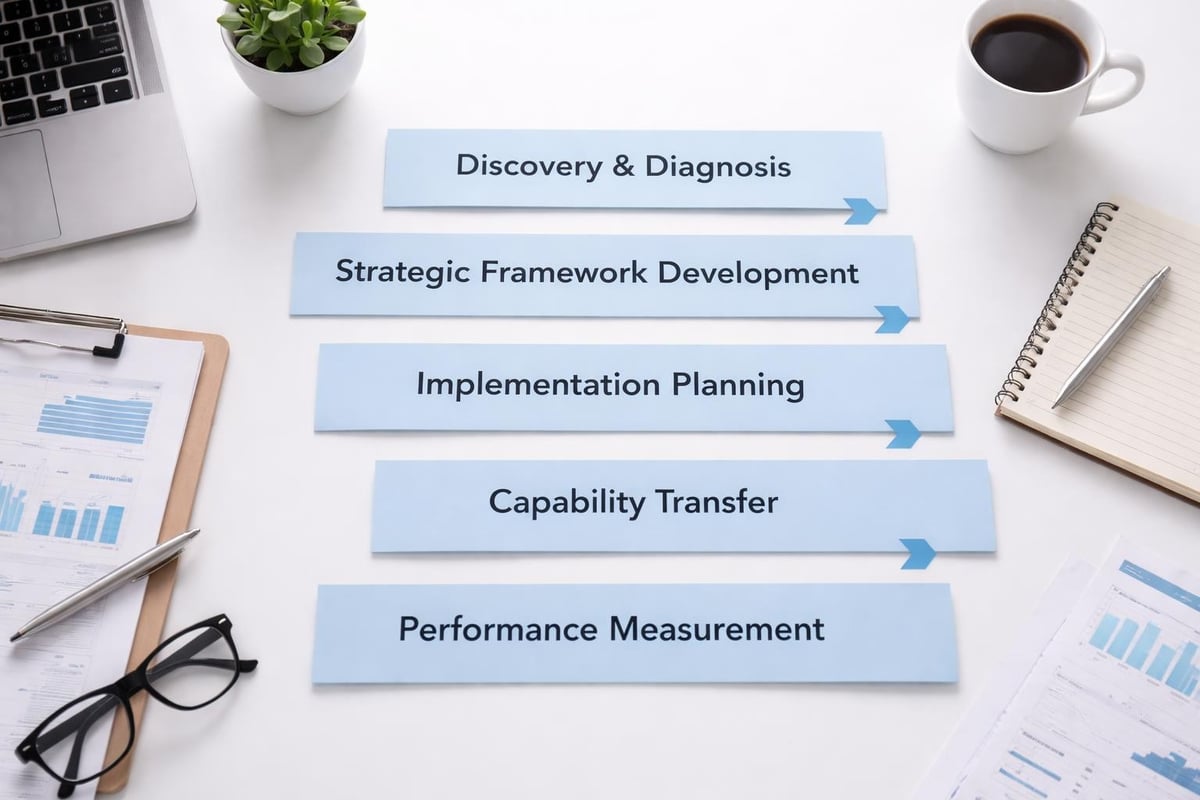
Leading firms integrate AI throughout their methodology, from initial discovery to implementation tracking. This technological leverage allows consultants to focus on higher-value strategic thinking while automation handles data processing and routine analysis. Organizations partnering with top AI consulting companies gain access to proprietary tools and frameworks that combine human expertise with computational power.
Selecting the Right Strategic Partner
Choosing among business strategy consulting companies requires careful evaluation of multiple factors beyond reputation and brand recognition. The best fit depends on your organization's specific challenges, industry context, and growth objectives.
Key Selection Criteria
Firm expertise and specialization matter significantly. Some consultancies focus on specific industries like technology, healthcare, or financial services, while others maintain broad sectoral coverage. Specialized firms bring deep domain knowledge and established relationships, while generalist firms offer cross-industry perspective and fresh thinking.
Consider these evaluation dimensions:
- Track record and case studies – Request specific examples of similar challenges solved
- Methodology and frameworks – Understand their strategic approach and tools
- Team composition – Assess the experience level of consultants assigned to your project
- Implementation support – Determine whether they help execute recommendations or just advise
- Cultural alignment – Ensure their working style matches your organizational culture
- Pricing structure – Compare fixed-fee, hourly, and value-based pricing models
| Evaluation Factor | Questions to Ask | Red Flags |
|---|---|---|
| Experience | How many similar projects completed? | Vague answers, no specific metrics |
| Approach | What frameworks will you use? | One-size-fits-all methodology |
| Team | Who will lead the engagement? | Junior staff doing most work |
| Outcomes | What results can we expect? | No measurable objectives |
The fundamentals of strategy consulting emphasize the importance of collaborative partnership rather than dictated solutions. The right firm should challenge your assumptions while respecting your organizational knowledge and context.
Innovation-Driven Strategic Approaches
Business strategy consulting companies increasingly recognize that competitive advantage stems from continuous innovation rather than static positioning. This shift reflects market realities where disruption comes from unexpected sources and customer preferences evolve rapidly.
Discovering New Market Opportunities
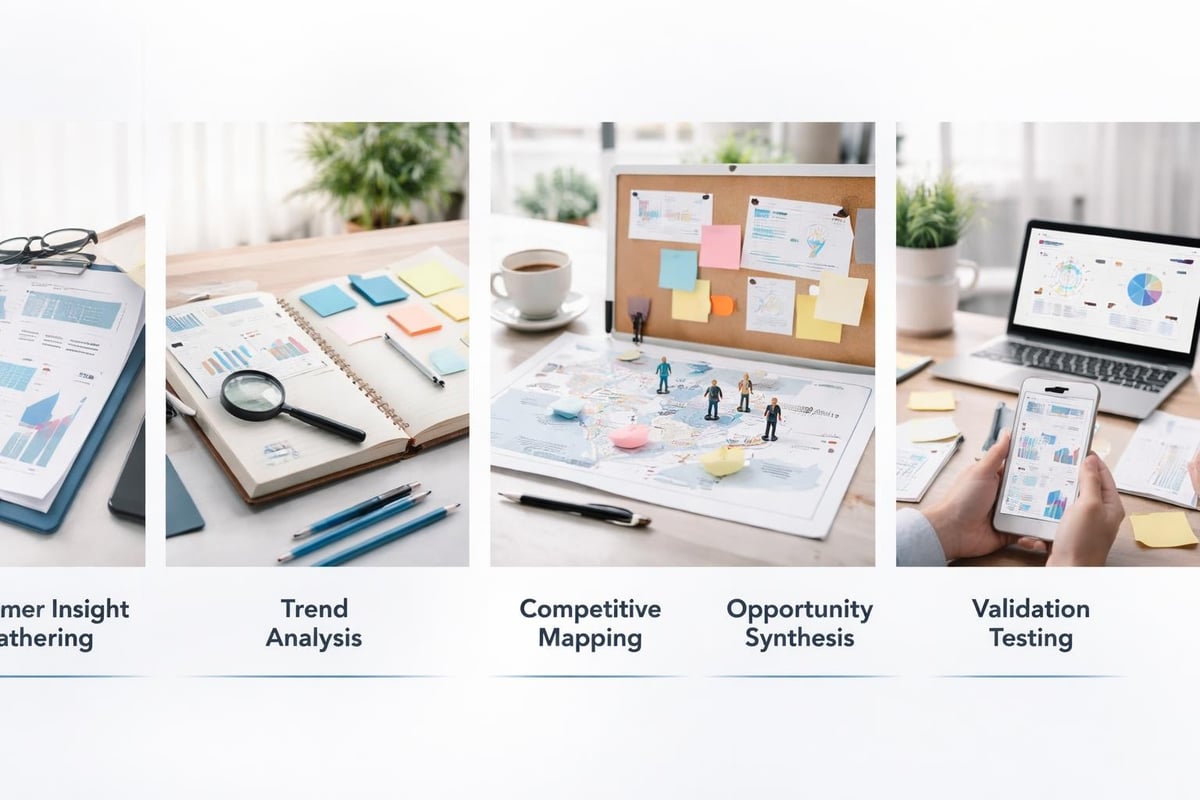
Identifying untapped market spaces requires systematic exploration of customer needs, competitive gaps, and emerging trends. Advanced firms employ methodologies like business model transformation to reimagine value creation rather than incrementally improving existing approaches.
Opportunity discovery techniques include:
- Jobs-to-be-done analysis revealing unmet customer needs
- Blue ocean strategy identifying uncontested market space
- Scenario planning exploring future market conditions
- Design thinking uncovering latent customer desires
- Competitive gap analysis finding underserved segments
The process combines qualitative insights from customer interviews with quantitative market data. Successful firms don't simply present opportunities but help organizations develop the capabilities needed to pursue them effectively. This often involves building innovation frameworks that become permanent organizational assets.
Revenue Growth and Profitability Focus
While many consultancies discuss growth abstractly, the most effective business strategy consulting companies maintain laser focus on measurable revenue impact and profitability improvement. This results-oriented approach ensures strategic recommendations translate into financial performance.
Revenue growth strategies encompass multiple levers:
- Customer acquisition optimization – Improving marketing efficiency and sales conversion
- Customer lifetime value expansion – Increasing retention, upsell, and cross-sell
- Pricing strategy refinement – Capturing more value through strategic pricing
- Product portfolio optimization – Focusing resources on highest-return offerings
- Market expansion – Entering new geographies or customer segments
Best practices in strategy consulting implementation emphasize the importance of establishing clear metrics and accountability mechanisms from the engagement's inception. Without measurable objectives, strategic work becomes theoretical rather than transformational.
Building Internal Strategic Capabilities
Progressive business strategy consulting companies recognize that creating dependency undermines long-term client success. Instead, leading firms prioritize capability transfer, ensuring organizations can continue strategic work independently after the engagement concludes.
Training and Knowledge Transfer
Capability building transforms how organizations approach strategy on an ongoing basis. Rather than outsourcing strategic thinking permanently, companies develop internal expertise through structured learning programs and hands-on application.
Effective training programs combine multiple learning modalities. Classroom-style workshops establish foundational knowledge of strategic frameworks and methodologies. Facilitated working sessions allow teams to apply concepts to real business challenges under expert guidance. Coaching provides individualized support as internal strategists develop confidence and competence.
| Capability Area | Training Approach | Expected Outcome |
|---|---|---|
| Strategic analysis | Framework workshops + practice | Independent market assessment |
| Innovation methods | Design thinking sessions | New product ideation capability |
| Business modeling | Canvas exercises + iteration | Business model design skills |
| Implementation planning | Project management training | Execution excellence |
Sales training workshops represent one example of specialized capability building, equipping teams with skills to execute go-to-market strategies developed during strategic planning. This integrated approach ensures strategy and execution capabilities develop in parallel.
Sustainable Competitive Advantage
The strategy consulting market continues experiencing significant growth precisely because organizations recognize that competitive advantage requires continuous strategic renewal. Business strategy consulting companies that focus on capability transfer help clients build this renewal capacity internally.
Sustainable advantage comes from developing organizational competencies in:
- Systematic opportunity identification and evaluation
- Rapid strategic experimentation and learning
- Cross-functional collaboration on strategic initiatives
- Data-driven decision making and performance tracking
- Adaptive strategy updating based on market feedback
These capabilities enable organizations to respond quickly to market changes without requiring external consultants for every strategic decision. The consulting relationship evolves from tactical problem-solving to strategic partnership, with consultants providing fresh perspective and specialized expertise on complex challenges while internal teams handle routine strategic work.
The Future of Strategic Consulting
Business strategy consulting companies continue evolving in response to technological advancement, changing client expectations, and competitive pressures. Understanding emerging trends helps organizations anticipate how strategic partnerships will develop over the coming years.
Emerging Trends and Methodologies
Several significant shifts are reshaping the consulting landscape in 2026. First, the integration of AI and advanced analytics has moved from experimental to standard practice. Firms that fail to leverage these technologies find themselves at competitive disadvantage as clients expect data-driven insights and predictive modeling as baseline deliverables.
Second, the focus has shifted from purely advisory work to implementation support and results accountability. Clients increasingly demand consultants who stay engaged through execution, helping navigate the messy reality of organizational change. This trend reflects dissatisfaction with beautiful strategy documents that gather dust rather than driving transformation.
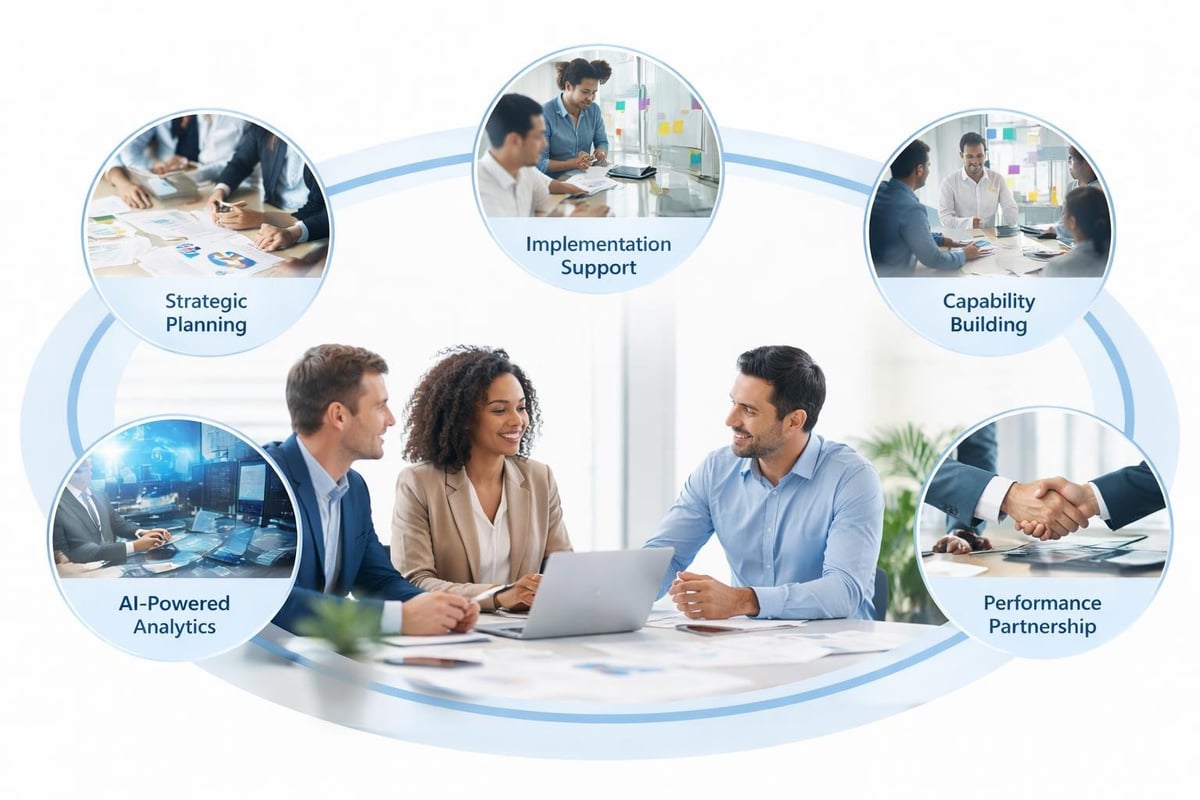
Third, specialization continues deepening as beginners entering business strategy consulting must develop both broad business acumen and deep functional or industry expertise. Generalist consultants face pressure from specialized boutiques offering superior domain knowledge.
Industry-Specific Strategic Approaches
Different industries require adapted strategic methodologies reflecting their unique dynamics. Technology companies prioritize speed and experimentation, requiring agile execution frameworks that enable rapid iteration. Healthcare organizations navigate complex regulatory environments demanding compliance-aware strategy development. Manufacturing firms focus on operational efficiency and supply chain resilience alongside market positioning.
Business strategy consulting companies that understand these nuances deliver significantly more value than those applying cookie-cutter frameworks across contexts. The best firms maintain industry practices combining sector expertise with proven methodologies, creating the optimal balance between specialized knowledge and tested approaches.
Industry-specific considerations include:
- Regulatory environment and compliance requirements
- Technology adoption curves and digital maturity
- Customer buying processes and decision criteria
- Competitive dynamics and market concentration
- Innovation cycles and product development timelines
Measuring Consulting Engagement Success
Defining and tracking success metrics remains essential for maximizing value from business strategy consulting companies. Without clear measurement frameworks, organizations struggle to assess whether strategic investments deliver appropriate returns.
Key Performance Indicators
Effective measurement combines leading indicators showing progress toward strategic objectives with lagging indicators demonstrating ultimate impact. Leading indicators might include percentage of new products launched, market share in targeted segments, or customer satisfaction scores in specific areas. Lagging indicators focus on revenue growth, profitability improvement, and market valuation changes.
The specific metrics depend on engagement objectives. A corporate innovation strategy engagement might track innovation pipeline value, time-to-market for new offerings, and percentage revenue from products launched in the past three years. A market expansion initiative would measure market penetration rates, customer acquisition costs, and revenue per new market.
| Strategic Objective | Leading Indicators | Lagging Indicators |
|---|---|---|
| Revenue growth | Pipeline value, conversion rates | Actual revenue increase |
| Market expansion | Market awareness, trial rates | Market share, revenue |
| Innovation | Ideas generated, projects launched | New product revenue |
| Efficiency | Process cycle time, cost per unit | Profitability margins |
Establishing baseline measurements before engagement commencement and tracking progress throughout ensures accountability and enables course correction when initiatives underperform. The most sophisticated business strategy consulting companies incorporate performance dashboards providing real-time visibility into strategic initiative progress.
Calculating Return on Investment
Determining ROI from strategic consulting requires comparing investment costs against quantifiable benefits. Direct costs include consulting fees, internal resource time, and implementation expenses. Benefits encompass revenue increases attributable to new strategies, cost savings from efficiency improvements, and avoided losses from better strategic positioning.
ROI calculation methodology:
- Define measurable objectives with specific targets
- Establish baseline performance before engagement
- Track performance changes during and after engagement
- Isolate consulting impact from other variables
- Compare incremental benefit against total investment cost
While some benefits resist precise quantification, conservative estimates provide sufficient clarity for investment decisions. A new product development initiative generating $5 million in incremental revenue against $500,000 in consulting and implementation costs delivers clear positive ROI even accounting for internal resources and opportunity costs.
Maximizing Value from Strategic Partnerships
Working effectively with business strategy consulting companies requires active client participation and organizational commitment. Passive approaches where consultants operate independently while management awaits recommendations consistently underperform collaborative models.
Best Practices for Client Organizations
Successful engagements share common characteristics regardless of firm selection or strategic focus. First, executive sponsorship ensures strategic work receives appropriate attention and resources. Without visible C-suite commitment, strategic initiatives struggle to overcome organizational inertia and competing priorities.
Second, dedicating capable internal resources to work alongside consultants accelerates knowledge transfer and improves recommendation quality. These team members provide organizational context consultants lack while learning methodologies they can apply to future challenges. This collaborative approach transforms consulting from outsourced service to capability-building partnership.
Client success factors include:
- Clear objective definition and success criteria
- Senior leader engagement and visible support
- Cross-functional team participation
- Honest data sharing and transparent communication
- Willingness to challenge assumptions and consider alternatives
- Commitment to implementation beyond strategic planning
Third, maintaining realistic timelines balances thoroughness with urgency. Rushed strategic work produces superficial recommendations missing critical insights, while extended timelines allow market conditions to shift before implementation begins. Most substantial strategic engagements require three to six months for comprehensive analysis and planning.
Common Pitfalls to Avoid
Organizations frequently make predictable mistakes when engaging business strategy consulting companies. Recognizing these pitfalls helps avoid wasted investment and disappointing outcomes.
The most common mistake involves treating strategy as one-time event rather than ongoing process. Markets evolve continuously, requiring regular strategic review and adaptation. Organizations viewing their strategic plan as fixed document rather than living framework struggle when conditions change.
Another frequent error is delegating strategic thinking entirely to consultants rather than maintaining ownership. External advisors bring valuable perspective and expertise, but organizational leaders must ultimately own and champion strategy. Consultants who encounter passive clients should push for greater engagement rather than accepting detachment.
Finally, many organizations fail to plan adequately for implementation, focusing energy on strategic planning while neglecting the harder work of execution. The most elegant strategy delivers zero value without effective implementation. Progressive business strategy consulting companies address this by incorporating implementation planning and change management directly into strategic engagements.
Business strategy consulting companies play an increasingly vital role helping organizations navigate complexity, identify opportunities, and build competitive advantages in rapidly evolving markets. Success requires selecting the right strategic partner, actively participating throughout the engagement, and maintaining focus on measurable outcomes and capability building. Whether you're exploring new market opportunities, developing innovative business models, or accelerating revenue growth, Six Paths Consulting combines AI-powered strategic innovation with proven methodologies to deliver transformational results while building your internal capabilities for sustained success.