

Accelerating revenue growth remains the paramount objective for ambitious business leaders navigating today's competitive landscape. Organizations seeking sustainable expansion must look beyond traditional sales tactics and embrace strategic innovation as the foundation for capturing new market opportunities. In 2026, the intersection of artificial intelligence, innovative business models, and customer-centric strategies creates unprecedented pathways for companies ready to transform their approach to growth.
Understanding the Revenue Growth Imperative
Revenue growth serves as the lifeblood of organizational sustainability and market competitiveness. Companies that fail to expand their top-line revenue face stagnation, reduced market share, and diminished investor confidence. The challenge intensifies as markets mature and customer acquisition costs continue rising across virtually every industry.
Strategic leaders recognize that sustainable revenue growth requires a fundamental shift from incremental improvements to breakthrough innovation. Traditional approaches focused solely on optimizing existing operations deliver diminishing returns over time. Organizations must simultaneously defend their core business while exploring new revenue streams through innovative products, services, and business models.
The Innovation-Revenue Connection
Innovation drives measurable business outcomes when organizations align their strategic initiatives with market opportunities. Companies that establish visible AI strategies are twice as likely to experience significant revenue gains, according to recent research on AI adoption. This correlation highlights how technological innovation translates directly into financial performance.
The relationship between innovation and revenue growth operates through several mechanisms:
- Market expansion through new product categories and customer segments
- Premium pricing enabled by differentiated value propositions
- Operational efficiency that reduces costs while improving margins
- Customer retention driven by superior experiences and outcomes
- Competitive advantage that protects market position and pricing power

Identifying High-Impact Growth Opportunities
Strategic opportunity identification separates successful growth initiatives from resource-draining experiments. Organizations must develop systematic approaches to scanning the market environment, analyzing customer needs, and evaluating emerging technologies that could reshape their industry.
Market Opportunity Assessment
Effective opportunity assessment begins with understanding unmet customer needs and market gaps. Leaders should examine adjacent markets where their core competencies create competitive advantages. Innovative business model transformation enables companies to serve existing customers in new ways or reach entirely new customer segments.
| Assessment Criteria | Strategic Questions | Expected Outcomes |
|---|---|---|
| Market Size | What is the addressable market potential? | Revenue ceiling estimation |
| Customer Pain Points | Which problems remain unsolved? | Value proposition definition |
| Competitive Landscape | Who serves this market today? | Differentiation requirements |
| Resource Alignment | Can we execute with existing capabilities? | Investment requirements |
Organizations should prioritize opportunities based on strategic fit, market attractiveness, and execution feasibility. The most promising initiatives typically combine strong customer demand with organizational capabilities that competitors cannot easily replicate.
Customer-Centric Discovery
Customer consulting methodologies reveal hidden growth opportunities by deeply understanding customer workflows, challenges, and desired outcomes. Companies that invest in systematic customer discovery uncover revenue opportunities invisible to competitors focused solely on product features.
Leading organizations employ multiple discovery techniques:
- Ethnographic research to observe customer behavior in natural contexts
- Journey mapping to identify friction points and enhancement opportunities
- Jobs-to-be-done analysis to understand underlying customer motivations
- Prototype testing to validate solutions before full-scale investment
- Data analytics to identify patterns in customer behavior and preferences
These approaches generate insights that inform both incremental improvements and breakthrough innovations. The most successful companies establish continuous discovery processes rather than treating customer research as one-time projects.
Leveraging AI-Powered Innovation
Artificial intelligence represents the most significant driver of revenue growth opportunities in 2026. Organizations that strategically integrate AI into their operations, products, and customer experiences gain substantial competitive advantages. The technology enables new business models, operational efficiencies, and customer value previously impossible to deliver.
AI Implementation Strategies
Successful AI adoption requires deliberate strategy rather than opportunistic experimentation. Companies should identify specific use cases where AI creates measurable value for customers or meaningful operational improvements. Growth business consulting helps organizations navigate the complexity of AI integration while maintaining focus on revenue outcomes.
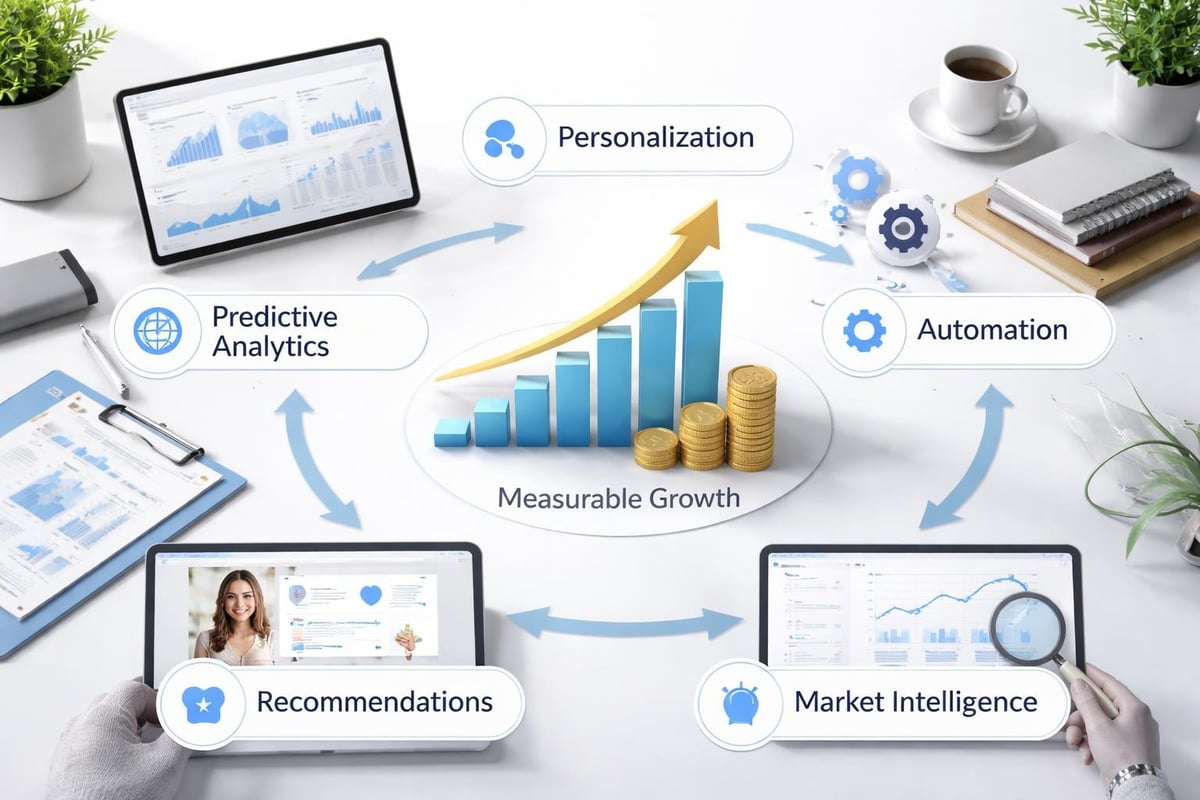
Strategic AI applications for revenue growth include:
- Predictive analytics that identify high-value customers and expansion opportunities
- Personalization engines that tailor experiences to individual customer preferences
- Automated processes that reduce friction in customer acquisition and service delivery
- Product recommendations that increase average transaction values and cross-selling
- Market intelligence that reveals emerging trends and competitive threats
The key to successful AI implementation lies in selecting initiatives with clear connections to revenue metrics. Organizations should avoid technology-first approaches that prioritize technical sophistication over business outcomes.
Building AI Capabilities
Developing internal AI capabilities enables sustained competitive advantage rather than dependence on vendor solutions. Organizations should invest in talent development, data infrastructure, and experimental learning cultures that support continuous innovation. Design thinking in training programs equip teams with methodologies for translating AI capabilities into customer value.
Companies achieve the greatest returns when they combine technical AI expertise with deep domain knowledge. Cross-functional teams that bring together data scientists, product managers, and customer-facing professionals create solutions that address real market needs rather than theoretical possibilities.
Transforming Business Models for Growth
Business model innovation unlocks revenue growth by changing how organizations create, deliver, and capture value. Companies constrained by traditional business models miss opportunities to serve customers in new ways or monetize existing capabilities more effectively.
Revenue Model Diversification
Forward-thinking organizations diversify their revenue streams to reduce dependence on single sources and capture value across the customer lifecycle. Subscription models, usage-based pricing, marketplace commissions, and outcome-based fees represent alternatives to traditional transaction models.
| Revenue Model | Primary Advantage | Best Fit Scenarios |
|---|---|---|
| Subscription | Predictable recurring revenue | Products requiring ongoing engagement |
| Freemium | Rapid user acquisition | Digital products with network effects |
| Usage-Based | Alignment with customer value | Variable consumption patterns |
| Platform/Marketplace | Scalability without inventory | Connecting buyers and sellers |
| Outcome-Based | Risk sharing with customers | Measurable business impact |
Successful revenue model transformation requires understanding customer willingness to pay and structuring offers that align pricing with perceived value. Organizations should test new models with customer segments before wholesale transitions that risk core revenue streams.
Ecosystem and Partnership Strategies
Strategic partnerships extend organizational capabilities and market reach without proportional resource investments. Companies can accelerate revenue growth by collaborating with complementary businesses, technology providers, and distribution partners. These relationships create value networks that benefit all participants while delivering superior customer outcomes.
Effective partnership strategies focus on mutual value creation rather than one-sided extraction. The most successful collaborations involve shared risk, transparent communication, and aligned incentives that reward collective success. Organizations should establish clear governance structures and performance metrics to ensure partnerships deliver expected results.
Scaling Innovation Capabilities
Sustained revenue growth requires organizations to build repeatable innovation processes rather than relying on occasional breakthroughs. Companies must develop systematic approaches to generating, evaluating, and scaling new ideas while maintaining operational excellence in core business activities.
Innovation Portfolio Management
Strategic leaders manage innovation portfolios that balance short-term revenue opportunities with long-term transformational initiatives. Top management consulting frameworks help organizations allocate resources across horizon one (core business optimization), horizon two (adjacent market expansion), and horizon three (breakthrough innovation) initiatives.
A balanced innovation portfolio typically includes:
- Core enhancements that improve existing products and services (60-70% of resources)
- Adjacent innovations that expand into new markets or customer segments (20-30% of resources)
- Transformational bets that could reshape the industry or business model (10-20% of resources)
This distribution ensures organizations generate near-term revenue while building capabilities for future growth. The specific allocation should reflect industry dynamics, competitive position, and strategic ambition.
Measurement and Learning
Effective innovation measurement focuses on learning velocity rather than just financial returns. Organizations should establish metrics that track progress toward strategic objectives while enabling course corrections based on market feedback. Leading indicators might include customer engagement, prototype iterations, or partnership discussions rather than lagging revenue metrics alone.
Companies should create safe environments for experimentation where teams can test hypotheses without fear of failure. The most valuable insights often emerge from initiatives that fail to achieve original objectives but reveal unexpected opportunities. Innovative ideas for business growth emerge when organizations systematically capture and apply lessons from both successes and setbacks.

Driving Organizational Alignment
Revenue growth initiatives fail when organizations lack alignment across functions, levels, and geographies. Leaders must create shared understanding of strategic priorities, establish clear accountability, and remove organizational barriers that impede execution.
Cross-Functional Collaboration
Growth initiatives require coordination across product development, sales, marketing, operations, and customer service functions. Organizations should establish cross-functional teams with clear mandates, decision-making authority, and resource allocation. These teams break down silos that fragment customer experiences and slow time-to-market.
Successful collaboration depends on several enabling factors:
- Shared metrics that align incentives across organizational boundaries
- Regular communication that surfaces issues and enables rapid problem-solving
- Leadership support that reinforces collaboration as a strategic priority
- Technology platforms that enable information sharing and workflow coordination
- Cultural norms that reward collective success over individual achievement
Companies that excel at cross-functional collaboration achieve faster innovation cycles, superior customer experiences, and more efficient resource utilization compared to siloed organizations.
Capability Development
Sustainable revenue growth requires investing in people and processes that enable continuous improvement. Organizations should provide training, tools, and support that help employees contribute to innovation initiatives. Management consulting tools and methodologies accelerate capability building by providing structured approaches to common challenges.
Leadership development programs should emphasize strategic thinking, customer empathy, and change management skills that enable managers to navigate uncertainty and drive transformation. Technical training in emerging technologies, data analytics, and digital tools ensures teams can leverage modern capabilities effectively.
Learning from Growth Success Stories
Examining how leading organizations achieve revenue growth provides actionable insights for companies at any stage. Case studies demonstrate tangible results from companies that have successfully implemented strategic initiatives across diverse industries and market conditions.
Organizations should study both direct competitors and companies in adjacent industries facing similar challenges. Cross-industry learning often yields the most valuable insights because solutions from one domain can be adapted to create competitive advantages in another. Companies achieving exponential revenue growth typically combine multiple strategies rather than relying on single initiatives.
The most instructive case studies reveal not just successful outcomes but the strategic thinking, organizational changes, and execution approaches that enabled those results. Leaders should analyze decision-making processes, resource allocation patterns, and risk management strategies alongside financial performance metrics.
Sustaining Growth Momentum
Maintaining revenue growth over extended periods requires different capabilities than achieving initial success. Organizations must balance exploitation of proven strategies with exploration of new opportunities as markets evolve and competitive dynamics shift.
Adaptive Strategy
Rigid strategic plans become obsolete as market conditions change. Leading organizations adopt adaptive approaches that combine directional vision with tactical flexibility. They establish review cadences that assess performance, evaluate assumptions, and adjust initiatives based on emerging data.
Adaptive strategy requires monitoring multiple environmental factors:
- Customer behavior shifts that signal changing preferences or needs
- Competitive moves that alter market dynamics or customer expectations
- Technology developments that enable new capabilities or business models
- Regulatory changes that create opportunities or constraints
- Economic conditions that affect customer spending patterns
Organizations that detect and respond to these signals faster than competitors sustain advantages over time. Strategic agility becomes as important as strategic positioning in dynamic markets.
Continuous Innovation Culture
Embedding innovation into organizational culture ensures growth capabilities outlast individual initiatives or leadership tenures. Companies should celebrate experimentation, reward learning, and normalize intelligent risk-taking as core cultural values. These norms encourage employees at all levels to contribute ideas and challenge conventional thinking.
Leaders reinforce innovation culture through their actions, not just words. They must visibly support experiments that fail, invest resources in unproven ideas, and recognize contributions regardless of hierarchical position. Cultural transformation typically requires sustained effort over multiple years as new norms gradually replace legacy behaviors and mindsets.
Strategic revenue growth requires deliberate innovation, customer-centricity, and organizational alignment working in concert. Organizations that master these elements position themselves for sustained expansion regardless of market conditions or competitive pressures. Six Paths Consulting partners with ambitious leaders to discover transformational opportunities, develop AI-powered innovations, and build the capabilities that drive measurable revenue growth and long-term competitive advantage.