

Organizations investing in professional development face a persistent challenge: traditional training programs often fail to engage participants or deliver lasting behavioral change. Design thinking in training offers a transformative approach that shifts learning from passive information transfer to active problem-solving. This human-centered methodology empowers trainers to create experiences that resonate with participants, addressing real workplace challenges while building innovation capabilities that drive competitive advantage. As businesses navigate rapid technological change and market disruption, the ability to design adaptive, engaging training becomes not just beneficial but essential for organizational success.
Understanding the Foundation of Design Thinking in Training
Design thinking represents a fundamental shift in how organizations approach learning and development. Rather than starting with content experts and predetermined curricula, this methodology begins with deep empathy for learners and their authentic challenges. The design thinking process applies iterative cycles of understanding, exploring, and materializing to create training experiences that genuinely solve problems.
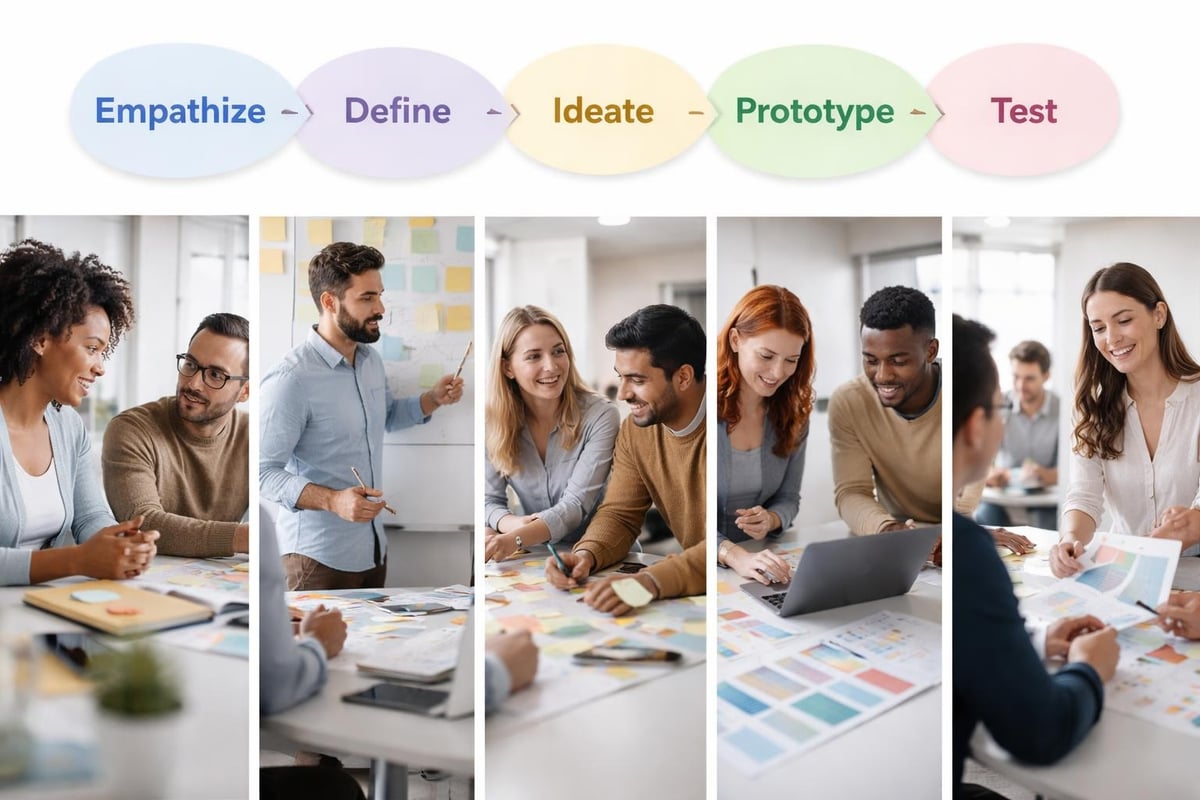
The Five Core Phases Applied to Learning Design
Empathize involves understanding learners' actual needs, not what stakeholders assume they need. Training designers conduct interviews, observe workplace behaviors, and immerse themselves in the learner's environment to uncover hidden pain points and motivations.
Define synthesizes research into clear problem statements. Rather than "employees need better communication skills," a design-thinking approach might reveal "mid-level managers struggle to deliver constructive feedback during remote interactions because they lack frameworks for asynchronous communication."
Ideate generates multiple potential solutions without immediate judgment. Training teams brainstorm diverse formats, from microlearning modules to collaborative workshops, challenging assumptions about what effective learning must look like.
Prototype creates low-fidelity versions of training interventions. This might mean rough PowerPoint sketches, role-play scripts, or simple digital mockups that allow rapid testing without extensive resource investment.
Test validates assumptions with actual learners, gathering feedback that informs the next iteration. This cycle repeats until the training demonstrably solves the defined problem.
Building Innovation Capabilities Through Training Design
Organizations seeking to build in-house innovation capabilities recognize that design thinking in training serves dual purposes. First, it creates more effective learning experiences. Second, when participants engage with design thinking methodologies during training, they simultaneously develop innovation skills applicable to their core work.
Experiential Learning Versus Traditional Instruction
Traditional training often follows a predictable pattern: presentation of concepts, case study review, knowledge assessment, and attempted application. Design thinking in training flips this model entirely.
| Traditional Training | Design Thinking Approach |
|---|---|
| Expert-led lectures | Participant-centered discovery |
| Standardized content | Customized problem-solving |
| Individual assessments | Collaborative prototyping |
| Post-training application | Real-time problem engagement |
| Linear progression | Iterative experimentation |
Participants working on actual business challenges during training sessions generate solutions with immediate applicability. A workshop designed around real market opportunities identified through frameworks for innovation creates learning that transcends theoretical knowledge.
Consider a scenario where sales teams need training on consultative selling. A traditional approach might include lecture modules on questioning techniques and objection handling. Design thinking in training would begin by shadowing sales representatives, identifying specific moments where customer conversations stall, then co-creating conversation frameworks with participants that address those precise friction points. The resulting training artifacts become tools the team actually uses, not binders gathering dust.
Implementing Human-Centered Training Methodologies
The practical application of design thinking in training requires fundamental shifts in how learning and development teams operate. Organizations must move from subject-matter experts dictating content to facilitators guiding discovery processes.
Conducting Effective Learner Research
Understanding your training audience demands more than demographic surveys or needs assessments filled with checkbox questions. Design thinking training programs emphasize ethnographic research techniques that reveal underlying motivations and barriers.
Shadow days place training designers alongside learners during typical workdays, observing challenges in context rather than conference rooms. A training designer shadowing customer service representatives might notice that existing knowledge bases are difficult to search under time pressure, suggesting that training alone cannot solve performance gaps.
Empathy interviews use open-ended questions to explore experiences, frustrations, and aspirations. Rather than asking "What training topics interest you?" effective questions probe deeper: "Describe the last time you felt unprepared for a client conversation. What specific information or skills would have changed the outcome?"
Journey mapping documents the complete learning experience from initial awareness through long-term application, identifying emotional highs and lows that reveal design opportunities.
Creating Rapid Training Prototypes
Prototyping allows organizations to test training concepts before committing significant resources. This approach particularly benefits innovative ideas for business growth that require workforce capability development.
Low-fidelity prototypes might include:
- Storyboard sketches showing training flow and participant interactions
- Sample exercise instructions tested with small volunteer groups
- Rough video scripts filmed on smartphones to evaluate content resonance
- Paper-based simulations of digital learning interfaces
- Five-minute "lightning sessions" testing core concepts
Each prototype iteration incorporates participant feedback, refining the training design before full development. A prototype testing session might reveal that participants respond better to competitive team challenges than individual reflection exercises, fundamentally changing the training architecture.

Fostering Creativity and Collaboration in Learning Environments
Design thinking in training transforms passive participants into active co-creators. This shift proves particularly valuable for organizations implementing creativity workshops for teams designed to break entrenched thinking patterns.
Designing Collaborative Learning Experiences
Traditional training often isolates individuals, measuring success through individual test scores or certifications. Design thinking emphasizes collective intelligence, recognizing that innovation emerges through diverse perspectives colliding.
Effective collaborative structures include:
- Cross-functional learning pods that mix departments and experience levels, preventing echo chambers
- Rotating facilitation roles where participants lead different segments, building ownership and engagement
- Build-measure-learn cycles embedded within sessions, where teams prototype solutions, gather peer feedback, and iterate rapidly
- Divergent-convergent pacing that alternates between expansive brainstorming and focused decision-making
The physical or virtual environment significantly impacts collaboration quality. Flexible spaces with movable furniture, abundant wall space for visual thinking, and accessible materials for physical prototyping enable the hands-on experimentation central to design thinking approaches.
Measuring Training Effectiveness Beyond Traditional Metrics
Design thinking in training demands different success metrics than completion rates or satisfaction scores. Organizations must evaluate whether training produces behavioral change and business impact.
Outcome-based metrics might include:
- Number of participant-generated solutions implemented within 90 days
- Customer satisfaction improvements in areas addressed by training
- Revenue or efficiency gains attributable to newly developed capabilities
- Percentage of learners applying specific techniques in observed work situations
- Quality and quantity of innovations emerging from trained teams
These measurements require more sophisticated data collection than standard learning management systems provide. Organizations might deploy workplace observations, manager interviews, or customer feedback analysis to assess real-world application.
Integrating Design Thinking With Strategic Innovation Training
Organizations pursuing comprehensive innovation transformation recognize that design thinking in training works most effectively when integrated with broader strategic frameworks. The design thinking for innovation approach becomes even more powerful when combined with market strategy methodologies.
Connecting Learning to Business Model Innovation
Training programs isolated from business strategy rarely generate meaningful impact. Design thinking in training should connect directly to organizational priorities like business model innovation or market expansion.
Consider a financial services company developing new digital products. Rather than generic "innovation training," a design thinking approach might engage cross-functional teams in actual customer research for emerging market segments. The training becomes indistinguishable from strategic work, with participants developing both innovation capabilities and concrete product concepts simultaneously.
This integration requires alignment between learning and development leaders and business strategists. Training objectives should map to specific strategic initiatives, with success measured by contribution to business outcomes rather than training completion statistics.
Building Continuous Learning Cultures
Single training events, regardless of quality, rarely transform organizational capabilities. Design thinking in training supports continuous learning by teaching methodologies participants can apply independently after formal programs end.
Effective approaches include:
- Innovation toolkits with templates and frameworks participants use for ongoing projects
- Peer learning communities where cohorts continue meeting after training to share progress and challenges
- Micro-credentialing systems recognizing applied innovation work, not just training attendance
- Internal innovation challenges that provide practice opportunities for newly developed skills
- Mentorship pairings connecting training participants with experienced innovation practitioners
Organizations embracing creativity in business recognize that design thinking training represents not a one-time event but the foundation of ongoing capability development. The most successful programs create self-reinforcing systems where each application of design thinking methodologies deepens participant expertise and confidence.

Overcoming Common Implementation Challenges
Despite its proven effectiveness, design thinking in training faces predictable obstacles during implementation. Understanding these challenges allows organizations to proactively address them rather than abandoning promising approaches when difficulties emerge.
Resistance From Traditional Training Professionals
Training departments with established curricula and delivery methods may perceive design thinking as threatening or unnecessarily complex. Subject-matter experts accustomed to controlling content might resist approaches that empower participants to shape their own learning paths.
Addressing this resistance requires:
- Pilot programs that demonstrate effectiveness with low-stakes audiences before broader rollout
- Train-the-trainer programs that build internal facilitator capabilities rather than relying solely on external consultants
- Hybrid approaches that integrate design thinking elements into existing programs, proving value incrementally
- Executive sponsorship making clear that innovation in training methodology aligns with organizational priorities
Organizations benefit from partnering with experienced consultants who have successfully navigated these transitions. The expertise offered through innovation consulting can accelerate adoption while minimizing internal conflict.
Balancing Structure and Flexibility
Design thinking's iterative nature creates tension with organizational needs for predictable schedules, budgets, and outcomes. Learning leaders must balance the methodology's inherent flexibility with practical constraints.
Time management presents particular challenges. Design thinking processes, especially comprehensive empathy research and multiple prototype iterations, consume more upfront time than traditional instructional design. However, this investment typically reduces long-term costs by ensuring training addresses actual needs and generates measurable results.
Resource allocation requires different thinking. Rather than budgeting primarily for content development and delivery, organizations must allocate resources for learner research, prototyping materials, iteration cycles, and ongoing measurement. This shift may require educating finance teams about design thinking's value proposition.
Outcome uncertainty makes some organizations uncomfortable. Traditional training can promise specific knowledge transfer with reasonable certainty. Design thinking in training pursues more ambitious goals like behavioral change and innovation capability, which prove harder to guarantee but generate significantly greater business value when achieved.
Scaling Design Thinking Across Training Programs
Organizations achieving success with initial design thinking in training initiatives face the challenge of scaling these approaches across diverse learning programs without losing effectiveness or overwhelming training teams.
Creating Scalable Frameworks
Scaling requires balancing consistency with customization. Design thinking applications work best when tailored to specific contexts, yet organizations need repeatable processes that don't require starting from scratch each time.
Effective scaling strategies include:
- Modular design libraries with tested components (exercises, templates, facilitation guides) that trainers can combine for different audiences
- Decision frameworks helping trainers determine which design thinking elements suit particular learning objectives
- Quality standards defining what constitutes sufficient empathy research or adequate prototype testing
- Community of practice where training designers share insights and continuously improve methodologies
- Technology platforms supporting research documentation, prototype sharing, and collaborative design across distributed teams
Organizations pursuing opportunities for innovation recognize that training capability represents a competitive advantage worth systematic development.
Measuring Return on Investment
Executive stakeholders increasingly demand evidence that innovative training approaches justify their investment. Design thinking in training requires more sophisticated ROI analysis than traditional training metrics provide.
| Metric Category | Traditional Measures | Design Thinking Measures |
|---|---|---|
| Participation | Completion rates | Active engagement scores |
| Knowledge | Test scores | Application in real scenarios |
| Satisfaction | Post-training surveys | Behavioral change observations |
| Business Impact | Indirect correlation | Direct solution implementation |
| Long-term Value | Annual recertification | Sustained innovation capability |
Demonstrating ROI requires connecting training investments to business outcomes through careful tracking. Organizations might measure how many customer problems were solved using techniques learned in training, revenue generated from innovations developed during training sessions, or efficiency improvements resulting from process redesigns created by trained teams.
Adapting Design Thinking for Virtual and Hybrid Training
The shift toward distributed workforces has required rethinking how design thinking in training operates in virtual or hybrid environments. While face-to-face interaction offers advantages for collaborative ideation and physical prototyping, digital tools create new possibilities for inclusive, scalable training experiences.
Virtual Collaboration Technologies
Modern collaboration platforms enable sophisticated design thinking exercises that were previously only possible in physical spaces. Digital whiteboards allow simultaneous ideation from participants across time zones, with capabilities exceeding physical sticky notes and markers.
Virtual prototyping tools enable rapid concept visualization without specialized software skills. Participants can mockup user interfaces, process flows, or service blueprints using intuitive drag-and-drop interfaces, then share instantly for feedback.
Breakout room functionality facilitates small-group empathy interviews and brainstorming sessions within larger training programs, replicating the intimate conversations critical to effective design thinking.
Asynchronous elements extend training beyond scheduled sessions, allowing participants to conduct user research, refine prototypes, or provide peer feedback between live meetings. This flexibility often produces higher-quality work than compressed in-person sessions.
Organizations implementing change management training recognize that virtual design thinking capabilities help distributed teams collaborate effectively during transformation initiatives.
Maintaining Human Connection in Digital Environments
Despite technological sophistication, design thinking fundamentally concerns human understanding and creativity. Virtual training must intentionally preserve the interpersonal elements that drive innovation.
Effective practices include:
- Opening each session with personal check-ins that build psychological safety
- Using video-on expectations to maintain non-verbal communication cues
- Scheduling shorter, more frequent sessions rather than marathon virtual workshops
- Incorporating physical activities participants complete offline and share virtually
- Creating dedicated channels for informal conversation and relationship building
The most successful virtual design thinking in training doesn't simply replicate in-person experiences through screens but reimagines what's possible when geographical and scheduling constraints disappear.
Future Directions for Design Thinking in Training
As organizations increasingly recognize learning and development as strategic capabilities rather than administrative functions, design thinking in training continues evolving. Several emerging trends promise to enhance its effectiveness and accessibility.
AI-Powered Personalization
Artificial intelligence enables unprecedented customization of learning experiences. AI systems can analyze individual learning patterns, workplace challenges, and skill gaps to suggest personalized design thinking exercises that address specific needs. AI-powered strategic innovation capabilities extend to training design, where machine learning algorithms identify which methodologies produce the strongest outcomes for different learner profiles.
Rather than replacing human trainers, AI augments their capabilities by handling routine personalization while freeing facilitators to focus on relationship building and complex guidance.
Neuroscience-Informed Design
Research into how adults learn, remember, and change behaviors increasingly informs training design. Understanding cognitive load, memory consolidation, and emotional engagement helps designers create experiences that work with rather than against neurological realities.
Design thinking in training naturally aligns with neuroscience findings emphasizing active learning, spaced repetition, and emotional connection. Future approaches will likely integrate these insights more deliberately, using techniques like retrieval practice and interleaving to enhance long-term retention and application.
Cross-Industry Knowledge Transfer
Organizations increasingly recognize that breakthrough innovations often emerge when methodologies from one domain apply to another. Design thinking in training benefits from cross-pollination with fields like behavioral economics, systems thinking, and lean startup methodologies. The integration of multiple frameworks, such as combining design thinking with Blue Ocean Strategy approaches, creates more comprehensive innovation capabilities than any single methodology alone.
Design thinking in training represents far more than a passing trend in professional development. It offers a proven methodology for creating learning experiences that genuinely transform capabilities, drive innovation, and deliver measurable business results. Organizations that embrace these human-centered approaches position themselves to adapt faster, innovate more effectively, and build competitive advantages through superior talent development. Six Paths Consulting specializes in helping ambitious leaders implement design thinking and innovation training programs that build lasting in-house capabilities, combining strategic frameworks with practical application to accelerate growth and market success.