

Organizations that consistently outperform competitors share a common trait: they cultivate creativity and innovation as systematic capabilities, not random occurrences. In an era where market disruption accelerates and customer expectations evolve rapidly, companies need structured approaches to develop these skills across their workforce. Creativity and innovation training has emerged as a critical investment for businesses seeking sustainable competitive advantage, enabling teams to identify breakthrough opportunities and transform them into market-ready solutions. The challenge lies in selecting training approaches that deliver measurable results rather than superficial inspiration.
The Business Case for Structured Innovation Development
Business leaders increasingly recognize that innovation cannot remain confined to designated departments or occasional brainstorming sessions. Market pressures demand that organizations embed creative thinking throughout operations, from product development to customer service.
Research demonstrates clear connections between systematic creativity development and business outcomes. Companies investing in comprehensive innovation training report higher rates of new product success, faster time-to-market, and improved employee engagement. Managing creativity and innovation in modern organizations requires deliberate frameworks that transform abstract concepts into actionable methodologies.
The financial implications extend beyond direct revenue generation. Organizations with strong innovation capabilities attract top talent, retain institutional knowledge more effectively, and adapt to market changes with greater agility. These factors compound over time, creating sustained performance advantages.
Measuring Training Impact
| Metric Category | Key Indicators | Measurement Timeframe |
|---|---|---|
| Idea Generation | Volume and quality of concepts submitted | 3-6 months |
| Implementation Success | Percentage of ideas reaching market | 6-12 months |
| Revenue Contribution | New product/service revenue percentage | 12-24 months |
| Cultural Indicators | Employee engagement scores, retention rates | Ongoing |
Organizations must establish baseline measurements before initiating creativity and innovation training programs. This enables accurate assessment of skill development and return on investment.

Core Components of Effective Training Programs
Successful creativity and innovation training integrates multiple elements that work synergistically to build capabilities. Programs focused solely on theoretical concepts fail to generate practical results, while purely tactical approaches lack the conceptual foundation needed for sustained application.
Cognitive Skill Development
Effective training begins with understanding how creative thinking operates at the cognitive level. Participants learn to recognize and interrupt habitual thought patterns that limit possibility exploration.
- Divergent thinking exercises that expand solution spaces before convergence
- Analogical reasoning techniques that transfer insights across domains
- Reframing methodologies that challenge underlying assumptions
- Pattern recognition skills that identify opportunities others overlook
Research on cognitive processes underlying creativity informs curriculum design, ensuring training targets specific mental capabilities rather than delivering generic motivation.
Practical Methodology Training
Participants need structured frameworks that guide innovation work from opportunity identification through implementation. Design thinking, TRIZ, and blue ocean strategy represent complementary approaches applicable to different challenge types.
The integration between design thinking and innovation outcomes varies based on experience levels and organizational context. Empirical studies examining design thinking’s influence reveal that structured methodologies accelerate capability development when combined with hands-on application.
Training programs should incorporate real business challenges rather than hypothetical scenarios. Teams working on actual organizational problems develop skills while generating tangible value. This dual benefit justifies training investments and sustains leadership support.
Building Organizational Innovation Capabilities
Individual skill development represents only one dimension of effective creativity and innovation training. Organizations must simultaneously address systemic factors that enable or constrain creative work.
Environmental and Cultural Factors
The research of Teresa Amabile demonstrates how organizational environments profoundly influence creative output. Training initiatives succeed when paired with cultural adjustments that support experimentation and intelligent risk-taking.
Leadership behaviors set the tone for innovation efforts. When executives demonstrate curiosity, tolerate productive failures, and allocate resources for exploration, training participants apply new skills confidently. Conversely, risk-averse cultures undermine even the most sophisticated training programs.
Organizations benefit from assessing their current innovation climate before launching training. This diagnostic identifies specific barriers that curriculum design must address.
Cross-Functional Collaboration Skills
Innovation increasingly requires integration across disciplines and departments. Training must develop participants' ability to collaborate effectively with colleagues from different backgrounds.
Key collaboration competencies include:
- Communicating technical concepts to non-specialist audiences
- Synthesizing diverse perspectives into coherent strategies
- Navigating organizational politics to secure resources
- Building coalitions that support implementation
Strategy experts recognize that breakthrough innovations emerge from intersections between different knowledge domains. Training designs that bring together cross-functional teams accelerate both learning and relationship-building.
Advanced Training Approaches for Sustained Impact
Organizations seeking lasting transformation move beyond introductory workshops to comprehensive capability-building programs. These advanced approaches embed innovation practices into daily workflows and decision-making processes.
Cohort-Based Learning Programs
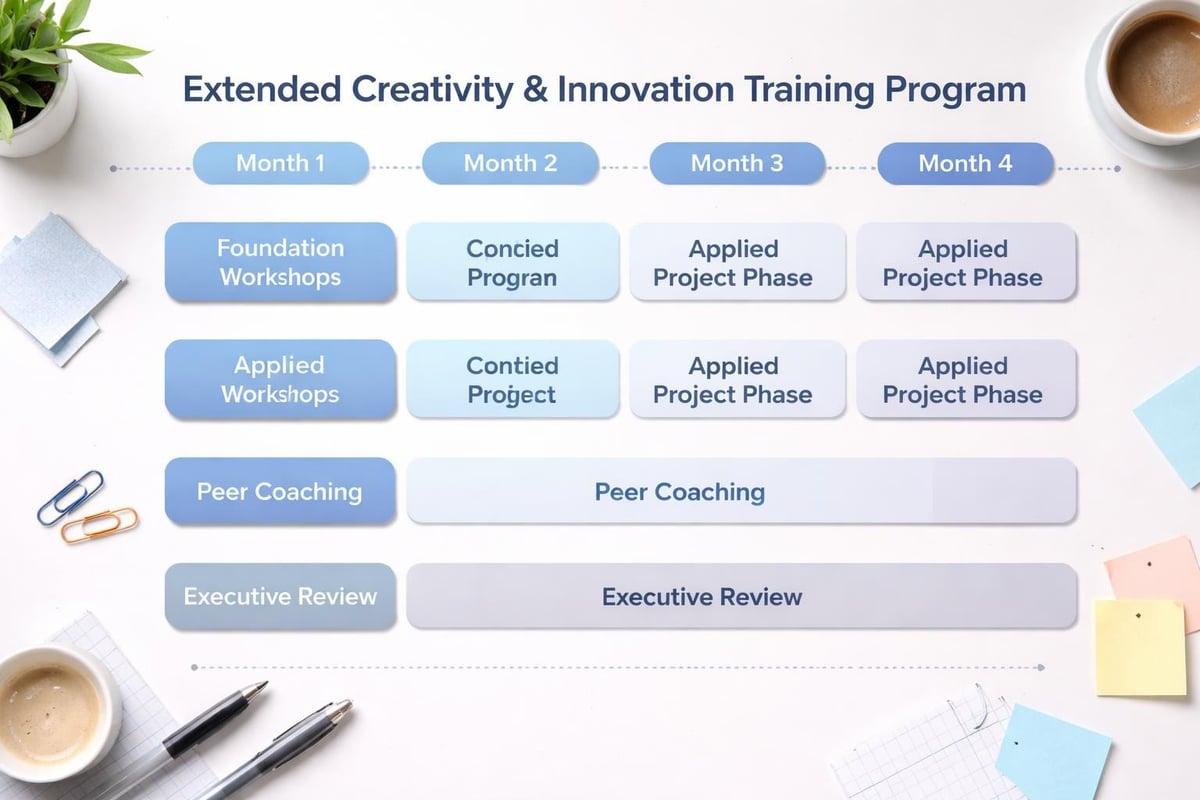
Extended programs that develop cohorts over multiple months generate deeper skill integration than single-event workshops. Participants apply concepts between sessions, bringing back real experiences for discussion and refinement.
| Program Element | Typical Duration | Primary Outcome |
|---|---|---|
| Foundation Training | 2-3 days | Framework understanding |
| Applied Projects | 8-12 weeks | Practical skill development |
| Peer Coaching | Ongoing | Capability reinforcement |
| Executive Reviews | Monthly | Accountability and support |
This structure mirrors how professionals develop complex capabilities in other domains. Spaced repetition and practical application drive skill retention significantly more effectively than concentrated exposure.
Integration with Strategic Planning
The most sophisticated organizations integrate creativity and innovation training directly into strategic planning cycles. Teams apply innovation methodologies to identify growth opportunities, challenge strategic assumptions, and develop differentiated positioning.
This integration ensures that trained capabilities receive immediate application to high-stakes business challenges. It also signals that innovation represents core business strategy rather than peripheral activity.
Innovation and business strategy alignment requires deliberate design. Training curricula should address the specific opportunity spaces and competitive dynamics relevant to the organization's context.
Customizing Training for Industry Context
Generic creativity and innovation training programs miss critical nuances that determine success across different industries. Regulatory environments, customer decision processes, and competitive dynamics vary substantially, requiring tailored approaches.
Sector-Specific Considerations
Financial services organizations face innovation constraints different from manufacturing companies or professional services firms. Training effectiveness increases when examples, case studies, and exercises reflect participants' actual business environment.
Industry-specific factors influencing training design:
- Regulatory compliance requirements affecting experimentation scope
- Typical innovation cycle lengths and resource requirements
- Customer risk tolerance and adoption patterns
- Competitive intensity and imitation speed
- Technology infrastructure and legacy system constraints
Building innovation capabilities in financial services requires addressing sector-specific challenges like compliance integration and risk management frameworks. Manufacturing contexts emphasize different considerations around supply chain innovation and production feasibility.
Scaling Across Organizational Levels
Training needs differ significantly between frontline employees, middle managers, and senior executives. Effective programs recognize these distinctions and customize content accordingly.
Frontline staff benefit from problem-solving techniques applicable to immediate operational challenges. Middle managers need skills for identifying opportunities within their domains and building business cases. Senior executives require strategic frameworks for portfolio management and resource allocation across innovation initiatives.
Multi-level programs that coordinate these different perspectives create organizational alignment while developing appropriate capabilities at each level.
Implementation Best Practices
Organizations maximize training impact through careful attention to program implementation details. Even well-designed curricula underperform when execution overlooks critical success factors.
Pre-Training Preparation
Successful programs begin before the first training session. Participants should understand learning objectives, expectations for application, and how training connects to broader organizational priorities.
Effective preparation includes:
- Clear communication about program purpose and expected outcomes
- Pre-work that establishes baseline knowledge and primes thinking
- Identification of real challenges participants will address
- Leadership messages reinforcing the initiative's strategic importance
- Logistical arrangements that minimize friction and maximize focus
This groundwork signals that the organization takes innovation capability development seriously, increasing participant engagement and application likelihood.
Post-Training Support Systems
The period immediately following training represents a critical window for skill integration. Organizations that provide structured support during this phase achieve dramatically higher application rates.
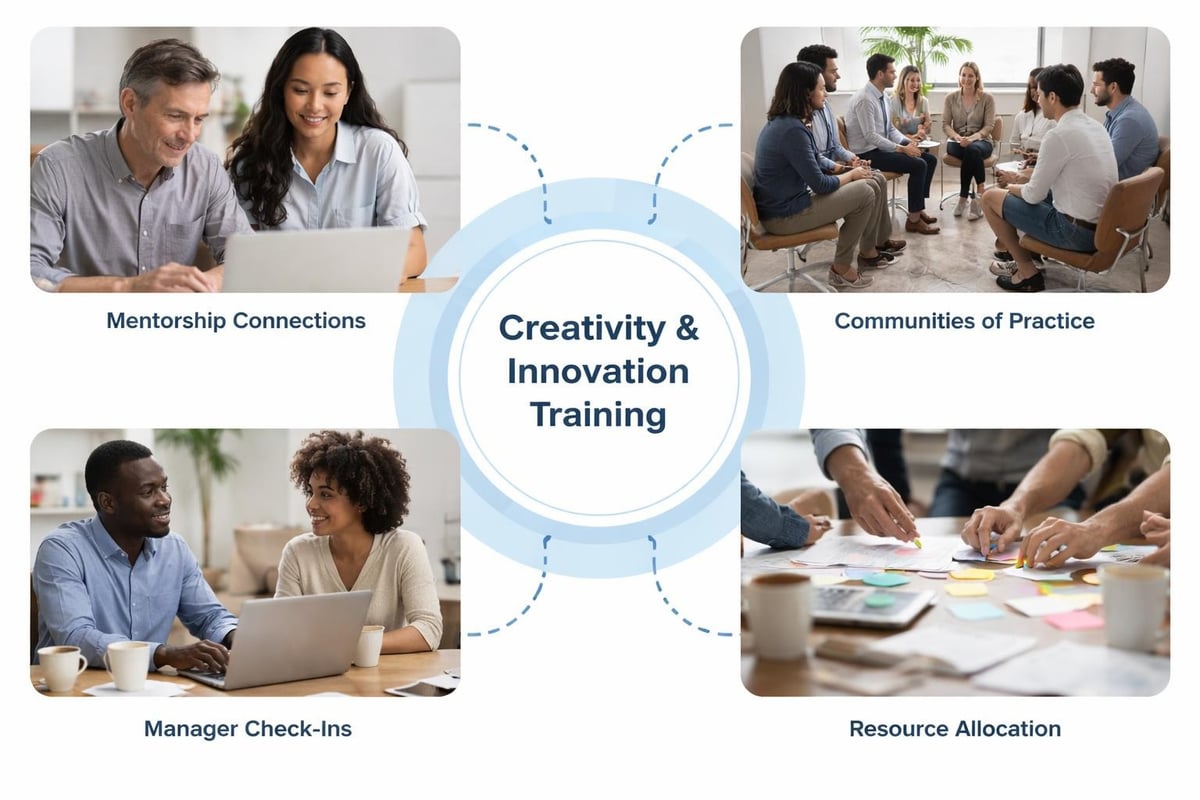
Mentoring relationships pair participants with experienced innovators who provide guidance on real projects. Communities of practice create forums for sharing experiences and problem-solving collaboratively. Regular check-ins with managers ensure that participants receive time and resources for applying new skills.
These support mechanisms prevent the common pattern where initial enthusiasm fades without producing sustained behavioral change or business results.
Selecting Training Partners and Resources
Organizations face numerous options when sourcing creativity and innovation training, from internal development to external providers. Each approach offers distinct advantages depending on organizational circumstances.
Internal versus External Providers
Developing internal training capabilities builds long-term organizational knowledge and allows continuous customization. However, this approach requires significant upfront investment and may lack exposure to external best practices.
External providers bring fresh perspectives, tested methodologies, and specialized expertise. Top business consulting firms offer training programs integrated with strategic advisory services, ensuring that capability development aligns with broader transformation objectives.
Hybrid approaches often deliver optimal results, combining external expertise for framework introduction with internal resources for ongoing reinforcement and customization.
Evaluation Criteria
| Criterion | Key Considerations | Evaluation Method |
|---|---|---|
| Relevance | Industry experience, challenge alignment | Case study review, reference checks |
| Methodology | Evidence-based approaches, proven frameworks | Curriculum assessment, pilot programs |
| Customization | Adaptation to organizational context | Discovery process depth, proposal specificity |
| Support | Post-training resources and coaching | Service scope review, alumni interviews |
| Results | Documented outcomes and impact metrics | Performance data, ROI analysis |
Organizations should request detailed information about training providers' methodologies, facilitator qualifications, and outcome measurement approaches. Vague promises of "unleashing creativity" signal superficial programs unlikely to deliver sustained results.
Integrating AI and Technology Tools
Modern creativity and innovation training increasingly incorporates artificial intelligence and digital collaboration tools. These technologies augment human capabilities while introducing new methodological possibilities.
AI-Powered Innovation Processes
Artificial intelligence enhances multiple stages of innovation work, from opportunity identification through concept testing. Training programs should prepare participants to leverage these tools effectively while maintaining the human judgment essential for strategic decision-making.
AI applications in innovation include trend analysis across massive data sets, rapid prototyping and simulation, customer insight generation from unstructured feedback, and competitive intelligence synthesis. Participants learn when to apply these tools and how to interpret results within business context.
Organizations investing in AI-powered innovation need training that develops both technical literacy and critical evaluation skills. The goal is creating teams that use technology as a force multiplier rather than a replacement for creative thinking.
Digital Collaboration Platforms
Remote and hybrid work environments require new approaches to collaborative innovation. Training must address how teams generate and develop ideas across physical distance using digital tools.
Effective programs include hands-on experience with virtual whiteboarding, asynchronous ideation platforms, and digital prototyping tools. Participants learn facilitation techniques adapted for online environments and protocols that maintain creative momentum across time zones.
Measuring Long-Term Training ROI
Organizations justifiably expect measurable returns from creativity and innovation training investments. Comprehensive measurement frameworks track both leading indicators of capability development and lagging indicators of business impact.
Multi-Level Assessment Approach
Level 1: Participant Satisfaction
Immediate feedback on training experience and perceived value
Level 2: Learning Outcomes
Assessment of knowledge acquisition and skill demonstration
Level 3: Behavioral Application
Observation of new practices in actual work settings
Level 4: Business Results
Measurement of innovation outputs and financial outcomes
Level 5: Strategic Impact
Evaluation of competitive positioning and market leadership
This framework, adapted from standard training evaluation models, provides comprehensive visibility into program effectiveness across different timeframes and organizational levels.
Organizations should establish measurement systems before training begins, enabling accurate tracking of progression through these levels. Quarterly reviews assess leading indicators while annual analyses examine business outcomes and strategic impact.
Developing systematic creativity and innovation capabilities represents a strategic imperative for organizations navigating today's dynamic markets. Through structured training that combines cognitive skill development, practical methodologies, and organizational alignment, companies build the capacity for sustained competitive advantage. Six Paths Consulting partners with ambitious leaders to design and implement customized innovation training programs that drive measurable business results, leveraging AI-powered strategic insights to accelerate capability development and unlock new growth opportunities.