

In today's hyper-competitive marketplace, delivering exceptional customer experiences has become the primary differentiator between thriving organizations and those struggling to maintain relevance. Experience consulting emerges as a critical discipline that combines strategic thinking, human-centered design, and data-driven insights to transform how businesses interact with their customers at every touchpoint. This specialized consulting approach goes beyond traditional strategy frameworks by placing the customer journey at the center of innovation initiatives, revenue growth strategies, and organizational transformation efforts.
Understanding the Foundation of Experience Consulting
Experience consulting represents a strategic fusion of management consulting expertise and design thinking methodologies. Unlike conventional consulting practices that focus primarily on operational efficiency or cost reduction, experience consulting combines strategy and management consulting with human-centered design to create meaningful interactions that drive both customer satisfaction and business outcomes.
The Core Components
The practice encompasses several interconnected disciplines that work together to create holistic transformation:
- Customer journey mapping to identify pain points and opportunities across the entire lifecycle
- Behavioral research to understand motivations, needs, and decision-making patterns
- Service design to architect seamless experiences across channels
- Digital transformation to leverage technology in enhancing interactions
- Organizational alignment to ensure internal capabilities support external promises
Organizations implementing experience consulting initiatives typically see measurable improvements in customer retention, lifetime value, and brand advocacy. The discipline requires deep expertise in both strategic business planning and empathetic customer understanding.
Strategic Integration with Innovation Frameworks
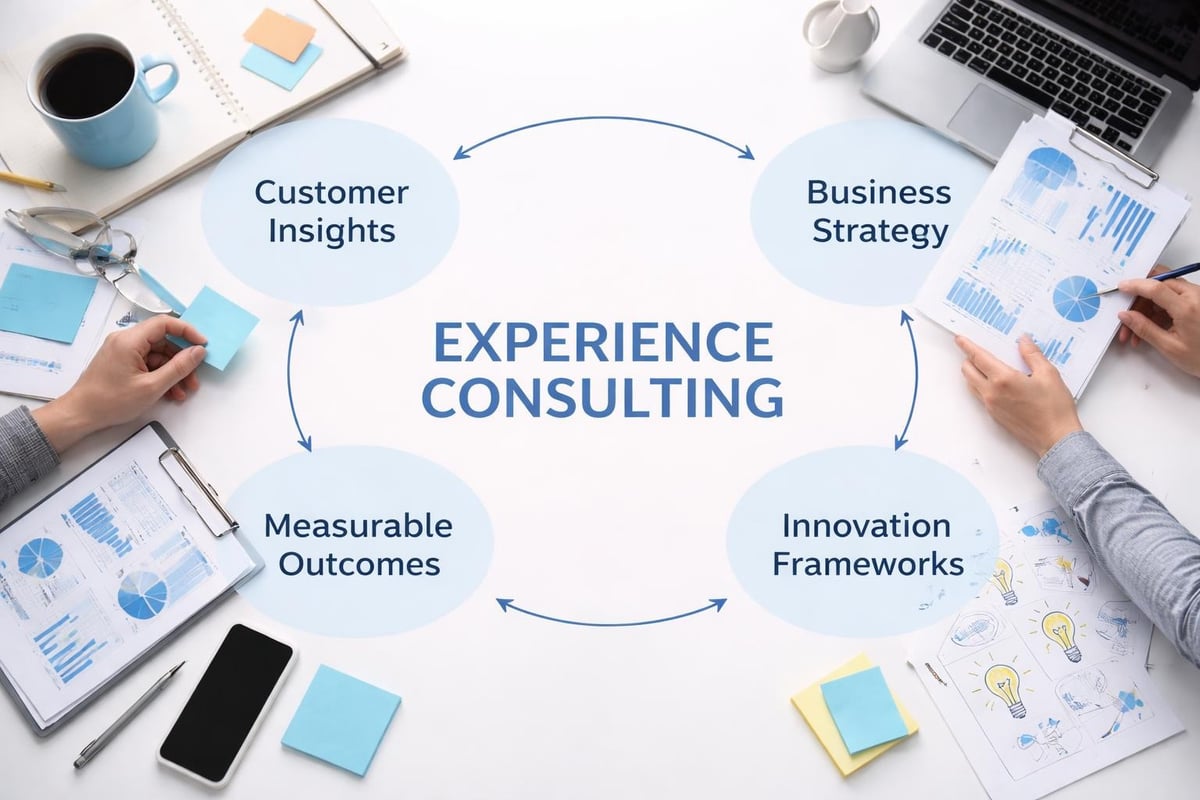
Experience consulting thrives when integrated with robust innovation frameworks that guide systematic transformation. The most successful implementations align customer experience initiatives with broader business model innovation, ensuring that improved interactions translate directly into revenue growth and market differentiation.
Mapping the Customer Experience Ecosystem
Journey mapping forms the backbone of experience consulting engagements. This process involves documenting every interaction customers have with a brand, from initial awareness through post-purchase support and advocacy.
| Journey Stage | Key Activities | Experience Consulting Focus |
|---|---|---|
| Awareness | Research, discovery, problem recognition | Message clarity, channel optimization |
| Consideration | Evaluation, comparison, research deepening | Information architecture, trust signals |
| Purchase | Decision-making, transaction completion | Friction reduction, value communication |
| Onboarding | Implementation, first use, learning | Success enablement, support accessibility |
| Advocacy | Renewal, referrals, loyalty | Relationship building, community engagement |
This systematic approach reveals gaps between customer expectations and actual delivered experiences. IBM’s customer experience consulting services demonstrate how front-office transformation can drive significant revenue improvements through better customer interactions.
AI-Powered Experience Transformation
The integration of artificial intelligence into experience consulting represents a paradigm shift in how organizations understand and respond to customer needs. AI technologies enable real-time personalization, predictive analytics, and automated optimization at scales previously impossible with manual approaches.
Modern experience consulting leverages machine learning algorithms to analyze massive datasets of customer interactions, identifying patterns that human analysts might miss. These insights drive hyper-personalized experiences that adapt dynamically based on individual behaviors, preferences, and contexts.
Implementing Intelligent Experience Systems
Organizations pursuing AI-powered strategic innovation benefit from several key capabilities:
- Predictive customer modeling that anticipates needs before customers articulate them
- Natural language processing for conversational interfaces and sentiment analysis
- Recommendation engines that surface relevant products, content, or services
- Automated journey orchestration that guides customers through optimal paths
- Real-time personalization that adjusts experiences based on current context
These technologies transform experience consulting from a periodic assessment activity into a continuous optimization discipline. The ability to test, measure, and refine experiences at digital speed creates competitive advantages that compound over time.
Employee Experience as Strategic Foundation
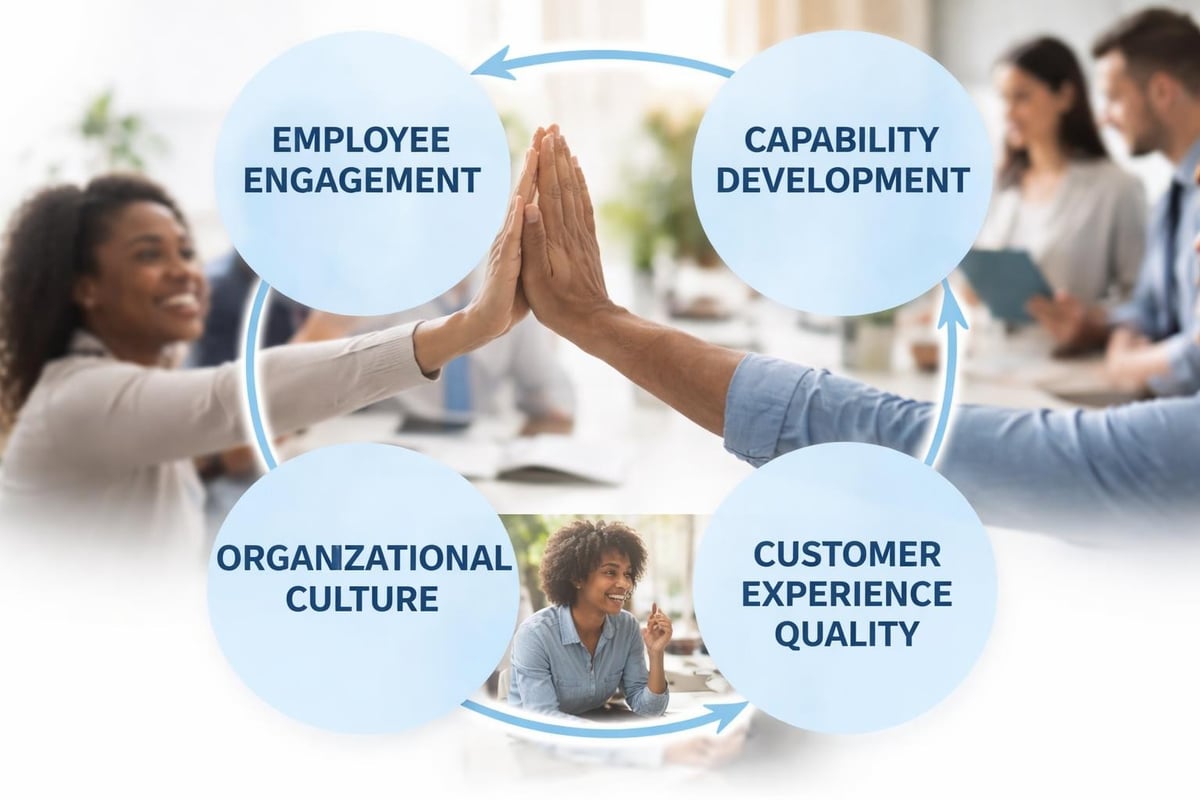
While customer-facing experiences receive most attention, employee experience consulting plays an equally critical role in sustainable transformation. Organizations cannot consistently deliver exceptional customer experiences without engaged, empowered employees who understand and embody customer-centric values.
Experience consulting addresses both external and internal audiences through integrated strategies. Employee engagement, capability building, and organizational culture directly impact the quality of customer interactions. Companies investing in employee experience report higher customer satisfaction scores, lower churn rates, and stronger financial performance.
Building Experience-Driven Organizations
Transforming organizational culture requires systematic approaches that go beyond surface-level training programs:
- Leadership alignment on experience as a strategic priority
- Cross-functional collaboration breaking down departmental silos
- Measurement systems tracking experience metrics alongside traditional KPIs
- Incentive structures rewarding customer-centric behaviors
- Capability development building design thinking and empathy skills
Partners like Be Creative specialize in helping organizations undergo digital transformation by aligning strategy, operations, and technology to support superior customer and employee experiences. This holistic approach ensures that experience improvements are sustainable rather than temporary initiatives.
Revenue Growth Through Experience Innovation
Experience consulting directly impacts top-line growth by identifying and capitalizing on unmet customer needs. Organizations that excel at experience design command premium pricing, enjoy lower customer acquisition costs, and benefit from higher retention rates that compound lifetime value.
The discipline enables businesses to discover new market opportunities by understanding customer jobs-to-be-done that competitors overlook. This customer insight-driven innovation creates blue ocean opportunities where competition becomes irrelevant because the offering addresses needs in fundamentally differentiated ways.
Quantifying Experience Impact
| Metric | Traditional Approach | Experience Consulting Impact |
|---|---|---|
| Customer Acquisition Cost | $250-500 | $150-300 (improved conversion) |
| Customer Lifetime Value | $2,000 | $3,500+ (retention increase) |
| Net Promoter Score | 20-30 | 50-70 (advocacy growth) |
| Revenue per Customer | $500/year | $750+/year (expanded engagement) |
These improvements stem from deeply understanding customer motivations and designing experiences that create genuine value at every interaction. Clear M&C Saatchi’s approach to experience consulting demonstrates how customer journey mapping and experience strategy drive measurable retention and growth outcomes.
Implementation Strategies for Ambitious Leaders
Leaders seeking to implement experience consulting within their organizations face several critical decisions regarding scope, resourcing, and organizational readiness. Successful implementations balance quick wins that build momentum with longer-term structural transformations that embed customer-centricity into organizational DNA.
Phased Transformation Roadmap
Phase One: Foundation Building (Months 1-3)
- Conduct baseline customer research and journey mapping
- Identify high-impact pain points and opportunities
- Establish cross-functional experience governance
- Define success metrics and measurement systems
Phase Two: Pilot Implementation (Months 4-6)
- Launch focused initiatives addressing priority pain points
- Test new experience concepts with customer cohorts
- Gather feedback and refine approaches
- Document learnings and best practices
Phase Three: Scale and Embed (Months 7-12)
- Expand successful pilots across customer base
- Integrate experience design into product development processes
- Build internal capabilities through training and tools
- Establish continuous improvement mechanisms
Organizations developing in-house innovation capabilities through experience consulting create sustainable competitive advantages. Rather than depending entirely on external consultants, building internal expertise ensures experience excellence becomes part of organizational culture.
Leveraging Digital Channels for Experience Excellence
Digital transformation has fundamentally reshaped experience consulting by expanding the channels through which customers interact with brands. Modern experience strategies must orchestrate seamless journeys across mobile apps, websites, social media, physical locations, and emerging platforms like voice assistants and augmented reality.
Realm Digital’s experience consulting services emphasize the importance of enhancing customer, user, and employee interactions across all digital touchpoints. This omnichannel approach recognizes that customers expect consistent, personalized experiences regardless of how they choose to engage.
Channel Integration Principles
Successful digital experience strategies follow these core principles:
- Channel-agnostic customer data enabling consistent personalization everywhere
- Responsive design adapting interfaces to device capabilities and contexts
- Progressive disclosure revealing complexity gradually as needed
- Contextual assistance providing help precisely when customers need it
- Frictionless transitions allowing seamless movement between channels
Organizations investing in client-centricity through integrated digital experiences build stronger relationships and capture greater wallet share. The ability to meet customers where they are, with relevant value at every touchpoint, differentiates leaders from laggards.

Business Model Innovation Through Experience Design
Experience consulting serves as a catalyst for business model transformation by revealing opportunities to create and capture value in novel ways. Understanding customer jobs-to-be-done often exposes unmet needs that existing business models fail to address, opening paths to differentiated market positions.
Leading organizations use experience insights to shift from product-centric to service-centric models, from transactional to subscription relationships, or from individual sales to platform ecosystems. These transformations fundamentally change how value flows between the organization and its customers.
Experience-Led Business Model Patterns
Several proven patterns emerge from experience consulting engagements:
- Servitization: Converting product sales into ongoing service relationships
- Platform models: Connecting multiple customer segments through orchestrated experiences
- Subscription economics: Building recurring revenue through continuous value delivery
- Freemium strategies: Attracting users with free experiences, converting through premium features
- Ecosystem partnerships: Extending value through integrated third-party services
These models require careful value proposition design ensuring that customer benefits clearly justify required investments. Experience consulting helps organizations test and refine these propositions before committing significant resources to implementation.
Measuring Experience Consulting Success
Establishing robust measurement frameworks is essential for demonstrating experience consulting value and guiding continuous improvement. Organizations need balanced scorecards that capture both leading indicators (like engagement metrics) and lagging indicators (like revenue impact) to fully understand program effectiveness.
Comprehensive Measurement Framework
Customer Experience Metrics:
- Net Promoter Score (NPS) and customer satisfaction ratings
- Customer effort scores measuring interaction ease
- Journey completion rates across key flows
- Time-to-value for new customers
- Support ticket volume and resolution times
Business Performance Metrics:
- Customer acquisition cost trends
- Lifetime value expansion
- Retention and churn rates
- Revenue per customer growth
- Cross-sell and upsell performance
Organizational Capability Metrics:
- Employee engagement scores
- Time-to-market for experience improvements
- Innovation pipeline volume
- Cross-functional collaboration ratings
Organizations working with strategy and transformation consulting partners establish measurement disciplines that connect experience investments to business outcomes. This rigor ensures continued executive support and resource allocation for experience initiatives.
Future Trends Reshaping Experience Consulting
The experience consulting discipline continues evolving as new technologies, customer expectations, and competitive dynamics emerge. Forward-thinking organizations monitor these trends to maintain experience leadership as markets shift.
Emerging capabilities transforming the field:
- Spatial computing creating immersive experiences through AR/VR technologies
- Voice-first interfaces enabling natural conversational interactions
- Predictive personalization using AI to anticipate needs before articulation
- Ethical AI ensuring algorithmic fairness and transparency in automated decisions
- Sustainability integration making environmental impact part of experience value
These trends require organizations to balance innovation with practical implementation, testing new capabilities while maintaining excellence in core experiences. The most successful companies adopt portfolio approaches, allocating resources across proven practices and emerging experiments.
Leaders seeking to position their organizations for future success invest in building adaptive capabilities that enable rapid response to changing customer expectations. This organizational agility, combined with deep customer insight, creates sustainable competitive advantages in dynamic markets.
Experience consulting represents a powerful approach for organizations seeking to differentiate through superior customer interactions while driving measurable business results. By combining strategic insight, human-centered design, and advanced technologies, ambitious leaders can transform how their organizations create value for customers and capture returns for stakeholders. Six Paths Consulting helps forward-thinking executives discover new market opportunities and develop innovative customer experiences through AI-powered strategic innovation, building the internal capabilities needed to sustain experience excellence over time. Connect with our team to explore how experience consulting can accelerate your organization's growth and competitive positioning.