

The management consulting industry in the United States represents a powerful force driving business transformation, strategic innovation, and organizational growth across every sector of the economy. With annual revenues exceeding $70 billion, the top us management consulting firms serve as trusted advisors to the world's most influential companies, helping them navigate complexity, seize opportunities, and build competitive advantage. These firms employ thousands of the brightest minds in business, leveraging deep industry expertise, proprietary methodologies, and cutting-edge technologies to solve their clients' most pressing challenges. Understanding which firms lead the industry, their unique approaches, and how they deliver value has become essential knowledge for ambitious leaders seeking transformational results.
The Dominant Players in Management Consulting
The management consulting landscape features several elite firms that consistently rank at the top of industry assessments. These organizations have built global reputations through decades of successful client engagements, thought leadership, and consistent delivery of measurable results.
McKinsey & Company stands as perhaps the most recognized name in management consulting, serving more than 2,000 institutions across 65 countries. Founded in 1926, McKinsey has shaped modern business strategy through frameworks like the Three Horizons of Growth and extensive research published through the McKinsey Quarterly. The firm specializes in corporate strategy, organizational design, and large-scale transformation programs.
Boston Consulting Group (BCG) has distinguished itself through analytical rigor and strategic innovation since its establishment in 1963. BCG’s contributions to business thinking include the growth-share matrix and experience curve, tools that remain relevant in strategic planning today. The firm employs approximately 32,000 professionals worldwide and generates over $12 billion in annual revenue.
Bain & Company rounds out the traditional "Big Three" with a distinctive focus on results delivery and private equity consulting. Bain's approach emphasizes measurable outcomes, with the firm often tying portions of its fees to client results. This performance-oriented model has attracted Fortune 500 companies and private equity firms seeking accountability alongside expertise.
Specialized Excellence Among Top Firms
Beyond the Big Three, several firms have carved out powerful positions through specialized expertise or distinctive approaches. Deloitte Consulting, PwC Advisory, EY-Parthenon, and KPMG Advisory (the "Big Four" consulting arms) leverage their parent organizations' audit and assurance capabilities to deliver integrated solutions combining strategy, technology, and implementation support.
Kearney has built a strong reputation in operations strategy and procurement, serving clients across manufacturing, retail, and consumer goods industries. The firm's employee ownership structure creates alignment between consultant incentives and client success.
Oliver Wyman excels in financial services, risk management, and actuarial consulting, making it a preferred partner for banks, insurance companies, and asset managers navigating regulatory complexity and market disruption.
Strategy& (formerly Booz & Company) differentiates itself through tight integration with PwC's broader capabilities and a "strategy that works" philosophy emphasizing implementable recommendations rather than theoretical frameworks.
Evaluating Firm Capabilities and Specializations
When ambitious leaders assess the top us management consulting firms, understanding each organization's core competencies becomes critical for selecting the right partnership. Different firms excel in distinct domains, and matching your strategic challenges with specialized expertise dramatically improves engagement outcomes.
| Firm Category | Primary Strengths | Ideal Client Profile | Typical Engagement Focus |
|---|---|---|---|
| Big Three (McKinsey, BCG, Bain) | Corporate strategy, C-suite advisory, transformation | Fortune 500, private equity | Growth strategy, M&A, organizational redesign |
| Big Four Consulting | Technology integration, risk, regulatory | Large enterprises with complex compliance | Digital transformation, ERP implementation |
| Specialized Firms | Deep industry expertise, focused methodologies | Mid-market to enterprise in specific sectors | Operations, supply chain, customer experience |
| Innovation-Focused Firms | New business models, disruption strategy, AI integration | Companies facing market disruption | Innovation capability building, new market entry |
The rankings of management consulting firms reveal significant variation in areas of expertise, with some firms dominating certain practices while others maintain broader but shallower capabilities across multiple domains.
Service Portfolio Comparison
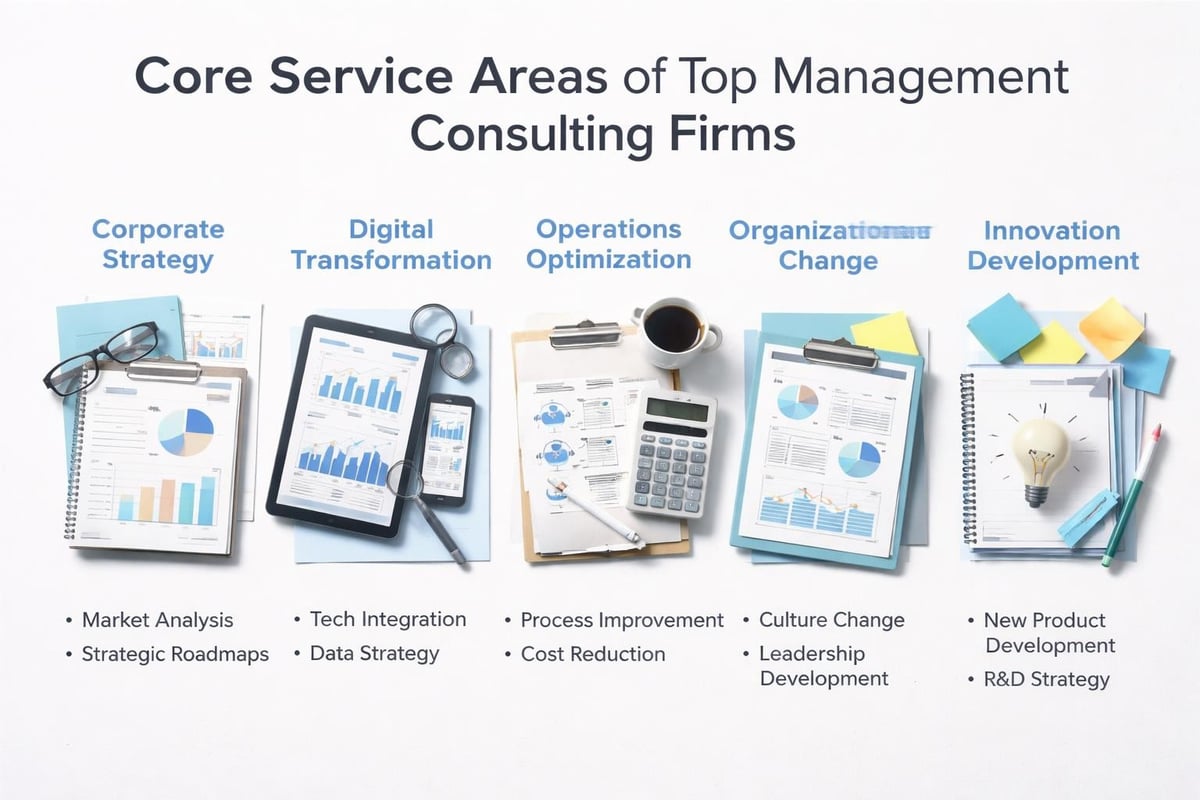
Top firms structure their offerings around several core service lines, each requiring distinct skill sets and delivery methodologies:
Strategy Consulting remains the highest-margin and most prestigious practice area. These engagements typically involve senior partners working directly with C-suite executives to define corporate direction, evaluate growth opportunities, and make critical business decisions. Strategy work at leading firms commands premium pricing, often exceeding $500,000 per consultant per year.
Operations Consulting focuses on improving efficiency, reducing costs, and optimizing business processes. This practice area tends to involve longer engagements with larger teams implementing changes across procurement, manufacturing, supply chain, and service delivery. The work requires deep operational expertise combined with change management capabilities.
Digital Transformation has emerged as the fastest-growing practice area among top us management consulting firms, driven by technological disruption across every industry. These engagements blend technology and consulting expertise to help organizations modernize their technology infrastructure, adopt cloud platforms, implement artificial intelligence, and redesign customer experiences for digital channels.
Organization and People consulting addresses talent strategy, leadership development, culture change, and organizational design. As businesses recognize that sustainable competitive advantage increasingly depends on human capital, this practice area has grown substantially, with firms developing sophisticated approaches to workforce transformation.
Innovation and Strategic Transformation Leadership
The most forward-thinking among the top us management consulting firms have recognized that traditional advisory models must evolve to address the unprecedented pace of market disruption. Innovation consulting has shifted from a niche specialty to a central capability as companies across industries face threats from digital natives, changing customer expectations, and technological breakthroughs.
Leading firms now invest heavily in innovation strategy consulting capabilities, building dedicated practices that help clients discover uncontested market space, develop breakthrough business models, and create products that customers genuinely want. This shift reflects a fundamental change in what clients need: less focus on optimizing existing operations and more emphasis on creating new sources of growth.
Several approaches distinguish the most effective innovation-focused consulting:
- Market opportunity identification through systematic analysis of customer pain points, underserved segments, and white space in competitive landscapes
- Business model innovation that challenges industry assumptions and creates new value propositions
- Rapid prototyping and experimentation to test concepts quickly before committing significant resources
- Innovation capability building through training programs that enable organizations to innovate independently
- AI-powered strategic insight that accelerates opportunity discovery and enhances decision-making quality
Building Internal Innovation Capacity
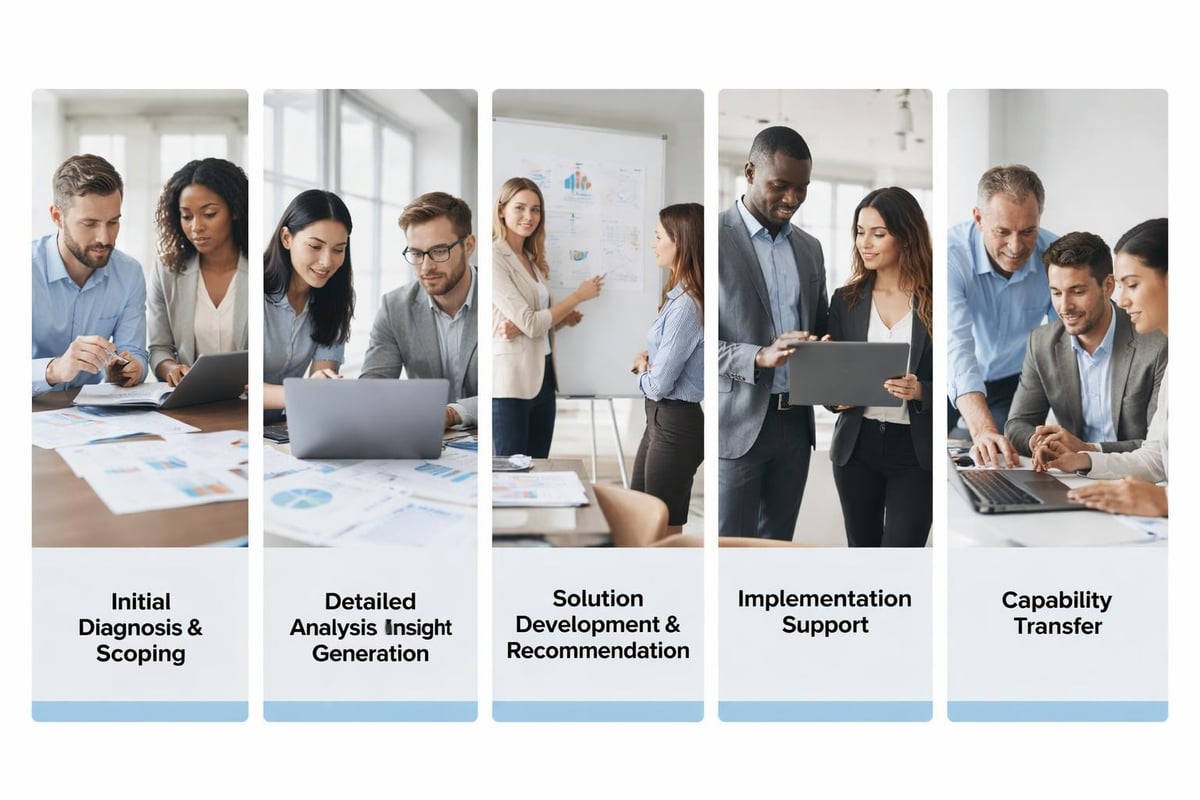
Progressive consulting firms recognize that sustainable client success requires more than delivering recommendations. The most valuable engagements transfer knowledge and build capabilities that enable organizations to continue innovating after consultants depart. This philosophy aligns closely with approaches like design thinking and innovation consulting, which emphasize collaborative problem-solving and skill development.
Top firms increasingly offer structured training programs in creativity, strategic innovation methodologies, and change leadership. These programs transform how organizations approach challenges, moving beyond incremental improvement toward breakthrough thinking that opens new growth trajectories.
Selecting the Right Consulting Partner
Choosing among the top us management consulting firms requires careful evaluation of multiple factors beyond brand recognition and prestige rankings. The most successful client-consultant relationships align firm capabilities with specific business needs, cultural fit, and engagement objectives.
Key Selection Criteria
Relevant Industry Experience ranks as perhaps the most critical selection factor. While general business acumen matters, consultants who deeply understand your industry's dynamics, competitive pressures, regulatory environment, and customer behaviors deliver insights that generic frameworks cannot match. Request case studies and references from similar companies facing comparable challenges.
Demonstrated Innovation Capability becomes increasingly important as market conditions accelerate and disruption threatens established business models. Evaluate how firms approach strategy and transformation consulting by examining their track record of helping clients enter new markets, launch successful new products, or reinvent their business models.
Team Composition and Continuity directly impacts engagement quality. The partners who participate in the sales process should remain actively involved throughout the project, not disappear after contract signing. Ask about staffing plans, partner involvement levels, and policies regarding team continuity.
Methodology and Approach varies significantly across firms. Some rely heavily on proprietary frameworks and standardized approaches, while others customize methodologies to each client's unique situation. Understanding a firm's philosophical approach helps predict whether their style will fit your organization's culture and decision-making processes.
| Evaluation Factor | Questions to Ask | Red Flags to Avoid |
|---|---|---|
| Track Record | What similar engagements have you completed? What results did you achieve? | Vague descriptions, inability to quantify outcomes |
| Team Expertise | Who will staff this engagement? What is their background? | Junior-heavy teams, frequent turnover during project |
| Knowledge Transfer | How will you build our internal capabilities? | Pure deliverable focus without capability building |
| Pricing Structure | How do you charge? Are fees tied to results? | Lack of transparency, resistance to outcome-based pricing |
Understanding Fee Structures and Value
The top us management consulting firms employ various pricing models, each with implications for engagement economics and risk allocation. Traditional time-and-materials billing remains common, with daily rates ranging from $2,000 for junior consultants to $15,000 or more for senior partners. This model provides flexibility but creates potential misalignment between consultant incentives and client interests.
Value-based pricing ties fees to project scope and expected outcomes rather than hours worked. This approach can deliver better client economics when engagements generate substantial measurable value. Success-based fees, where consultants receive bonuses for achieving specific metrics, represent the strongest alignment but remain relatively uncommon outside private equity-backed transformations.
The Future of Management Consulting
The management consulting industry faces its own transformation as client needs evolve, technology disrupts traditional delivery models, and new competitors enter the market. Understanding these trends helps leaders anticipate how relationships with the top us management consulting firms will change in coming years.
Artificial Intelligence Integration is reshaping how consultants work and the insights they deliver. Leading firms now deploy AI for data analysis, pattern recognition, scenario modeling, and even recommendation generation. This technology enables consultants to process vastly more information and identify opportunities that manual analysis would miss. Firms that excel at AI-powered strategic innovation deliver accelerated insights and more robust strategies.
Implementation Emphasis reflects client demand for help executing recommendations, not just developing them. The traditional model where consultants deliver slide decks and depart has given way to engagements that include implementation support, interim management, and sustained partnership through execution phases. This shift benefits clients but requires consulting firms to develop new capabilities beyond strategy formulation.
Sustainability and ESG have emerged as central concerns for businesses across industries. Top consulting firms now maintain dedicated practices helping clients improve environmental performance, strengthen social responsibility programs, and enhance governance structures. These capabilities respond to investor pressure, regulatory requirements, and consumer expectations around corporate responsibility.
Emerging Competition and Market Dynamics
The consulting market continues evolving as new entrants challenge traditional firms. Specialized boutiques focusing on specific industries or capabilities often deliver deeper expertise than generalist firms in their domains of focus. Technology companies including Accenture, IBM, and Cognizant have built substantial consulting practices that integrate strategic advisory with technology implementation.
The prestige rankings of consulting firms demonstrate that reputation remains crucial for attracting top talent and premium clients, yet prestige alone no longer guarantees engagement success. Clients increasingly value demonstrated expertise, relevant experience, and measurable results over brand recognition.
Internal strategy teams at large corporations have also grown more sophisticated, handling projects that previously required external consultants. This trend pushes consulting firms toward more complex, specialized work where external expertise adds clear value. The most successful firms adapt by developing deeper capabilities, investing in proprietary methodologies, and demonstrating measurable impact.
Maximizing Consulting Engagement Value
Organizations that achieve exceptional returns from consulting engagements share common practices that maximize the value delivered by the top us management consulting firms. These approaches transform consulting from an expensive cost center into a powerful catalyst for growth and transformation.
Best Practices for Client Organizations
Define Clear Objectives and Success Metrics before engaging consultants. Vague mandates like "help us grow" or "improve performance" rarely produce satisfactory outcomes. Specific, measurable goals such as "identify three new market opportunities each capable of generating $50 million in revenue within three years" provide direction and enable objective evaluation of consulting impact.
Commit Internal Resources to support the engagement. The most successful projects involve dedicated client team members working alongside consultants, ensuring knowledge transfer, organizational buy-in, and implementation feasibility. Companies that treat consulting as something done to them rather than with them rarely achieve sustainable results.
Empower Decision-Making by involving the right executives at appropriate points. Consultants need access to senior leaders who can provide context, make decisions, and champion recommended changes. Engagement success correlates strongly with executive sponsorship quality.
Plan for Implementation from the project's beginning rather than treating it as an afterthought. Building implementation capabilities through approaches like business model transformation ensures recommendations translate into actual business results rather than remaining theoretical exercises.
The most sophisticated clients view consulting relationships as opportunities to build internal capabilities that extend beyond individual project boundaries. They prioritize knowledge transfer, actively participate in methodology training, and systematically capture insights for future application.
Measuring Consulting Impact
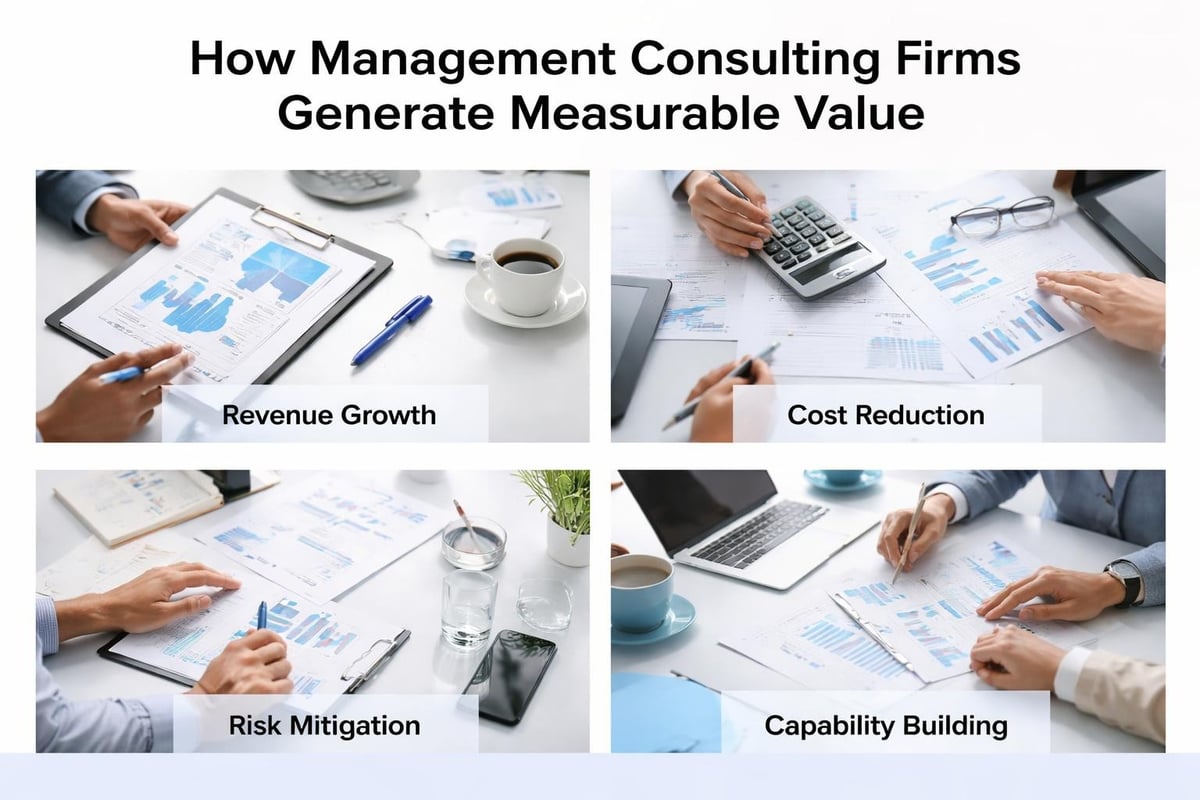
Quantifying the return on consulting investments requires establishing baselines, tracking relevant metrics, and attributing outcomes appropriately. While some benefits like cost reductions or revenue from new products can be measured directly, other impacts including improved decision quality, accelerated time-to-market, or enhanced innovation capability prove harder to quantify.
Leading organizations implement structured approaches to measure consulting value:
- Financial metrics tracking revenue growth, cost savings, profit improvement, and return on invested capital directly attributable to consulting recommendations
- Operational metrics measuring efficiency gains, quality improvements, cycle time reductions, and productivity enhancements
- Strategic metrics assessing market share changes, customer satisfaction improvements, new market entries, and successful product launches
- Capability metrics evaluating skill development, process improvements, and organizational readiness for future challenges
The most valuable consulting engagements often deliver benefits that compound over time as new capabilities enable continuous improvement and innovation beyond the initial project scope.
Specialized Consulting for Innovation-Driven Growth
While the largest top us management consulting firms maintain broad service portfolios, specialized firms focusing on innovation and growth strategy offer distinct advantages for organizations prioritizing breakthrough thinking over incremental improvement. These firms combine strategic rigor with creativity, helping clients discover opportunities that traditional analysis might overlook.
Innovation-focused consulting emphasizes discovering new market space rather than competing more effectively in existing markets. This approach draws on methodologies like Blue Ocean Strategy, design thinking, and jobs-to-be-done frameworks to identify unmet customer needs and develop offerings that create new demand rather than capturing share from competitors.
Organizations facing market disruption, commoditization pressure, or growth plateaus particularly benefit from strategy experts who specialize in opportunity discovery and business model innovation. These consultants help companies break free from industry conventions, challenge limiting assumptions, and develop strategies that open new growth trajectories.
The most effective innovation consulting combines external perspective with collaborative engagement models that build internal capabilities. Rather than arriving with predetermined solutions, consultants facilitate structured processes that surface insights from the organization's own expertise while introducing proven frameworks and methodologies that enhance creative thinking.
The landscape of top us management consulting firms offers diverse capabilities, approaches, and specializations to address virtually any strategic challenge organizations face. Success in consulting relationships depends on selecting partners whose expertise aligns with your specific needs, defining clear objectives, and approaching engagements as collaborative partnerships rather than outsourced tasks. As markets continue accelerating and disruption becomes the norm rather than the exception, the firms that thrive will be those that help clients not just optimize current operations but discover and capture entirely new opportunities for growth. Six Paths Consulting specializes in exactly this type of transformational work, combining AI-powered strategic innovation with proven methodologies to help ambitious leaders discover new market opportunities, develop breakthrough business models, and build the internal innovation capabilities that drive sustained competitive advantage.