
Creating products and services that customers genuinely want requires more than intuition or assumptions. It demands a systematic approach to understanding customer needs and aligning them with what your business offers. This is where value proposition design becomes essential for organizations seeking sustainable growth and competitive advantage. By providing a structured methodology for crafting compelling value propositions, this framework enables businesses to reduce market risks, accelerate product development, and deliver solutions that resonate deeply with target audiences.
Understanding the Foundation of Value Proposition Design
Value proposition design represents a disciplined approach to creating, testing, and refining the value your business delivers to customers. Unlike traditional marketing approaches that focus primarily on positioning, value proposition design emphasizes the critical alignment between what customers need and what products or services provide.
The methodology emerged from the recognition that most new products fail not because of poor execution, but because they solve problems customers don't actually have. This framework addresses that fundamental challenge by starting with deep customer understanding before moving to solution development.
The Core Components
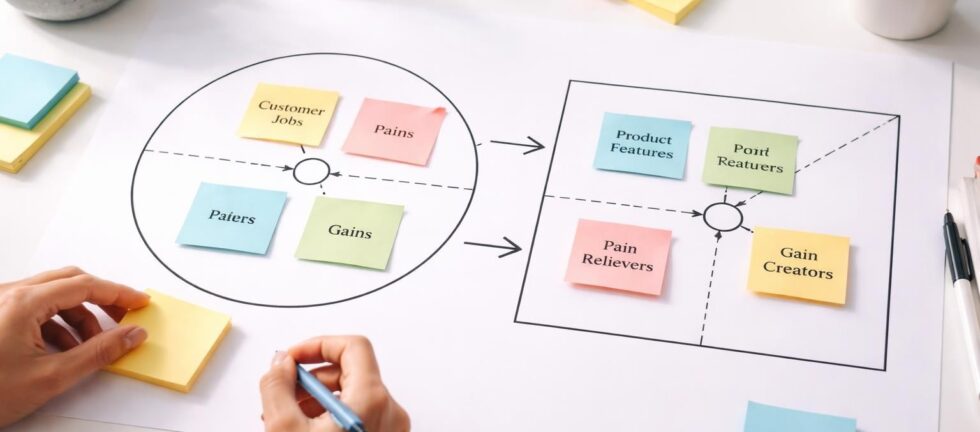
At its heart, value proposition design consists of two primary elements that must work in harmony. The customer profile captures the jobs customers are trying to accomplish, the pains they experience, and the gains they desire. The value map outlines your products and services, how they relieve pains, and how they create gains.
The customer profile includes:
- Jobs: The tasks customers are trying to complete, problems they're solving, or needs they're satisfying
- Pains: The negative outcomes, risks, and obstacles customers experience
- Gains: The benefits and outcomes customers want to achieve
The value map encompasses:
- Products and services: What you offer to customers
- Pain relievers: How your offerings reduce or eliminate customer pains
- Gain creators: How your offerings produce customer gains and benefits
The Value Proposition Canvas as a Strategic Tool
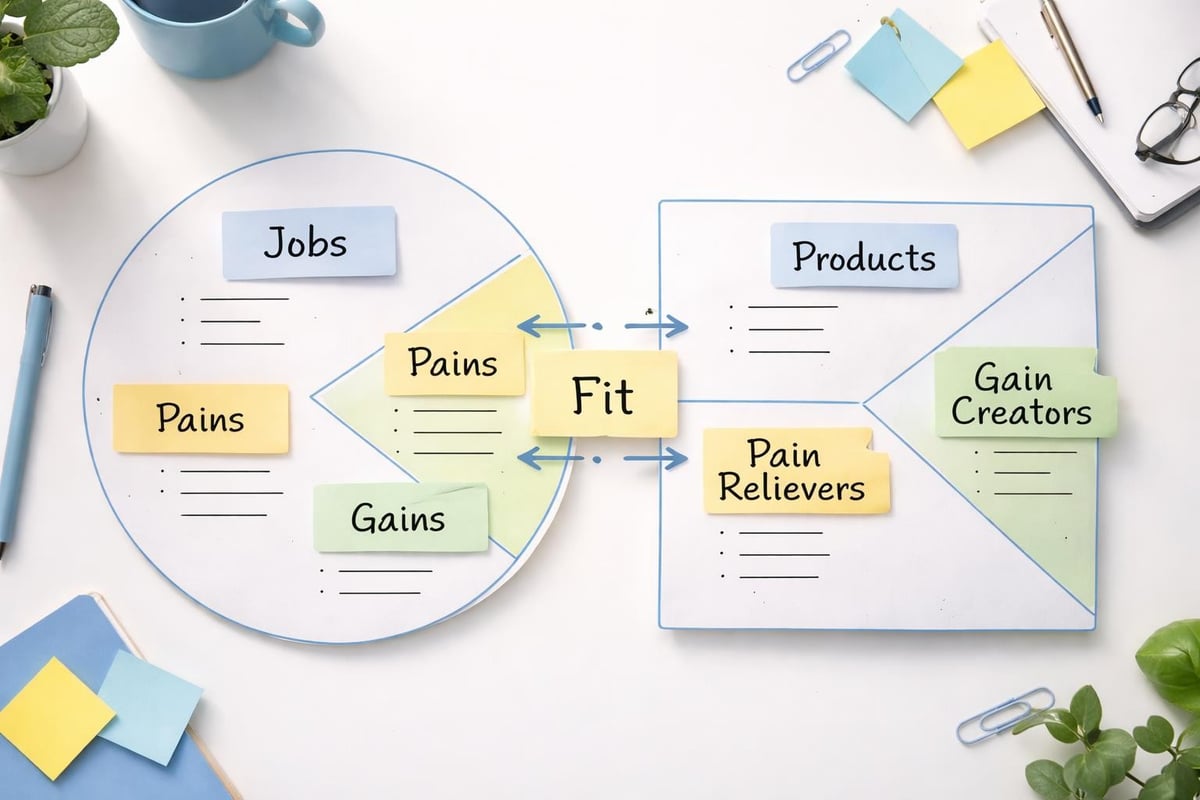
The Value Proposition Canvas serves as the primary visual framework for value proposition design. Developed by Alex Osterwalder and Yves Pigneur, this tool provides a practical method for establishing a credible and consistent basis for articulating value to customers.
| Canvas Section | Purpose | Key Questions |
|---|---|---|
| Customer Jobs | Identify what customers are trying to accomplish | What functional, social, and emotional jobs is the customer trying to get done? |
| Customer Pains | Understand frustrations and obstacles | What annoys customers? What risks do they fear? |
| Customer Gains | Define desired outcomes | What would make customers happy? What would save them time or money? |
| Products/Services | List your offerings | What do you offer to help customers? |
| Pain Relievers | Show how you eliminate problems | How do your offerings reduce or eliminate pains? |
| Gain Creators | Demonstrate value creation | How do your offerings create customer gains? |
The canvas becomes particularly powerful when used iteratively throughout the product innovation process. Rather than a one-time exercise, successful organizations revisit and refine their value propositions as they gather customer feedback and market intelligence.
Achieving Product-Market Fit
The ultimate goal of value proposition design is achieving "fit" between what you offer and what customers need. This fit occurs when customers get excited about your value proposition, demonstrating clear preference for your solution over alternatives. Without this fit, even the most innovative products struggle to gain market traction.
Fit manifests in observable customer behaviors. Customers actively seek your product, recommend it to others, and express disappointment when it's unavailable. These signals indicate that your value proposition resonates at a fundamental level.
Implementing Value Proposition Design in Your Organization
Moving from theory to practice requires a structured approach that engages cross-functional teams and incorporates customer feedback at every stage. The implementation process typically follows several distinct phases, each building on insights from the previous stage.
Phase One: Customer Discovery and Research
Begin by conducting thorough customer research to understand the jobs, pains, and gains that matter most to your target segments. This research should combine quantitative and qualitative methods to capture both what customers say and what they actually do.
Effective research techniques include:
- In-depth customer interviews focusing on specific scenarios and decisions
- Observational studies to identify unarticulated needs and behaviors
- Survey data to validate hypotheses across larger customer populations
- Analysis of customer support tickets and complaints to uncover recurring pains
- Competitive analysis to understand alternative solutions customers consider
Organizations that excel at value proposition design integrate customer insights throughout their operations, not just during product development. This customer-centric culture ensures that value propositions remain relevant as markets evolve.
Phase Two: Mapping and Hypothesis Formation
With customer insights in hand, map your current or proposed offerings onto the value map portion of the canvas. Be brutally honest about which pains your products actually relieve and which gains they genuinely create. Many organizations discover gaps between what they assume their products deliver and what customers actually experience.
This mapping exercise often reveals opportunities for innovative ideas for business growth by highlighting unaddressed customer pains or potential new gain creators. The key is prioritizing based on what matters most to customers, not what's easiest to implement.

Phase Three: Testing and Validation
Common challenges in value proposition design emerge during the validation phase when assumptions meet reality. Rather than investing heavily in full product development, create rapid experiments to test whether your value proposition resonates with customers.
Testing methods range from simple to sophisticated:
- Landing page tests that measure customer interest through sign-ups or clicks
- Concierge MVPs where you manually deliver the value proposition to early customers
- Prototype testing with functional mockups that demonstrate core features
- Pricing experiments to understand willingness to pay
- A/B testing of different value proposition messaging
Each experiment should test specific hypotheses about your value proposition. Document what you learn and adjust your canvas accordingly. This learning loop accelerates dramatically when organizations embrace rapid iteration over prolonged planning.
Advanced Applications Across Business Models
Value proposition design extends beyond product development into multiple business contexts. Forward-thinking organizations apply these principles to business model transformation and strategic innovation initiatives.
Service Innovation and Customer Experience
Service-based businesses face unique challenges in value proposition design because their offerings are intangible and experienced over time. The framework helps service providers identify specific moments that create or destroy value in the customer journey.
For professional services firms, value proposition design clarifies the transformation clients seek rather than focusing solely on deliverables. A sales training workshop creates value not through the training session itself, but through improved sales performance and revenue growth that follows.
Platform and Ecosystem Strategies
Multi-sided platforms must design value propositions for each distinct customer segment. A marketplace serves both buyers and sellers, each with different jobs, pains, and gains. Successful platforms achieve fit with all segments simultaneously, creating network effects that strengthen over time.
The canvas helps platform businesses visualize these interconnected value propositions and identify how value creation for one segment enhances value for others. This systems thinking prevents the common pitfall of optimizing for one segment at the expense of another.
Integration with Strategic Frameworks
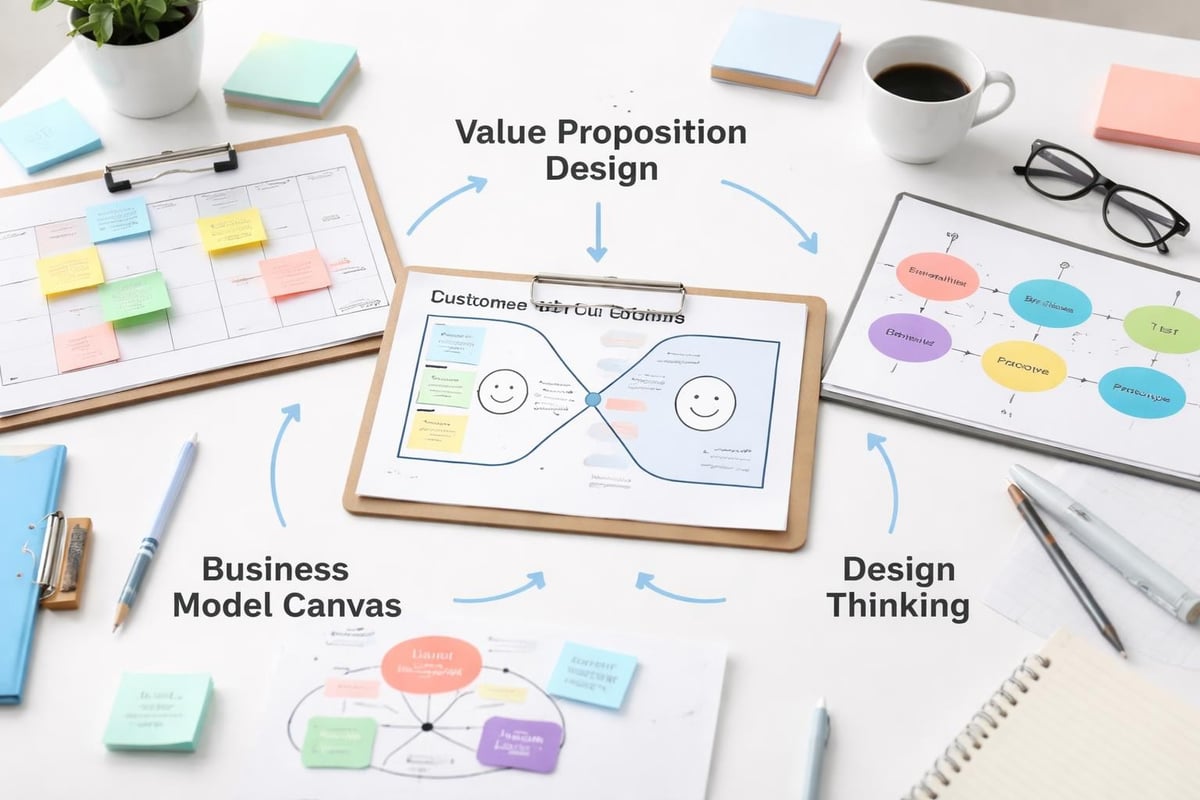
Value proposition design doesn't operate in isolation but integrates powerfully with other strategic tools and methodologies. Understanding these connections enhances the effectiveness of your innovation efforts.
| Strategic Framework | Connection to Value Proposition Design | Combined Benefits |
|---|---|---|
| Business Model Canvas | Value propositions form one of nine building blocks | Ensures value proposition aligns with revenue models, channels, and resources |
| Jobs-to-be-Done Theory | Deepens understanding of customer jobs | Reveals emotional and social dimensions beyond functional needs |
| Design Thinking | Provides human-centered innovation process | Embeds empathy and iteration into value proposition development |
| Lean Startup | Shares emphasis on hypothesis testing | Accelerates learning through build-measure-learn cycles |
| Blue Ocean Strategy | Identifies uncontested market spaces | Reveals non-customers and value innovation opportunities |
Organizations implementing frameworks for innovation benefit from understanding how value proposition design complements and enhances these approaches. The integration creates a comprehensive innovation system rather than isolated tools.
The Role in Corporate Innovation
Large organizations face additional complexity when applying value proposition design across multiple business units and product lines. The framework helps innovation teams communicate clearly with executive sponsors and secure resources for new initiatives by demonstrating customer validation early in the process.
Corporate innovation strategy benefits from value proposition design by reducing political debates about product features. When teams anchor decisions in validated customer insights rather than internal opinions, resource allocation becomes more objective and strategic.
Common Pitfalls and How to Avoid Them
Even experienced practitioners encounter challenges when implementing value proposition design. Recognizing these patterns helps organizations maintain momentum and achieve better outcomes.
Inside-out thinking represents the most frequent mistake. Teams describe their products using internal terminology and technical specifications rather than customer outcomes and benefits. The solution requires disciplined focus on the customer profile before developing the value map.
Insufficient customer contact undermines the entire framework. Reading reports about customers differs fundamentally from speaking directly with them. Commit to regular customer conversations throughout the innovation process, not just during initial research phases.
Premature scaling occurs when organizations invest heavily in solutions before achieving fit. The methodology explicitly recommends small experiments and iterative refinement. Resist pressure to move quickly into full development until customer validation clearly demonstrates demand.
Neglecting the competition leaves value propositions vulnerable. Customers always have alternatives, including doing nothing. Your value proposition must be compelling relative to these alternatives, not just good in isolation.
Measuring Value Proposition Effectiveness
Quantifying the impact of value proposition design helps justify ongoing investment and identify areas for improvement. Leading organizations track both input metrics that measure process quality and output metrics that capture business results.
Process Metrics
- Number of customer interviews conducted per month
- Percentage of features validated through experiments before development
- Time from initial hypothesis to validated learning
- Customer feedback incorporated into product iterations
- Cross-functional participation in value proposition workshops
Business Outcome Metrics
- Customer acquisition cost relative to lifetime value
- Conversion rates at each funnel stage
- Net Promoter Score and customer satisfaction ratings
- Revenue per customer segment
- Market share gains in target segments
The most sophisticated organizations establish clear connections between process improvements and business outcomes. This data-driven approach to value proposition design enables continuous optimization and demonstrates ROI to stakeholders.
Building Organizational Capability
Sustainable success with value proposition design requires more than executing a single project. It demands building organizational capabilities that persist beyond individual initiatives. This transformation touches processes, skills, and culture simultaneously.
Developing internal expertise starts with training cross-functional teams in the methodology and tools. Hands-on workshops where teams apply the canvas to real business challenges create deeper understanding than theoretical instruction alone. Organizations should combine initial training with ongoing coaching as teams encounter real-world complexity.
Knowledge sharing mechanisms ensure insights spread throughout the organization. Regular showcase sessions where teams present their value propositions and customer learnings create accountability and cross-pollination of ideas. Documentation standards help capture knowledge for future teams and new employees.
Leadership commitment proves essential for cultural change. When executives model customer-centric decision making and reward teams for validated learning rather than just execution speed, the entire organization shifts toward continuous value proposition refinement. This alignment between strategy and operations accelerates innovation velocity while reducing waste.
Future Directions and Emerging Practices
The field of value proposition design continues evolving as new technologies and market dynamics emerge. Artificial intelligence and machine learning now enable analysis of customer feedback at unprecedented scale, identifying patterns humans might miss. These tools complement rather than replace human judgment in understanding nuanced customer needs.
Real-time value proposition testing through digital channels allows continuous optimization. Rather than periodic research projects, leading organizations now maintain always-on feedback loops that inform daily product decisions. This shift from episodic to continuous customer understanding fundamentally changes how businesses operate.
The integration of UX design principles with value proposition methodology creates more holistic customer experiences. Visual designers, product managers, and strategists collaborate earlier in the innovation process, ensuring consistency between what organizations promise and what customers actually experience.
Mastering value proposition design transforms how organizations create and deliver customer value, reducing market risk while accelerating innovation velocity. The structured approach to understanding customer jobs, pains, and gains provides a foundation for developing products and services that customers genuinely want. Six Paths Consulting helps ambitious leaders apply these methodologies to discover new market opportunities and build sustainable competitive advantages through AI-powered strategic innovation. Our training programs develop in-house capabilities that enable your teams to continuously refine value propositions and drive profitable growth.