

Product innovation represents the cornerstone of competitive advantage in today's rapidly evolving marketplace. As businesses face unprecedented technological disruption and shifting customer expectations, the ability to systematically develop breakthrough products determines which organizations thrive and which struggle to maintain relevance. Understanding the strategic dimensions of product innovation extends beyond simply creating new features-it requires a comprehensive approach that integrates market insights, technological capabilities, and customer-centric design principles. For ambitious leaders seeking sustainable growth, mastering these innovation principles has become essential for building resilient, future-ready organizations.
The Strategic Foundation of Product Innovation
The fundamental nature of product innovation encompasses both incremental improvements and radical breakthroughs that create new value propositions for customers. This duality requires organizations to balance exploitation of existing products with exploration of entirely new market spaces.
Strategic product innovation begins with understanding the three essential components that drive success. First, market opportunity identification involves rigorous analysis of customer pain points, emerging trends, and competitive gaps. Second, capability assessment determines whether your organization possesses or can acquire the resources necessary to execute innovation initiatives. Third, value proposition design ensures that new products deliver measurable benefits that customers will pay for.
Building Innovation Capabilities
Organizations must develop systematic capabilities rather than relying on sporadic creative bursts. This involves establishing frameworks for innovation that provide structure while maintaining flexibility for creative exploration.
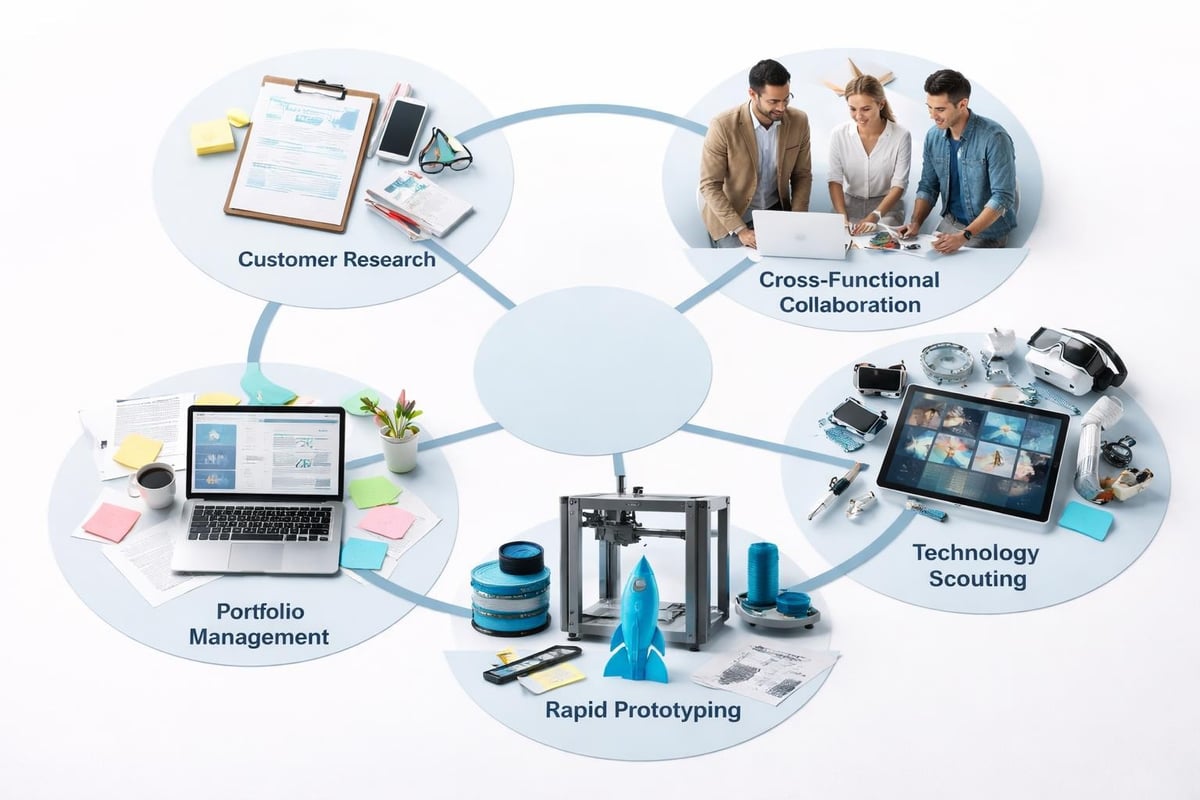
Core innovation capabilities include:
- Customer insight generation through ethnographic research and data analytics
- Cross-functional collaboration mechanisms that break down organizational silos
- Rapid prototyping and testing methodologies for quick learning cycles
- Portfolio management approaches balancing risk across multiple initiatives
- Technology scouting systems identifying emerging capabilities
Research demonstrates that external information sources significantly influence innovation outcomes, particularly when organizations actively engage with customers, suppliers, and research institutions. Companies that establish systematic processes for capturing external insights consistently outperform those relying solely on internal perspectives.
Sources of Innovation Inspiration
Identifying where innovation ideas originate separates high-performing innovation teams from those that struggle to generate compelling concepts. While conventional wisdom suggests innovation emerges randomly, strategic organizations cultivate specific sources that consistently produce valuable insights.
Leadership alignment stands as the primary source, ensuring innovation efforts connect directly to strategic priorities and resource allocation decisions. When executive teams establish clear innovation mandates, middle management and product teams can confidently pursue ambitious initiatives knowing they have organizational support.
Customer-Driven Discovery
The most valuable innovation insights frequently emerge from deep customer engagement that goes beyond traditional market research. Strategic sources for innovation inspiration include observing customer behaviors in natural contexts, analyzing usage data patterns, and conducting solution co-creation workshops.
Successful practitioners employ multiple research methodologies:
- Ethnographic observation capturing how customers actually use products versus how they describe their usage
- Jobs-to-be-Done analysis identifying the underlying progress customers seek rather than product features they request
- Lead user studies engaging early adopters facing needs ahead of mainstream markets
- Digital behavior analytics revealing patterns invisible in self-reported data
- Voice-of-customer programs systematically collecting and analyzing feedback across touchpoints
The integration of these approaches creates a comprehensive understanding that surfaces opportunities competitors miss. Organizations practicing customer consulting methodologies gain deeper insights by treating research as an ongoing dialogue rather than periodic surveys.
Product Innovation Types and Strategies
Product innovation manifests across a spectrum from sustaining innovations that improve existing offerings to disruptive innovations that create entirely new markets. Understanding these categories helps organizations allocate resources appropriately and set realistic expectations for returns.
| Innovation Type | Characteristics | Risk Level | Time Horizon | Market Impact |
|---|---|---|---|---|
| Incremental | Feature additions, performance improvements | Low | 6-18 months | Maintain position |
| Adjacent | New customer segments, related categories | Medium | 1-2 years | Expand market |
| Breakthrough | New technologies, business models | High | 3-5 years | Transform industry |
| Disruptive | Redefine value proposition, create markets | Very High | 5+ years | Create category |
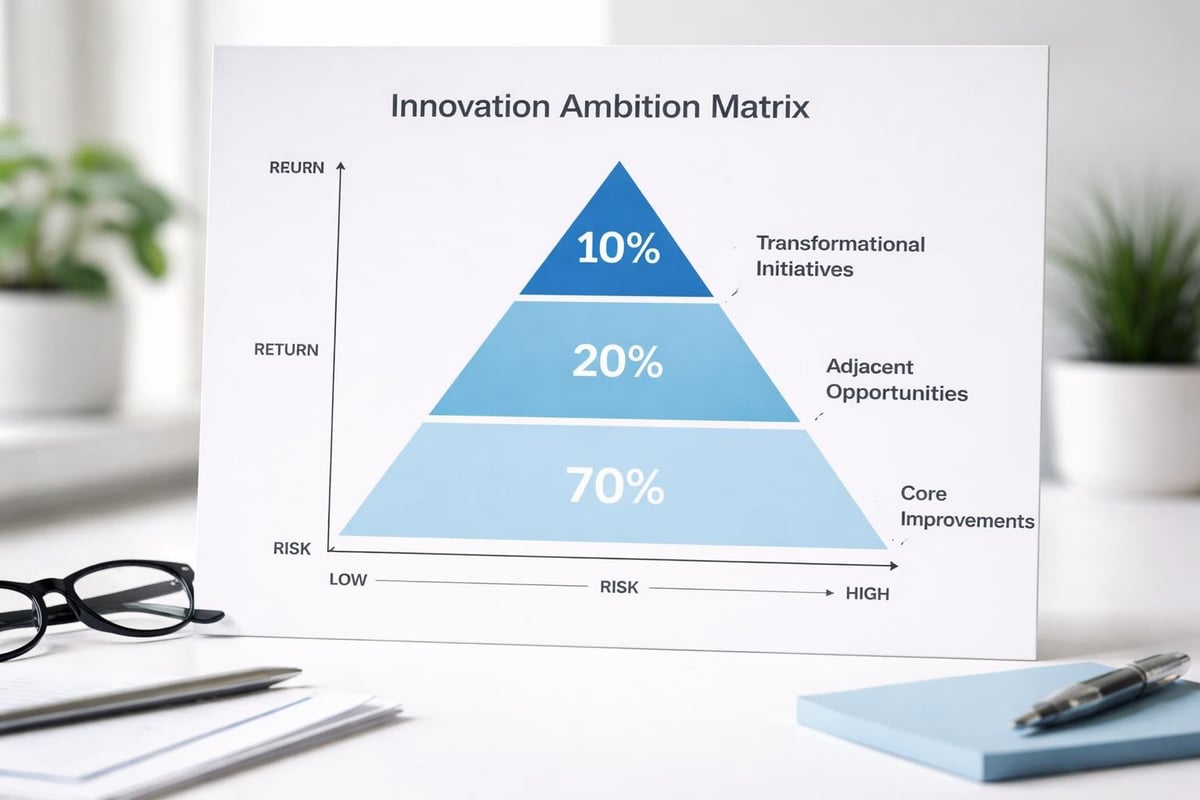
Organizations building robust innovation portfolios typically allocate resources across these categories, with roughly 70% supporting core business improvements, 20% pursuing adjacent opportunities, and 10% exploring transformational initiatives. This balanced approach, often called the "innovation ambition matrix," ensures short-term performance while building future growth engines.
Process Innovation Connections
While product innovation receives significant attention, its effectiveness often depends on underlying process innovations that enable efficient development and delivery. The relationship between product and process innovation creates synergies where advances in one domain accelerate progress in the other.
Manufacturing innovations enable product features previously impossible or economically unviable. Digital tools revolutionize how teams collaborate during development cycles. Artificial intelligence enhances both what products can do and how efficiently teams can design them.
The Product Development Innovation Process
Transforming concepts into market-ready products requires disciplined processes that manage uncertainty while maintaining creative flexibility. The most effective new product development and innovation approaches combine structured stage-gates with agile iteration methodologies.
The discovery phase focuses on problem definition and opportunity validation before investing significant development resources. Teams conduct market sizing analysis, assess competitive dynamics, and prototype core concepts for early customer feedback. This front-end investment dramatically reduces downstream waste by killing non-viable ideas quickly.
Development stages employ rapid iteration cycles that progressively refine product specifications based on ongoing customer testing. Rather than spending months perfecting features in isolation, teams release minimum viable products that gather real-world usage data informing subsequent enhancements.
Critical success factors throughout development:
- Clear decision rights preventing committee-driven mediocrity
- Dedicated resources avoiding part-time participant syndrome
- Customer access enabling continuous feedback loops
- Technical feasibility gates preventing over-promising
- Business model validation ensuring commercial viability
Launch preparation extends beyond marketing campaigns to encompass sales enablement, support infrastructure, and partnership ecosystems. Products fail not because of inferior technology but because organizations underinvest in go-to-market execution.
Design-Led Innovation Approaches
Design product innovation methodologies place user experience at the center of development decisions, ensuring technical capabilities translate into customer value. This human-centered approach reduces the risk of building sophisticated products nobody wants.
Design thinking frameworks guide teams through empathy-building research, ideation workshops generating diverse concepts, and rapid prototyping that makes ideas tangible for evaluation. The iterative nature of design processes accommodates learning and pivoting as teams discover what resonates with customers.
Visual prototypes communicate concepts more effectively than written specifications, enabling stakeholder alignment and reducing misunderstandings that derail projects. Interactive mockups let customers experience proposed solutions, providing feedback quality impossible through surveys or focus groups.
AI-Powered Innovation Acceleration
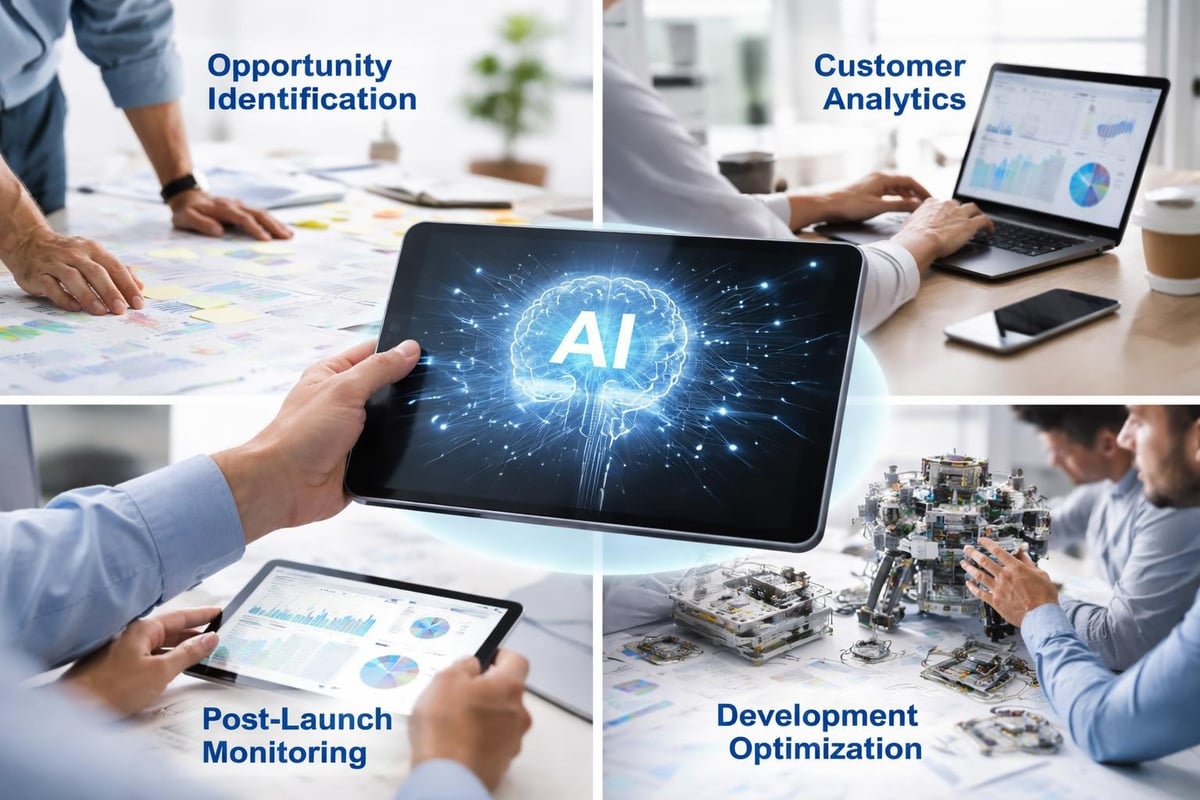
Artificial intelligence fundamentally transforms how organizations identify opportunities, develop products, and optimize performance. Rather than replacing human creativity, AI augments innovation capabilities by processing vast data sets, identifying patterns, and automating routine tasks that previously consumed innovation team bandwidth.
Generative AI assists in early-stage ideation by suggesting concept variations, identifying analogous solutions from other industries, and rapidly creating visual representations of proposed designs. Machine learning algorithms analyze customer usage data at scales impossible manually, surfacing insights about preferences, pain points, and emerging needs.
| AI Application | Innovation Impact | Implementation Complexity | Value Timeline |
|---|---|---|---|
| Customer analytics | Identify unmet needs from behavior data | Medium | 3-6 months |
| Predictive modeling | Forecast market reception before launch | High | 6-12 months |
| Generative design | Create optimized product configurations | High | 6-9 months |
| Sentiment analysis | Monitor real-time feedback at scale | Low | 1-3 months |
| Competitive intelligence | Track competitor moves and market shifts | Medium | 3-6 months |
Organizations leveraging AI-powered approaches through partnerships with specialists like top AI consulting companies accelerate time-to-market while improving product-market fit. The combination of human insight and machine processing creates competitive advantages difficult for traditional approaches to match.
Building AI Innovation Capabilities
Integrating artificial intelligence into innovation workflows requires both technological infrastructure and cultural readiness. Teams need access to quality data, appropriate tools, and training that builds confidence using AI-augmented processes.
Starting with focused pilot projects demonstrates value while building organizational competence. Customer segmentation analysis, concept testing optimization, or pricing strategy development provide contained scopes where teams can learn AI applications without betting entire product launches.
Successful AI integration maintains human judgment at critical decision points while automating data processing, pattern recognition, and scenario modeling. This balanced approach captures efficiency gains without sacrificing the creative intuition and contextual understanding that distinguish breakthrough innovations.
Building Internal Innovation Capabilities
Sustainable product innovation requires building organizational muscles rather than relying on external consultants for every initiative. While expert guidance accelerates initial progress, long-term success demands internal innovation capabilities embedded across the organization.
Training programs that develop innovation literacy enable employees at all levels to contribute ideas, participate in development initiatives, and champion new products within their networks. When innovation becomes everyone's responsibility rather than an isolated department function, organizations tap exponentially larger pools of creativity and market knowledge.
Effective capability-building approaches include:
- Innovation workshops teaching methodologies like design thinking and lean startup
- Cross-functional rotation programs exposing employees to different perspectives
- Innovation challenges encouraging grassroots idea generation
- Mentorship pairings connecting experienced innovators with developing talent
- Knowledge management systems capturing and sharing lessons learned
Measurement systems that track innovation inputs, processes, and outcomes create accountability while identifying improvement opportunities. Metrics spanning idea generation rates, development cycle times, launch success rates, and revenue from new products provide comprehensive performance visibility.
Market Opportunity Discovery Frameworks
Identifying where to focus innovation efforts determines ultimate value creation more than execution excellence. Organizations must systematically scan environments for emerging opportunities while maintaining disciplined evaluation criteria that separate genuine possibilities from distractions.
Blue ocean strategy methodologies help teams identify uncontested market spaces where competition becomes irrelevant through value innovation. By reconstructing market boundaries and focusing on non-customers, organizations discover opportunities incumbents systematically overlook.
Adjacent market exploration examines where existing capabilities could serve new customer segments or solve different problems. This leveraged growth approach builds on proven strengths while expanding addressable markets and reducing development risk.
Technology trend analysis monitors emerging capabilities that could enable new value propositions or delivery models. Systematic scouting processes track developments in artificial intelligence, materials science, biotechnology, and other fields relevant to your industry.
Competitive gap analysis identifies where market leaders underserve customer needs due to business model constraints, legacy technology limitations, or strategic blind spots. These gaps represent opportunities for entrants offering superior solutions.
Revenue Growth Through Innovation
Product innovation serves as the primary engine for sustainable revenue expansion beyond what organic growth and market share gains can deliver. Organizations consistently introducing valuable new products compound growth rates while building resilience against market disruptions.
The relationship between innovation investment and revenue growth follows predictable patterns when managed strategically. Companies maintaining 3-5% of revenue investment in product development typically achieve growth premiums of 2-4 percentage points above market rates.
Portfolio management approaches balance quick wins from incremental innovations against longer-term bets on breakthrough products. This temporal diversification ensures consistent revenue contributions while building future growth platforms.
Pricing strategy for innovative products requires understanding customer willingness to pay for novel value propositions. Value-based pricing captures fair returns on innovation investments while remaining competitive against alternatives customers might consider.
Launch sequencing decisions determine whether innovations reach their full potential or underperform due to poor timing. Market readiness assessment, competitive dynamics, and internal capacity considerations all influence optimal introduction timing.
Cross-Industry Innovation Perspectives
Breakthrough ideas frequently emerge from adapting concepts proven in other industries to new contexts. Organizations that systematically study innovation patterns across sectors access larger inspiration pools than those focusing narrowly on direct competitors.
Cross-industry innovation perspectives reveal recurring patterns in how disruption occurs, what customer adoption patterns emerge, and which business models succeed. These transferable lessons accelerate learning curves and reduce trial-and-error waste.
Analogical thinking exercises challenge teams to identify how solutions from unrelated fields might address their innovation challenges. How might hospitality industry approaches to customer experience enhance B2B software? Could manufacturing quality systems improve service delivery consistency?
Technology transfer opportunities arise when capabilities developed for one application prove valuable in different contexts. Materials created for aerospace applications find uses in consumer products. Algorithms designed for financial trading optimize supply chain management.
Partnership ecosystems that span industries create innovation advantages through diverse perspective integration. Collaborations with universities, startups, and non-competing corporations inject fresh thinking while sharing development costs and risks.
Innovation Metrics and Performance Management
What gets measured gets managed, making innovation measurement systems critical for sustained success. However, traditional financial metrics alone inadequately capture innovation performance since they lag actual activities by months or years.
Leading indicators track innovation pipeline health through metrics like ideas generated per employee, concepts in testing, and customer validation scores. These forward-looking measures provide early warnings when innovation activities slow before financial impacts appear.
Process efficiency metrics monitor how effectively organizations convert innovation investments into launched products. Development cycle times, resource utilization rates, and stage progression speeds reveal operational performance independent of market outcomes.
| Metric Category | Example Measures | Purpose | Target Audience |
|---|---|---|---|
| Input | R&D spending %, dedicated innovation team size | Resource allocation tracking | Executives |
| Process | Time to market, prototype iteration speed | Efficiency improvement | Operations |
| Output | Products launched, features released | Productivity measurement | Product teams |
| Outcome | Revenue from new products, market share gains | Business impact assessment | Board/investors |
Outcome metrics ultimately determine innovation success through market performance indicators. Revenue from products launched within the past three years, customer acquisition from new offerings, and market share in emerging categories demonstrate tangible business impact.
Balanced scorecards integrating financial and non-financial measures provide comprehensive views preventing optimization of individual metrics at others' expense. Teams need targets spanning efficiency, effectiveness, and impact dimensions.
Mastering product innovation requires integrating strategic frameworks, systematic processes, and organizational capabilities that transform creative concepts into market-winning products. As technological acceleration and market disruption intensify, the organizations that build robust innovation engines will capture disproportionate growth while competitors struggle with incremental improvements. Six Paths Consulting partners with ambitious leaders to develop AI-powered innovation strategies, build internal capabilities, and discover breakthrough market opportunities that drive sustainable revenue growth and competitive advantage.