

Organizations across industries face mounting pressure to innovate rapidly while maintaining profitability and customer relevance. A design thinking and innovation course provides leaders and teams with structured methodologies to tackle complex business challenges through human-centered problem-solving. These educational programs combine creative exploration with strategic rigor, enabling professionals to discover breakthrough opportunities and develop solutions that resonate with customers. As markets evolve and competitive dynamics shift, investing in design thinking capabilities has become essential for businesses seeking sustainable growth and differentiation.
Understanding the Value of Design Thinking Education
Design thinking represents more than a methodology; it embodies a fundamental shift in how organizations approach problem-solving and innovation. When professionals enroll in a design thinking and innovation course, they gain exposure to frameworks that balance analytical thinking with creative exploration. This dual approach proves particularly valuable for leaders navigating uncertain market conditions or exploring new revenue streams.
The core benefits include:
- Enhanced ability to identify unmet customer needs through empathetic research
- Structured processes for generating and testing innovative ideas rapidly
- Improved cross-functional collaboration and communication
- Reduced risk in new product or service development through iterative prototyping
- Greater confidence in challenging assumptions and reimagining business models
Recent research demonstrates the tangible impact of design thinking training. An empirical study examining creativity and innovation processes reveals that design thinking significantly influences how individuals approach problem-solving, regardless of their prior experience level. This finding underscores the accessibility of design thinking methodologies for diverse teams and backgrounds.
Curriculum Components That Drive Results
A comprehensive design thinking and innovation course typically structures content around five core phases: empathize, define, ideate, prototype, and test. Each phase builds upon the previous one, creating a cohesive framework for innovation. For instance, Harvard Business School’s course syllabus outlines specific exercises and learning objectives that guide participants through practical application of these principles.
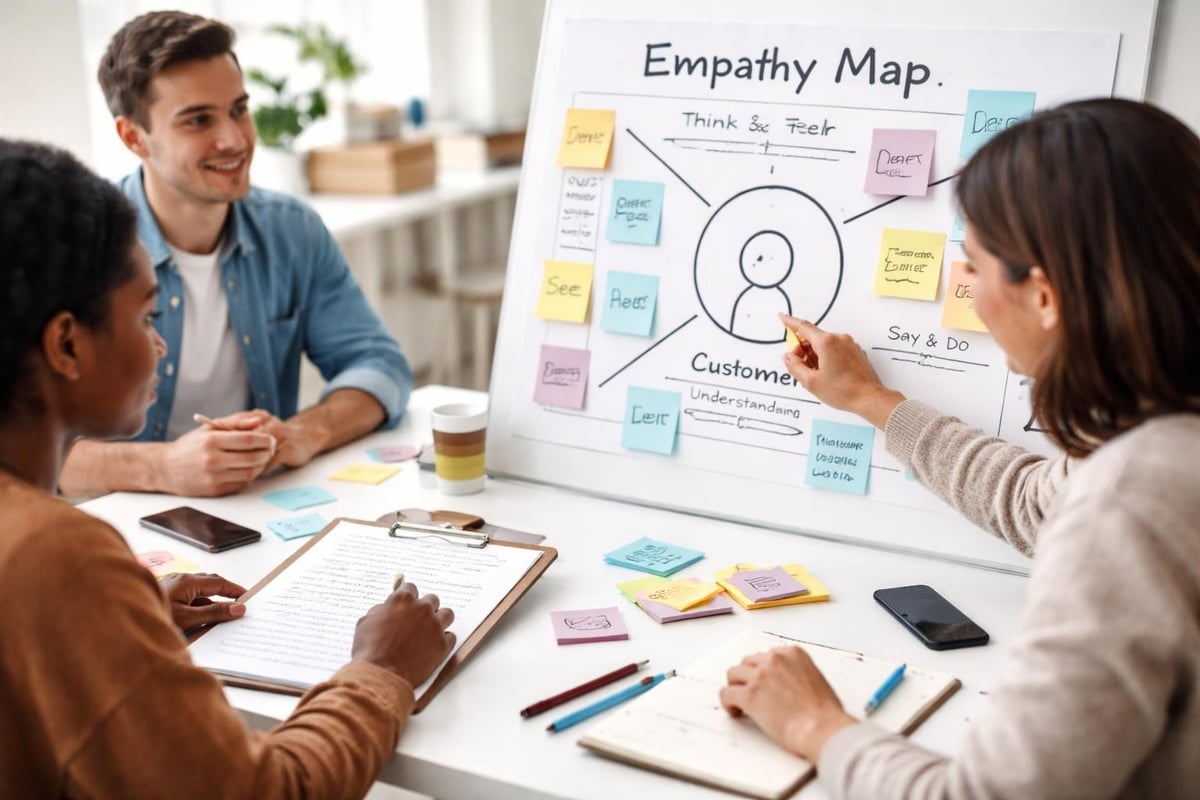
The empathize phase teaches observation and interview techniques that reveal deep customer insights. Participants learn to set aside assumptions and truly understand the experiences, frustrations, and aspirations of their target users. This foundation proves critical for identifying problems worth solving.
During the define stage, learners synthesize research findings into clear problem statements. This process requires analytical skills to identify patterns across diverse data points and strategic thinking to prioritize which challenges offer the greatest potential impact.
| Phase | Key Activities | Business Outcomes |
|---|---|---|
| Empathize | User interviews, observation, immersion | Deep customer understanding |
| Define | Synthesis, problem framing, prioritization | Clear focus on valuable challenges |
| Ideate | Brainstorming, divergent thinking, concept generation | Broad range of potential solutions |
| Prototype | Rapid mockups, minimum viable products, experimentation | Tangible concepts for testing |
| Test | User feedback, iteration, refinement | Validated solutions ready for implementation |
Selecting the Right Educational Pathway
Organizations and individuals face numerous options when choosing a design thinking and innovation course. Academic institutions, online platforms, and specialized training providers each offer distinct advantages. The optimal choice depends on learning objectives, time constraints, budget considerations, and desired depth of coverage.
Academic Programs and Their Advantages
Universities provide rigorous, research-backed curricula that blend theoretical foundations with practical application. Harvard University’s comprehensive course offers structured learning pathways that equip professionals to address complex business challenges systematically. These programs often include case studies from leading organizations, peer collaboration opportunities, and expert faculty guidance.
Similarly, the University of Virginia’s program through Coursera introduces fundamental design thinking concepts while emphasizing practical application across various sectors. The flexibility of online delivery combined with academic credibility makes these options attractive for working professionals.
Academic programs excel at:
- Providing theoretical grounding in innovation principles
- Offering structured progression through increasingly complex concepts
- Facilitating peer networking with diverse professionals
- Delivering recognized credentials that enhance professional credibility
- Incorporating latest research findings into curriculum design
Practical Workshops and Hands-On Learning
Many professionals benefit from intensive workshop formats that compress learning into focused sessions. Research from a mobile app development workshop demonstrates how concentrated, project-based learning accelerates skill development and immediately applicable outcomes. These experiences often involve working on real business challenges, creating immediate value for participants and their organizations.
Workshops typically emphasize rapid iteration and experimentation. Participants move quickly from concept to prototype, receiving immediate feedback and adjusting approaches in real-time. This accelerated learning cycle builds confidence and reduces hesitation around innovation initiatives. Organizations like Six Paths Consulting specialize in delivering customized workshops that address specific industry challenges and organizational contexts.
Integration with Strategic Business Functions
The true power of a design thinking and innovation course emerges when participants apply learned methodologies to critical business functions. Design thinking complements and enhances existing strategic processes rather than replacing them.
Requirements Engineering and Product Development
Design thinking naturally aligns with requirements engineering, creating more human-centered products and services. Academic research exploring this integration highlights synergies between design thinking's empathetic approach and requirements engineering's structured methodology. This combination proves particularly valuable for new product development initiatives where understanding user needs determines market success.

Teams trained in design thinking approach product specifications differently. Rather than starting with technical capabilities or competitive features, they begin with genuine user needs. This orientation often reveals unexpected opportunities that competitors overlook.
Key integration points include:
- User research informing technical requirement prioritization
- Rapid prototyping validating assumptions before full development
- Iterative testing reducing costly late-stage changes
- Cross-functional collaboration breaking down organizational silos
Innovation Strategy Development
Organizations investing in innovation strategy consulting benefit significantly when internal teams possess design thinking capabilities. The methodology provides practical tools for executing strategic innovation initiatives that drive measurable growth. Rather than relying solely on external consultants, companies with trained internal teams can maintain innovation momentum between engagements.
Design thinking enhances strategic planning by introducing customer-centric validation at every stage. Strategic hypotheses become testable through rapid prototyping rather than remaining abstract concepts. This approach reduces risk and accelerates learning cycles, critical factors for businesses operating in dynamic markets.
Emerging Applications and Future Directions
The design thinking field continues evolving, incorporating new technologies and addressing emerging challenges. Recent innovations expand the methodology's relevance and application potential.
AI and Design Thinking Convergence
Artificial intelligence introduces fascinating possibilities for enhancing design thinking practice. Research on user interface innovations for large language models demonstrates how design thinking principles guide the development of more intuitive, human-centered AI applications. As organizations increasingly adopt AI technologies, design thinking provides essential frameworks for ensuring these tools genuinely serve user needs.
The convergence proves particularly relevant for businesses exploring AI-powered strategic innovation. Design thinking methodologies help teams identify where AI creates authentic value rather than implementing technology for its own sake.
| Application Area | Design Thinking Contribution | AI Enhancement |
|---|---|---|
| Customer research | Qualitative insight generation | Pattern recognition across large datasets |
| Idea generation | Diverse perspective integration | Rapid concept variation and recombination |
| Prototyping | Quick physical/digital mockups | Generative design and simulation |
| Testing | User feedback collection | Predictive analytics and behavior modeling |
Expanding Beyond Traditional Boundaries
Contemporary design thinking education increasingly addresses complex, systemic challenges beyond product development. Coursera’s course examining the seven concerns of innovation exemplifies this broader perspective, guiding learners through empathy-driven approaches to organizational and societal challenges.
This expanded scope proves valuable for leaders working on business model innovation, customer experience transformation, or organizational change initiatives. A design thinking and innovation course equips professionals to tackle ambiguous challenges where traditional analytical methods fall short.
Building Organizational Capabilities
Individual learning represents just the starting point. Organizations achieve maximum value when design thinking capabilities become embedded across teams and functions. This cultural transformation requires intentional effort beyond initial training.
Creating Internal Champions
Successful organizations identify and develop internal champions who sustain design thinking practice after formal training concludes. These individuals facilitate workshops, coach colleagues, and advocate for human-centered approaches in decision-making processes. Their ongoing engagement prevents design thinking from becoming a one-time initiative that fades from organizational memory.
Champions benefit from advanced training that deepens their facilitation skills and broadens their methodological toolkit. They learn to adapt design thinking frameworks for diverse contexts, from strategic planning sessions to operational improvement projects.
Establishing Supporting Infrastructure
- Dedicated innovation spaces that encourage creative collaboration
- Resources for rapid prototyping and experimentation
- Time allocation for teams to pursue design thinking projects
- Metrics that value learning and iteration alongside traditional performance indicators
- Leadership commitment to customer-centric decision-making
Organizations partnering with consulting and change management specialists often accelerate capability building by combining external expertise with internal development efforts. This approach balances fresh perspectives with deep organizational knowledge.

Measuring Impact and Return on Investment
Executives rightfully question the business impact of training investments. A design thinking and innovation course delivers value through multiple channels, both quantitative and qualitative.
Quantifiable Outcomes
Organizations tracking design thinking impact typically measure:
- Reduction in new product development cycle times
- Increased success rates for innovation initiatives
- Higher customer satisfaction scores for new offerings
- Revenue growth from innovation-driven products or services
- Cost savings through early-stage problem identification
These metrics provide concrete evidence of return on investment, justifying continued training and capability development.
Strategic Advantages
Beyond immediate metrics, design thinking creates strategic advantages that compound over time. Teams develop shared language and frameworks for discussing innovation, reducing miscommunication and accelerating decision-making. Organizations become more adaptable, responding effectively to market shifts and emerging opportunities.
The methodology also enhances employee engagement. Team members appreciate opportunities to contribute creatively and see their ideas taken seriously through structured processes. This cultural shift supports talent retention and attracts innovation-minded professionals.
Customization for Industry Context
While design thinking principles apply universally, effective training acknowledges industry-specific challenges and opportunities. A design thinking and innovation course gains relevance when examples, case studies, and projects reflect participants' actual business contexts.
Financial services organizations face different innovation challenges than healthcare providers or manufacturing companies. Training that incorporates industry-appropriate scenarios accelerates learning transfer and practical application. Participants immediately recognize how methodologies address their specific pain points.
Customization extends beyond examples to include:
- Regulatory considerations affecting prototyping and testing approaches
- Industry-specific customer research techniques
- Relevant competitive dynamics and market structures
- Technical constraints or opportunities particular to the sector
- Cultural norms and stakeholder expectations within the industry
Sustaining Innovation Momentum
Completing a design thinking and innovation course marks a beginning rather than an endpoint. Organizations must intentionally sustain momentum to realize full potential from their training investment.
Recommended practices include:
- Regular design sprints addressing current business challenges
- Quarterly refresher sessions reinforcing key concepts and introducing advanced techniques
- Cross-functional innovation teams working on strategic priorities
- External speakers and case studies introducing fresh perspectives
- Participation in broader innovation communities and conferences
Frameworks for innovation provide ongoing structure for teams applying design thinking principles. These frameworks prevent the methodology from becoming abstract, instead grounding it in concrete business processes and decision points.
Organizations also benefit from periodic external perspectives. Even highly capable internal teams develop blind spots over time. Engaging specialists in value proposition design or creative innovation introduces fresh thinking while reinforcing foundational principles.
Investing in design thinking capabilities equips organizations with practical methodologies for navigating complexity, discovering opportunities, and creating customer-centered solutions that drive sustainable growth. The structured approaches learned through quality education programs translate directly into business results when applied with consistency and leadership support. Whether you're exploring new markets, reimagining customer experiences, or building internal innovation capacity, Six Paths Consulting partners with ambitious leaders to accelerate strategic innovation through AI-powered insights, customized training programs, and hands-on expertise that transforms learning into measurable business outcomes.