

The difference between an innovation that transforms an industry and one that languishes in obscurity often comes down to execution. Even the most groundbreaking products, services, or business models require a thoughtful approach to reach customers and generate revenue. A well-crafted go-to-market strategy serves as the blueprint that transforms strategic vision into commercial success, aligning every aspect of your organization around a common goal: delivering value to customers while achieving profitable growth.
Understanding the Strategic Foundation
A go-to-market strategy represents far more than a tactical plan for product launches. It encompasses the comprehensive framework that defines how an organization will engage with customers, deliver value, and capture market share in competitive environments.
Core Components of Effective Strategies
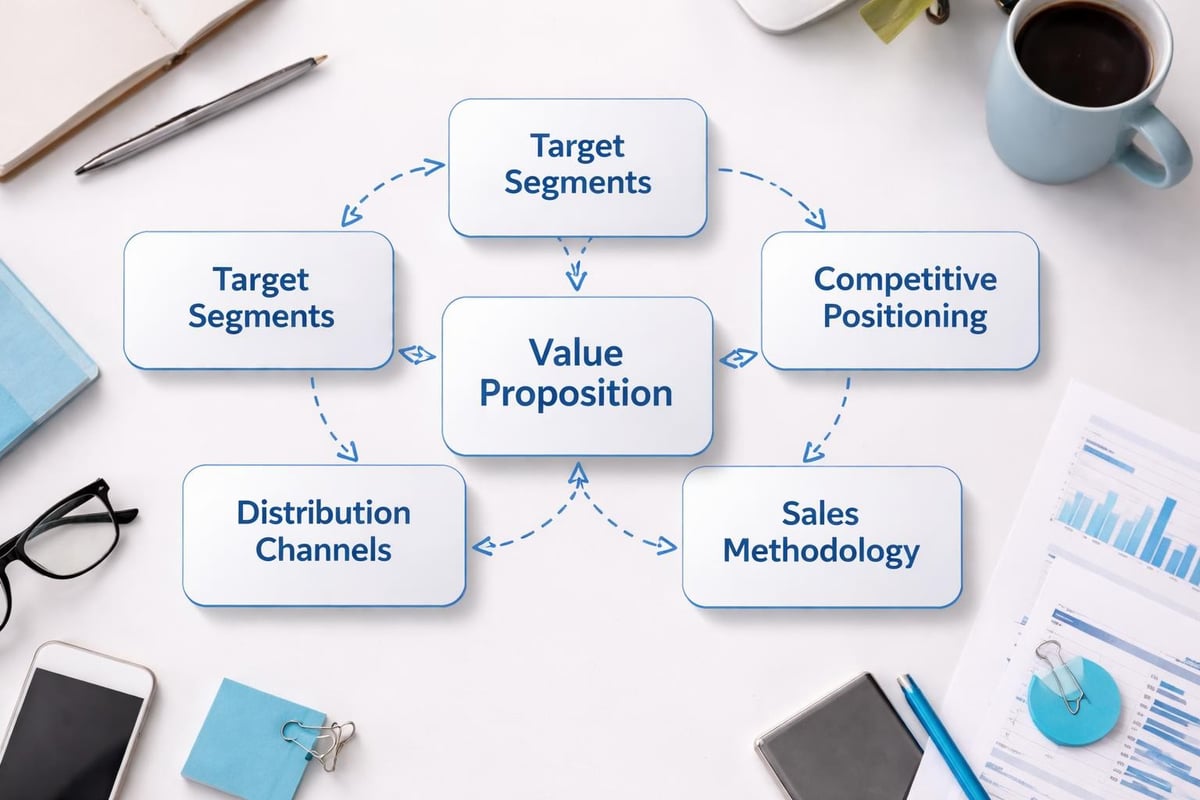
The foundation of any successful go-to-market approach rests on several critical elements that work in concert. Organizations must clearly articulate their value proposition, identifying precisely how their offering solves customer problems better than existing alternatives. This clarity becomes the cornerstone for all subsequent decisions.
Essential strategic components include:
- Target market segmentation and ideal customer profile definition
- Competitive positioning and differentiation strategy
- Pricing model and revenue structure
- Distribution channels and partnership ecosystem
- Marketing messaging and content strategy
- Sales methodology and enablement approach
Understanding these components requires deep market insight. Companies that invest in comprehensive market research and consulting gain competitive advantages by identifying unmet needs and emerging opportunities before competitors recognize them.
The Innovation-Market Fit Challenge
For innovation-focused organizations, the go-to-market challenge intensifies. Traditional approaches often fail when introducing disruptive solutions because existing market categories and customer expectations may not align with novel offerings. Product innovation demands equally innovative commercialization strategies.
This challenge manifests particularly in B2B contexts where buying committees, lengthy sales cycles, and risk aversion create barriers to adoption. Organizations must educate markets while simultaneously building credibility and trust. The most effective strategies balance bold positioning with pragmatic implementation.
Building Your Strategic Framework
Developing a robust go-to-market strategy requires systematic thinking and disciplined execution. The process begins with foundational research and evolves through iterative refinement as market feedback informs adjustments.
Market Opportunity Assessment
Before defining tactical approaches, organizations must thoroughly understand the landscape they're entering. This assessment examines market size, growth trajectories, competitive dynamics, and customer pain points with sufficient depth to inform confident decision-making.
| Assessment Dimension | Key Questions | Output |
|---|---|---|
| Market Size | What is the total addressable market? Which segments offer highest potential? | Prioritized market segments |
| Customer Analysis | What problems do target customers face? How do they currently solve them? | Customer persona profiles |
| Competitive Landscape | Who are direct and indirect competitors? What are their strengths and weaknesses? | Competitive positioning map |
| Regulatory Environment | What compliance requirements exist? How might regulations change? | Risk mitigation strategies |
Organizations leveraging business frameworks for this analysis gain structured approaches that ensure comprehensive evaluation. Frameworks provide repeatable processes that teams can apply across multiple initiatives.
Defining Your Value Proposition
The value proposition articulates why customers should choose your solution over alternatives. Effective value propositions speak directly to customer needs using language that resonates emotionally while supporting rational decision-making with concrete evidence.
Crafting compelling value propositions requires balancing multiple considerations. You must differentiate meaningfully while remaining credible. Bold claims without substantiation damage trust, while overly conservative positioning fails to capture attention in crowded markets.
Strong value propositions typically include:
- Clear problem statement that customers recognize
- Specific benefits delivered by your solution
- Quantifiable outcomes or results
- Differentiation from competitive alternatives
- Proof points such as case studies or testimonials
According to Salesforce’s comprehensive guide on go-to-market strategy, organizations that invest time in value proposition development achieve significantly higher conversion rates throughout the sales funnel.
Strategic Execution Models
The path from strategy to execution varies based on organizational context, market conditions, and offering characteristics. Different go-to-market models suit different situations, and selecting the appropriate approach determines resource allocation and success metrics.
Direct Sales Approaches
Direct sales models create relationships between your organization and end customers without intermediaries. This approach offers maximum control over customer experience and relationship development while requiring substantial investment in sales infrastructure.
Companies pursuing direct sales must build comprehensive capabilities spanning lead generation, sales development, account management, and customer success. Each function requires specialized skills, technologies, and processes that work together seamlessly.
High-value offerings, complex solutions requiring consultation, and situations demanding deep customer relationships typically justify direct sales investments. The model works particularly well for business model transformation initiatives where customers need extensive education and support.
Channel and Partnership Strategies
Indirect go-to-market strategies leverage partners who bring existing customer relationships, market presence, and specialized capabilities. Channel approaches enable rapid scaling without proportional increases in internal resources.
Common partnership models include:
- Reseller partnerships where partners sell your solution
- Referral arrangements compensating partners for introductions
- Technology integrations creating mutual value
- Co-marketing relationships expanding reach
- Strategic alliances combining complementary offerings
The challenge with partnership strategies lies in maintaining quality and consistency while relinquishing direct control. Successful channel programs invest heavily in partner enablement, providing training, tools, and support that ensure partners represent your solution effectively.

Product-Led Growth Models
Emerging as a dominant approach in software and digital services, product-led growth strategies allow the product itself to drive customer acquisition and expansion. Users experience value before committing to purchases, reducing friction in the buying process.
This model requires exceptional product design and user experience. The product must deliver immediate value, guide users toward deeper engagement, and create natural expansion opportunities. Design thinking methodologies prove invaluable when crafting product-led experiences that convert users into customers organically.
Organizational Alignment and Execution
Even brilliant strategies fail without organizational alignment and disciplined execution. The go-to-market strategy must cascade through every function, informing priorities and daily decisions across marketing, sales, customer success, and product teams.
Cross-Functional Coordination
Successful execution requires breaking down silos between departments. Marketing generates awareness and qualified leads. Sales converts opportunities into customers. Product delivers value that meets or exceeds expectations. Customer success ensures retention and expansion. Each function depends on others performing effectively.
Building effective go-to-market strategies requires establishing clear interfaces between teams, defining handoff processes, and creating shared metrics that encourage collaboration rather than competition. When marketing optimizes for lead volume without regard for quality, sales teams waste resources on unqualified prospects. When product ships features without informing customer-facing teams, confusion damages credibility.
Organizations achieve alignment through regular communication, integrated planning processes, and technology systems that provide visibility across functions. Shared dashboards tracking customer journey progression from awareness through advocacy create common understanding and accountability.
Metrics and Performance Management
What gets measured gets managed. Defining the right metrics ensures teams focus on activities that drive results rather than vanity metrics that look impressive but don't correlate with business outcomes.
| Stage | Key Metrics | Purpose |
|---|---|---|
| Awareness | Website traffic, social engagement, media mentions | Measure market reach and brand visibility |
| Consideration | Content downloads, demo requests, free trial signups | Track interest and qualification |
| Decision | Conversion rates, sales cycle length, win rates | Assess sales effectiveness |
| Retention | Customer satisfaction scores, renewal rates, expansion revenue | Monitor long-term value creation |
Effective measurement systems balance leading and lagging indicators. Lagging indicators like revenue reflect past performance. Leading indicators like pipeline velocity predict future results, enabling proactive adjustments.
Adapting Strategies for Different Contexts
No single go-to-market approach works universally. Context matters enormously, and successful organizations tailor strategies to their specific situations rather than applying generic templates.
New Market Entry Strategies
Entering established markets with new offerings requires different approaches than creating entirely new categories. In existing markets, customers understand the problem and evaluate solutions based on established criteria. Your strategy must clearly position against known alternatives.
Creating new markets demands education and category development. Customers may not recognize they have the problem your innovation solves. Early efforts focus on thought leadership, education, and proof of concept rather than aggressive scaling. As experts on go-to-market best practices emphasize, patience and persistence prove essential when building new categories.
B2B Versus B2C Considerations
Business-to-business and business-to-consumer markets require fundamentally different approaches. B2B strategies address longer sales cycles, multiple decision-makers, and complex evaluation processes. Relationship-building, thought leadership, and consultative selling dominate.
B2C strategies often emphasize brand building, emotional connection, and frictionless purchasing experiences. Decision cycles compress dramatically, and individual consumers make choices based on different criteria than corporate buyers.
B2B go-to-market priorities:
- Account-based marketing targeting specific organizations
- Content demonstrating expertise and building trust
- Sales processes addressing multiple stakeholder concerns
- Implementation and change management support
- Executive relationship development
B2C go-to-market priorities:
- Brand awareness and emotional resonance
- Optimized digital customer experiences
- Simplified purchase processes
- Social proof and peer recommendations
- Post-purchase engagement and community building
Organizations serving both markets often maintain separate strategies and teams, recognizing the distinct capabilities each context demands.

Innovation and Continuous Evolution
Markets evolve continuously, and go-to-market strategies must evolve with them. What works today may fail tomorrow as competitors respond, customer preferences shift, and new technologies emerge. Organizations committed to sustained success embed innovation and learning into their go-to-market approaches.
Testing and Experimentation
The most sophisticated organizations treat go-to-market execution as a series of experiments rather than fixed plans. They formulate hypotheses about what will work, design tests to validate assumptions, and rapidly incorporate learnings into refined approaches.
This experimental mindset pervades decisions at every level. Which value proposition messaging resonates most strongly? What content formats drive engagement? Which sales methodologies close deals most efficiently? Organizations systematically test alternatives and scale what works.
Innovation consulting firms help organizations build these capabilities, establishing processes and cultures that encourage intelligent risk-taking and rapid learning. The goal isn't perfection from day one but rather continuous improvement through disciplined iteration.
Technology Enablement
Modern go-to-market execution relies heavily on technology infrastructure that enables personalization, automation, and insight generation at scale. Customer relationship management systems, marketing automation platforms, sales enablement tools, and analytics solutions form the foundation.
Artificial intelligence increasingly augments human capabilities throughout the go-to-market process. AI-powered tools identify ideal customer prospects, personalize outreach at scale, predict which opportunities will close, and surface insights from customer interactions. Organizations that thoughtfully integrate these technologies gain significant efficiency and effectiveness advantages.
However, technology enables rather than replaces strategy. Tools amplify good strategies and accelerate bad ones. The foundational strategic work remains essential regardless of technological sophistication.
Common Pitfalls and How to Avoid Them
Even experienced organizations make predictable mistakes when developing and executing go-to-market strategies. Recognizing these pitfalls enables proactive avoidance.
Insufficient Customer Understanding
The most common failure mode involves projecting assumptions onto customers rather than deeply understanding their actual needs, preferences, and buying behaviors. Organizations fall in love with their solutions and neglect rigorous customer discovery.
This manifests in messaging that emphasizes product features rather than customer benefits, positioning that addresses problems customers don't recognize, and sales processes that ignore how customers actually evaluate and purchase solutions. The antidote involves continuous customer engagement, feedback collection, and willingness to adjust based on what you learn.
Misaligned Internal Incentives
When different functions optimize for conflicting objectives, the overall strategy suffers. Marketing teams measured solely on lead volume may prioritize quantity over quality. Sales teams compensated for new customer acquisition may neglect expansion opportunities within existing accounts.
Common misalignment patterns:
- Marketing and sales disagreeing on lead qualification criteria
- Product teams shipping features without customer validation
- Customer success isolated from expansion revenue responsibility
- Pricing decisions made without sales input
- Launch timelines that ignore market readiness
Addressing these requires deliberate incentive design that rewards outcomes rather than activities and encourages collaboration rather than competition between teams. Organizations that align incentives with customer success and business outcomes achieve far better results.
Premature Scaling
Many organizations attempt to scale go-to-market efforts before achieving product-market fit or validating their model. They hire large sales teams, invest heavily in marketing, and expand geographically based on optimism rather than evidence.
The result is burned capital and damaged credibility. Building innovative growth strategies requires patience and discipline, scaling only after establishing repeatable, profitable customer acquisition processes.
Integration with Broader Business Strategy
Go-to-market strategy never exists in isolation. It must align with and support broader business objectives, corporate strategy, and organizational capabilities. This integration ensures coherence and maximizes impact.
Strategic Consistency
Your go-to-market approach should reflect and reinforce your overall strategic positioning. If your corporate strategy emphasizes premium positioning and exceptional service, your go-to-market execution must deliver experiences consistent with those promises. Misalignment creates confusion and erodes credibility.
Organizations pursuing business transformation strategies often need to evolve go-to-market approaches in parallel with operational changes. New capabilities enable new market opportunities, and go-to-market strategies must capitalize on these emerging strengths.
Resource Allocation and Prioritization
Successful go-to-market execution requires adequate resources aligned with strategic priorities. Organizations must make explicit choices about where to invest time, talent, and capital. Attempting to pursue every opportunity simultaneously ensures mediocre results across the board.
Strategic resource allocation questions:
- Which market segments offer highest potential return?
- What capabilities must we build versus partner for?
- Where should we compete aggressively versus concede to competitors?
- How do we balance short-term revenue with long-term positioning?
- What experiments warrant investment despite uncertain outcomes?
These decisions shape organizational focus and determine what gets executed well versus what receives insufficient support. Regular strategic reviews ensure resource allocation evolves as markets and priorities shift.
Case Studies and Real-World Applications
Theory becomes actionable through concrete examples. Examining how organizations successfully navigate go-to-market challenges provides valuable insights applicable across contexts.
Enterprise Software Market Entry
Consider how established technology companies enter new enterprise segments. Success requires demonstrating value to multiple stakeholders with different priorities. Technical buyers evaluate functionality and integration. Financial buyers assess total cost of ownership. Executive buyers consider strategic alignment and risk.
Effective strategies address each constituency appropriately. Technical content demonstrates capabilities through detailed documentation and trials. Financial analysis quantifies ROI and compares against alternatives. Executive engagement builds relationships and alignment around strategic outcomes. As documented in this enterprise go-to-market case study, coordinating these parallel efforts determines win rates.
Biosimilar Pharmaceutical Launches
The pharmaceutical industry provides instructive examples of complex go-to-market challenges. Launching biosimilar products in European markets requires navigating regulatory requirements, reimbursement processes, physician education, and distribution networks simultaneously. This biosimilar go-to-market strategy case illustrates how manufacturers coordinate across multiple workstreams to achieve successful market entry.
These examples demonstrate that sophisticated offerings demand equally sophisticated commercialization approaches that address every dimension of market success.
Mastering go-to-market strategy separates organizations that capitalize on innovation from those that struggle despite great ideas. By building comprehensive frameworks, aligning cross-functional teams, and continuously refining approaches based on market feedback, ambitious leaders position their organizations for sustained growth. Six Paths Consulting partners with forward-thinking executives to develop and execute go-to-market strategies that transform innovative concepts into revenue-generating realities, combining strategic frameworks with AI-powered insights to accelerate market success and build lasting competitive advantages.