
The relationship between strategy and company performance has never been more critical in today's rapidly evolving business environment. Organizations face unprecedented challenges from technological disruption, changing customer expectations, and intensifying global competition. Leaders must understand how strategic choices shape organizational outcomes and how company structure, culture, and capabilities must align to execute those strategies effectively. This alignment determines whether ambitious growth objectives translate into measurable results or remain aspirational plans gathering dust on executive bookshelves.
The Foundation of Strategy and Company Alignment
Strategic planning represents the systematic process through which organizations define their competitive positioning and allocate resources to achieve specific objectives. The connection between strategy and company performance hinges on clarity of purpose, disciplined execution, and continuous adaptation.
Successful strategic frameworks share several characteristics:
- Clear articulation of value proposition and target markets
- Differentiated positioning based on unique capabilities
- Alignment between strategic priorities and resource allocation
- Measurable objectives with accountability mechanisms
- Flexibility to adapt based on market feedback
Research from Stanford Graduate School of Business demonstrates that companies achieving superior returns consistently demonstrate strong alignment between strategic intent and organizational execution. This alignment extends beyond mission statements to encompass operational processes, talent development, and performance management systems.
Understanding Porter's Strategic Approaches
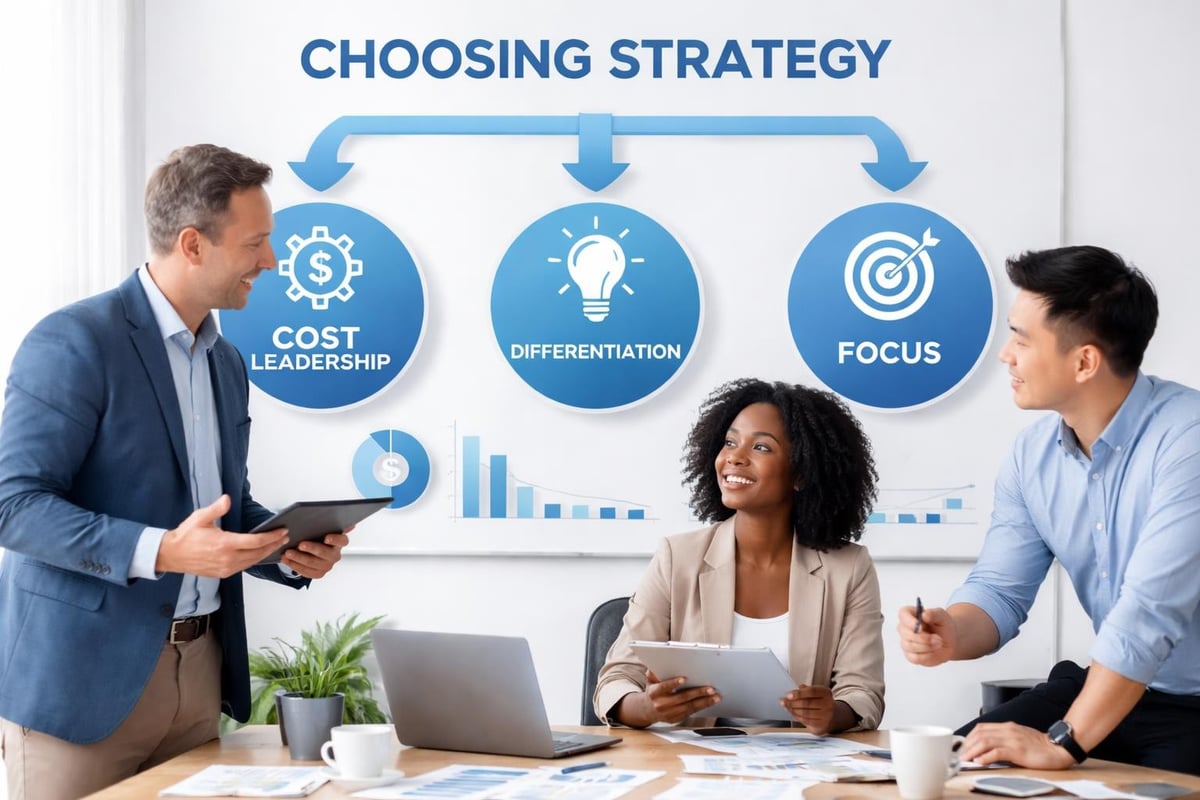
Michael Porter’s generic strategies provide a foundational framework for understanding how companies compete. Organizations must choose between cost leadership, differentiation, or focused strategies targeting specific market segments. This choice fundamentally shapes organizational design, investment priorities, and capability development.
The integration of strategy and company structure requires deliberate design decisions. Companies pursuing differentiation strategies invest heavily in innovation, marketing, and customer experience capabilities. Cost leaders optimize operational efficiency, supply chain management, and economies of scale. Mixed approaches often lead to competitive disadvantage, as organizations spread resources too thinly across conflicting priorities.
Building Innovation Capabilities Within Corporate Strategy
Innovation represents a critical strategic lever for companies seeking sustainable growth in 2026. Organizations must systematically develop capabilities for identifying market opportunities, generating creative solutions, and commercializing new offerings. The relationship between strategy and company innovation capabilities determines competitive resilience.
| Innovation Type | Strategic Objective | Key Capabilities Required | Timeline |
|---|---|---|---|
| Core Innovation | Optimize existing offerings | Process improvement, customer insights | 6-12 months |
| Adjacent Innovation | Expand into related markets | Market research, product development | 12-24 months |
| Transformational Innovation | Create new business models | Strategic foresight, technology expertise | 24-48 months |
Organizations building innovation capabilities systematically develop processes for opportunity identification, idea generation, prototyping, and scaling. This requires investment in training programs, collaborative tools, and leadership commitment to experimentation.
Implementing AI-Powered Strategic Innovation
Artificial intelligence transforms how companies develop and execute strategy. AI enables organizations to analyze vast datasets, identify hidden patterns, and simulate strategic scenarios with unprecedented accuracy. Forward-thinking companies leverage AI strategy and implementation to enhance decision-making quality and accelerate innovation cycles.
AI applications in strategic planning include:
- Market opportunity identification through predictive analytics
- Competitive intelligence gathering and analysis
- Customer segmentation and personalization strategies
- Scenario planning and risk assessment
- Performance tracking and strategy adjustment
The integration of AI into strategic processes enables real-time strategy adaptation based on market signals. Companies moving beyond traditional annual planning cycles gain agility advantages in rapidly changing markets.
Structuring Organizations to Execute Strategy
The principle that structure follows strategy remains as relevant in 2026 as when Alfred Chandler first articulated it decades ago. Organizational design must support strategic priorities rather than constraining them. The relationship between strategy and company structure determines execution effectiveness.
Companies pursuing growth through innovation require flexible organizational structures that encourage cross-functional collaboration. Traditional hierarchical models often impede the rapid experimentation and customer feedback loops essential for innovation success. Leading organizations adopt matrix structures, agile teams, and networked approaches that align with strategic imperatives.
Aligning Resources and Capabilities
Resource allocation represents strategy in action. Organizations claiming innovation as a priority while allocating minimal investment to research, development, or training demonstrate misalignment. The strategy and company resource allocation must demonstrate consistency.
Critical alignment checkpoints include:
- Budget allocation reflecting strategic priorities
- Talent acquisition and development supporting capability needs
- Technology infrastructure enabling strategic initiatives
- Performance metrics measuring strategic progress
- Incentive systems rewarding desired behaviors
Top-performing organizations conduct quarterly alignment reviews, assessing whether resource deployment supports strategic objectives. This discipline prevents drift toward comfortable but strategically irrelevant activities.
Executing Strategy Through Systematic Processes
Strategy execution separates successful companies from those with impressive plans but disappointing results. Effective strategy execution requires systematic processes translating strategic objectives into operational activities.
Research indicates that approximately 70% of strategic initiatives fail during execution, not due to poor strategy formulation but inadequate implementation. Organizations must develop execution capabilities as rigorously as they develop strategies.
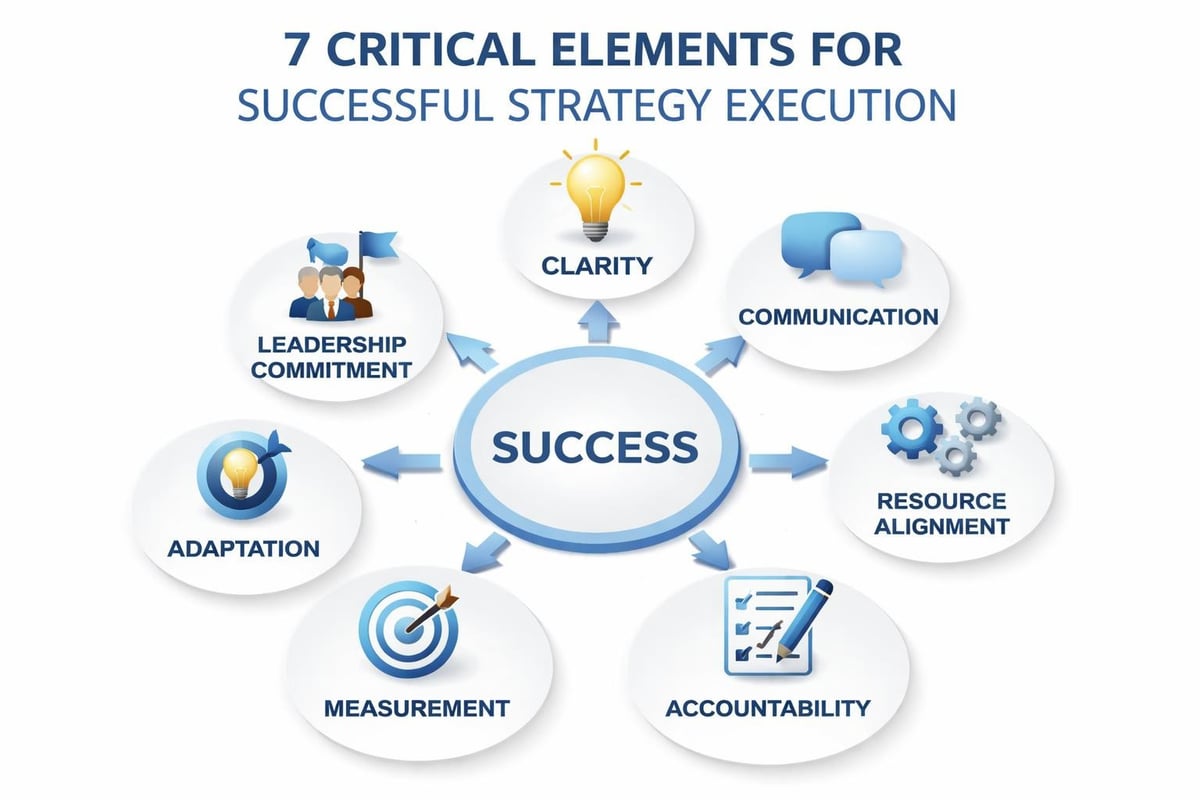
The Seven Pillars of Execution Excellence
- Strategic Clarity: Ensure every team member understands strategic priorities and their role in achieving them
- Scalable Planning: Break long-term strategies into quarterly objectives and actionable initiatives
- Cross-Functional Alignment: Coordinate activities across departments to eliminate silos
- Performance Measurement: Track leading and lagging indicators of strategic progress
- Regular Rhythm: Establish weekly and monthly review cadences maintaining momentum
- Adaptive Learning: Adjust approaches based on results and market feedback
- Leadership Engagement: Maintain visible executive commitment to strategic priorities
Companies excelling at execution demonstrate discipline in these areas. They understand that strategy and company performance improvement requires sustained attention, not occasional strategic retreats.
Avoiding Common Strategic Pitfalls
Organizations frequently stumble pursuing strategies that worked previously but become liabilities in changed circumstances. The Icarus Paradox illustrates how successful companies overextend winning strategies, leading to eventual decline.
Common strategic mistakes include:
- Copying competitor best practices rather than developing unique strategies
- Pursuing growth without clarifying competitive differentiation
- Maintaining outdated business models despite market shifts
- Allocating resources based on politics rather than strategic priorities
- Confusing operational excellence with strategic innovation
The Strategic Thinking Institute notes that best practices represent operational efficiency, not strategic differentiation. Companies must develop distinctive approaches creating unique customer value.
Building Sustainable Competitive Advantage
Sustainable business strategies integrate environmental and social considerations into competitive positioning. In 2026, stakeholders increasingly demand that companies demonstrate responsibility beyond profit maximization. The relationship between strategy and company sustainability practices shapes brand reputation, talent attraction, and regulatory positioning.
Forward-thinking organizations recognize sustainability as a source of innovation and competitive advantage rather than a compliance burden. They develop circular economy business models, invest in clean technologies, and create shared value with communities.
| Sustainability Strategy | Business Benefits | Implementation Complexity |
|---|---|---|
| Resource Efficiency | Cost reduction, risk mitigation | Low-Medium |
| Circular Economy | New revenue streams, customer loyalty | Medium-High |
| Social Impact | Brand differentiation, talent attraction | Medium |
| Climate Leadership | Regulatory advantage, investor appeal | High |
Developing Blue Ocean Strategies
Traditional competitive strategy focuses on outperforming rivals in existing markets. However, Blue Ocean Strategy consulting emphasizes creating uncontested market spaces where competition becomes irrelevant. This approach fundamentally redefines the relationship between strategy and company growth trajectories.
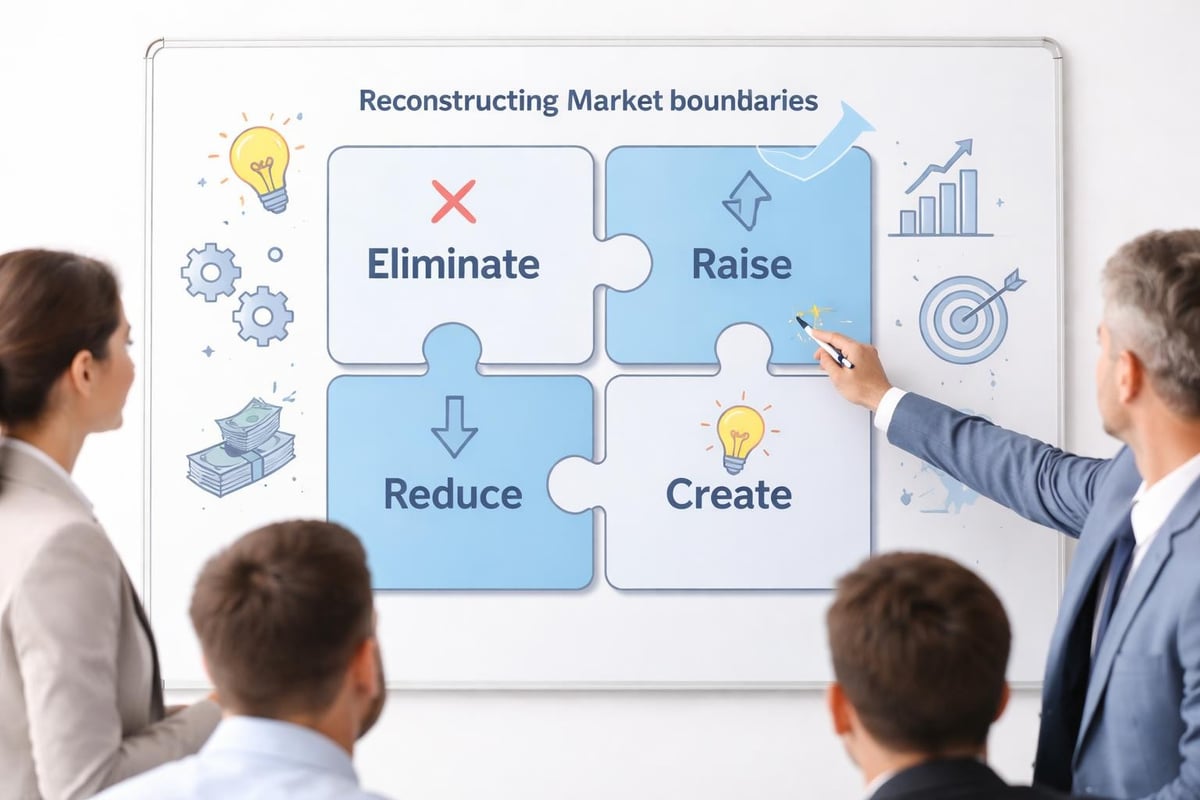
Blue Ocean strategies systematically reconstruct market boundaries by eliminating, reducing, raising, and creating factors defining industry competition. Organizations applying this methodology discover opportunities competitors overlook because they remain trapped in conventional industry logic.
The Six Paths Framework guides systematic opportunity discovery:
- Look across alternative industries serving similar customer needs
- Examine strategic groups within your industry
- Analyze the chain of buyers influencing purchase decisions
- Consider complementary products and services
- Explore functional-emotional orientation of industries
- Project trends shaping future demand
Companies implementing Blue Ocean approaches report higher growth rates and profitability than competitors fighting for share in crowded markets. This strategy particularly benefits organizations seeking market strategy consulting guidance for breakthrough growth.
Integrating Strategy and Transformation
Strategic initiatives often require fundamental transformation of organizational capabilities, processes, and cultures. The connection between strategy and company transformation determines whether organizations can execute ambitious strategies requiring new ways of working.
Strategy and transformation consulting helps organizations navigate the complex change processes required to implement new strategic directions. Transformation encompasses technology adoption, process redesign, talent development, and cultural evolution.
Managing Strategic Transformation Programs
Successful transformation programs demonstrate several characteristics distinguishing them from failed initiatives. They maintain strategic focus while managing operational details, balance urgency with sustainability, and engage employees throughout the organization.
Transformation success factors:
- Executive sponsorship with dedicated leadership attention
- Clear vision connecting transformation to strategic objectives
- Quick wins building momentum and credibility
- Capability building ensuring sustainable change
- Communication maintaining transparency and engagement
- Metrics tracking both progress and business outcomes
Organizations pursuing business model innovation often require the most extensive transformation efforts. Shifting from product sales to service subscriptions, for example, demands changes across operations, finance, sales, and customer success functions.
Building Internal Innovation Capabilities
Rather than depending exclusively on external consultants, leading organizations invest in innovation training programs developing internal capabilities for sustained strategic innovation. This approach ensures that strategy and company innovation capabilities evolve together over time.
Training initiatives should address both innovation methodologies and organizational change management. Participants learn frameworks for opportunity identification, creative problem-solving, rapid prototyping, and stakeholder engagement. Equally important, they develop skills for overcoming organizational resistance and building coalitions supporting innovation initiatives.
Measuring Strategic Performance
What gets measured gets managed. Organizations must establish comprehensive measurement systems tracking strategic progress across multiple dimensions. Financial metrics alone provide insufficient insight into strategic health.
| Metric Category | Example Measures | Strategic Insight |
|---|---|---|
| Financial | Revenue growth, profit margins, ROIC | Economic value creation |
| Customer | NPS, retention rate, lifetime value | Market positioning strength |
| Innovation | New product revenue, time to market | Future growth potential |
| Operational | Productivity, quality, cycle time | Execution efficiency |
| People | Engagement, capability development | Organizational capacity |
Balanced scorecards and OKR (Objectives and Key Results) frameworks provide structured approaches for comprehensive performance measurement. These systems connect strategy and company performance tracking across organizational levels.
Leveraging External Expertise Strategically
While building internal capabilities remains essential, organizations benefit from engaging top strategy consulting firms for specific initiatives requiring specialized expertise, external perspectives, or accelerated timelines. The key lies in strategic deployment of consulting resources rather than dependency.
External consultants add value through several mechanisms. They bring cross-industry insights, proven methodologies, additional analytical capacity, and objectivity unconstrained by internal politics. Effective consulting engagements transfer knowledge to internal teams, building capabilities for future initiatives.
Organizations should evaluate consulting partners based on their approach to capability building, not just deliverable quality. The best consulting relationships strengthen the connection between strategy and company execution capabilities for long-term benefit.
Adapting Strategy in Dynamic Markets
Static strategies become obsolete quickly in rapidly evolving markets. Organizations must develop processes for continuous strategy refinement based on market signals, competitive moves, and internal performance data. This adaptive approach recognizes that strategy and company circumstances evolve together.
Adaptive strategy practices include:
- Quarterly strategy reviews assessing assumptions and adjusting priorities
- Real-time competitive intelligence monitoring significant market changes
- Customer feedback loops informing strategy evolution
- Experimentation portfolios testing strategic hypotheses
- Scenario planning preparing for multiple possible futures
Companies embracing adaptive strategy avoid the paralysis of over-planning while maintaining strategic coherence. They balance conviction in core strategic direction with flexibility in tactical execution.
The alignment between strategy and company capabilities, structures, and cultures determines organizational success in achieving ambitious growth objectives. Organizations that systematically develop strategic thinking capabilities, align resources with priorities, and execute with discipline consistently outperform competitors. If you're ready to strengthen your strategic capabilities and unlock new growth opportunities through AI-powered innovation, Six Paths Consulting partners with ambitious leaders to develop breakthrough strategies and build the organizational capabilities needed to execute them successfully.