

In an era where markets shift rapidly and customer expectations evolve constantly, pricing decisions have become one of the most critical levers for business success. Many organizations leave significant revenue on the table by relying on outdated cost-plus formulas or competitive matching strategies that fail to capture their true value. Pricing strategy consulting services provide businesses with the expertise, frameworks, and data-driven insights needed to transform their pricing approach from a tactical afterthought into a strategic growth engine. By partnering with specialized consultants, companies can unlock hidden profit potential, strengthen their market position, and create sustainable competitive advantages through intelligent pricing mechanisms.
The Strategic Impact of Professional Pricing Consulting
Organizations that invest in pricing strategy consulting services typically see immediate and measurable improvements in profitability. Research consistently demonstrates that even modest pricing improvements deliver disproportionate returns compared to increasing sales volume or reducing costs. A one percent increase in price, assuming no loss in volume, can boost operating profits by 8-11 percent in most industries.
Professional pricing consultants bring several critical capabilities:
- Deep expertise in pricing psychology and behavioral economics
- Advanced analytical tools for segmentation and elasticity modeling
- Cross-industry best practices and proven frameworks
- Objective external perspective unclouded by internal politics
- Implementation support to ensure sustainable change
The transformation extends beyond simply raising prices. Effective value-based pricing strategies require comprehensive market understanding, customer segmentation, and alignment with overall business strategy. This holistic approach ensures that pricing decisions support long-term growth rather than short-term revenue maximization.
Building Value-Based Pricing Models
Traditional cost-plus pricing leaves money on the table by ignoring customer willingness to pay. Value-based approaches start with understanding the economic value delivered to different customer segments, then structuring prices to capture a fair share of that value creation.
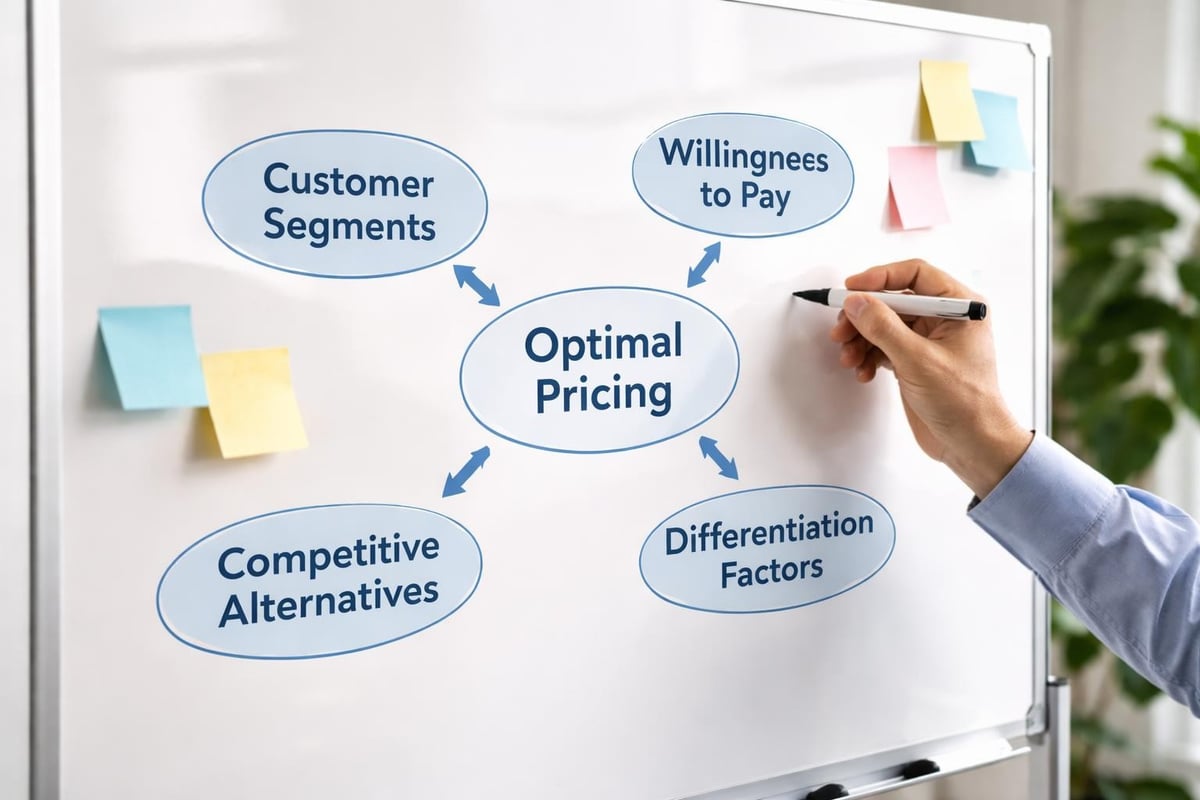
Pricing strategy consulting services help organizations develop sophisticated value models through structured customer research, competitive analysis, and economic value estimation. This process often reveals surprising insights about which features customers value most and where companies can command premium pricing.
| Traditional Pricing | Value-Based Pricing | Strategic Outcome |
|---|---|---|
| Cost-plus markup | Customer value analysis | Higher margins |
| Single price point | Segmented pricing | Better targeting |
| Product-focused | Outcome-focused | Stronger differentiation |
| Reactive to competition | Proactive positioning | Market leadership |
The shift to value-based models requires significant organizational change. Sales teams need new skills and messaging, marketing must articulate value propositions more clearly, and product development should focus on high-value features. Consultants provide the frameworks and change management support to navigate this transformation successfully.
Leveraging Data Analytics and AI in Pricing Optimization
Modern pricing strategy consulting services increasingly incorporate advanced analytics and artificial intelligence to uncover insights impossible to detect through traditional methods. These technologies enable dynamic pricing, personalized offers, and real-time optimization based on market conditions.
Machine learning algorithms can analyze millions of transactions to identify patterns in customer behavior, price sensitivity across segments, and optimal price points for different scenarios. This data-driven approach to pricing strategy transforms pricing from an art into a science while preserving the strategic judgment that experienced consultants provide.
Key analytics capabilities consultants deploy:
- Price elasticity modeling across customer segments and product categories
- Competitive intelligence gathering and automated monitoring
- Customer lifetime value calculations for strategic account pricing
- Cannibalization analysis for multi-product portfolios
- Predictive modeling for demand forecasting and inventory optimization
AI-powered pricing tools can process competitor pricing changes, inventory levels, seasonal patterns, and demand signals to recommend optimal prices in real-time. For businesses selling through digital channels, this enables sophisticated dynamic pricing similar to what airlines and hotels have employed for decades.
The integration of AI with human expertise creates superior outcomes. While algorithms excel at processing data and identifying patterns, experienced consultants provide strategic context, understand organizational constraints, and ensure pricing strategies align with broader business objectives. Organizations exploring AI-powered strategic innovation find that pricing represents one of the highest-impact applications of these technologies.
Industry-Specific Pricing Approaches
Different industries require tailored pricing methodologies that reflect their unique market dynamics, customer behaviors, and competitive landscapes. Pricing strategy consulting services adapt frameworks to address sector-specific challenges and opportunities.
In software and SaaS businesses, subscription pricing models demand careful consideration of packaging, tiering, and feature bundling. Manufacturing companies face complex transfer pricing and channel management issues. Professional services firms must balance utilization rates with premium positioning.
Consultants bring deep industry knowledge that accelerates implementation and reduces costly mistakes. They understand regulatory constraints in healthcare pricing, the role of formularies in pharmaceutical pricing, or how procurement processes influence B2B pricing dynamics. This specialized expertise proves especially valuable when entering new markets or launching innovative products where historical data provides limited guidance.
Implementing Dynamic and Personalized Pricing Strategies
The evolution toward dynamic pricing represents a significant opportunity for businesses willing to invest in the necessary systems and processes. Pricing strategy consulting services help organizations determine whether dynamic pricing makes strategic sense and how to implement it effectively without alienating customers.
Dynamic pricing adjusts prices based on real-time supply and demand conditions, competitive actions, customer characteristics, and business objectives. While common in travel and hospitality, these approaches are expanding into retail, e-commerce, and even B2B contexts.
Implementation considerations for dynamic pricing:
- Technology infrastructure and integration requirements
- Customer communication and transparency strategies
- Competitive response scenarios and countermeasures
- Performance metrics and optimization frameworks
- Legal and regulatory compliance across jurisdictions
Personalized pricing takes this further by tailoring prices to individual customers based on their specific value perception, purchase history, and predicted lifetime value. This requires sophisticated customer data platforms and careful attention to privacy regulations and fairness perceptions.
Consultants help businesses navigate the ethical and practical challenges of personalized pricing. The goal is creating win-win scenarios where customers receive offers matched to their needs while the business optimizes revenue. When implemented thoughtfully, these approaches enhance customer satisfaction rather than damaging relationships.

Organizations developing innovative business models often discover that pricing innovation provides as much competitive advantage as product innovation. New pricing models can unlock entirely new customer segments or usage occasions that traditional pricing approaches miss.
Organizational Alignment and Change Management
Technical pricing optimization means little without organizational buy-in and execution capability. The most sophisticated pricing strategy fails if sales teams discount aggressively or if implementation faces internal resistance. Pricing strategy consulting services therefore emphasize change management and capability building alongside analytical work.
Sales teams often resist pricing increases, fearing customer pushback and lost deals. This requires carefully designed incentive systems, robust value articulation training, and coaching on handling price objections. Sales training workshops that incorporate pricing strategy help teams confidently communicate value and defend prices.
Finance and operations must align on pricing governance, approval processes, and performance metrics. Marketing needs updated positioning and messaging that supports premium pricing. Customer success teams require scripts for explaining price changes to existing customers. This cross-functional alignment separates successful pricing transformations from failed initiatives.
Leading consulting firms employ proven change management methodologies to drive adoption:
- Executive sponsorship and visible leadership commitment
- Clear communication of the business case and expected benefits
- Pilot programs that demonstrate quick wins and build momentum
- Training programs tailored to each functional role
- Performance dashboards that track progress and identify issues
- Continuous improvement processes that refine approaches over time
Building internal pricing capabilities ensures sustainable results long after consultants depart. Many organizations establish dedicated pricing functions or centers of excellence that maintain expertise and drive ongoing optimization. Consultants help design these organizational structures and develop the talent to staff them effectively.
Measuring and Optimizing Pricing Performance
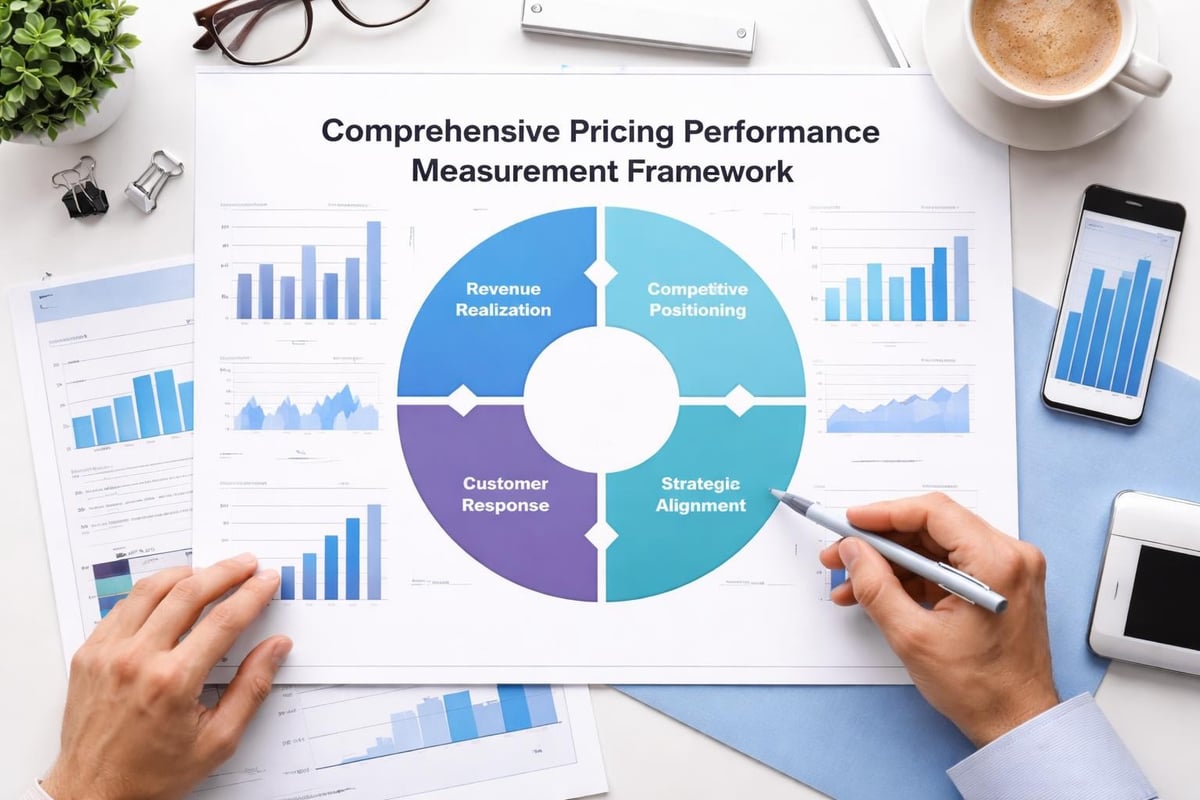
Effective pricing strategies require rigorous measurement frameworks that track both leading and lagging indicators. Pricing strategy consulting services help organizations define the right metrics, establish baselines, and create dashboards that enable data-driven decision-making.
Key performance indicators extend beyond simple revenue or margin metrics. Comprehensive pricing scorecards include:
| Metric Category | Example Metrics | Strategic Purpose |
|---|---|---|
| Revenue Realization | Price achievement vs. list, discount levels | Execution quality |
| Market Position | Price premium vs. competitors, share of wallet | Competitive strength |
| Customer Response | Win rates by segment, churn related to pricing | Market validation |
| Operational Efficiency | Quote-to-cash cycle time, approval turnaround | Process performance |
| Strategic Alignment | Mix of value vs. volume deals, new product pricing | Business model health |
Advanced analytics platforms enable real-time monitoring of these metrics with automated alerts when performance deviates from expectations. This allows rapid response to emerging issues before they significantly impact results.
Testing and experimentation provide crucial insights for continuous improvement. A/B testing different price points, packaging options, or promotional strategies generates empirical evidence about what works in specific contexts. Pricing consultants design these experiments to ensure statistical validity while minimizing business risk.
The discipline to continuously test, learn, and adapt separates pricing leaders from followers. Markets evolve, competitive dynamics shift, and customer preferences change. Organizations that treat pricing as an ongoing optimization process rather than a one-time project maintain their competitive edge over time.
Navigating Complex Pricing Challenges
Certain pricing scenarios present unique challenges that require specialized expertise. Pricing strategy consulting services prove especially valuable when organizations face complex situations like market entry, product launches, merger integrations, or business model transformation.
International pricing adds layers of complexity including currency fluctuation, transfer pricing regulations, varying competitive landscapes, and different customer value perceptions across cultures. Consultants help develop coherent global pricing strategies that balance standardization with local market adaptation.
Portfolio pricing for companies with multiple products or services requires sophisticated analysis to avoid cannibalization while maximizing total profitability. This involves understanding substitution patterns, cross-selling opportunities, and how to structure bundles that increase customer value and company margins.
Specialized pricing situations requiring expert guidance:
- Subscription and usage-based pricing for new business models
- Pricing for platforms and multi-sided markets
- Freemium conversion optimization in digital products
- Large enterprise deal structuring and negotiation
- Promotional and markdown optimization in retail
- Channel pricing and margin management
- New product pricing without historical benchmarks
Consultants also help organizations uncover hidden profits by identifying pocket price leakage where revenue disappears through excessive discounting, poor terms and conditions, or inefficient processes. Closing these gaps often delivers immediate profit improvements without requiring price increases that might trigger customer resistance.
Strategic Pricing in Innovation-Driven Markets
For businesses competing through innovation, pricing strategy becomes inseparable from product innovation and market development. Early pricing decisions for breakthrough offerings set trajectories that become difficult to change later, making expert guidance particularly valuable.
Innovative products often lack direct comparables, making traditional competitive pricing irrelevant. Value-based approaches work better, but require creative methods to quantify value when customers have no experience with the solution. Consultants employ techniques like conjoint analysis, economic value estimation, and reference pricing to determine optimal positioning.
The timing of price changes matters enormously in innovation contexts. Skim pricing captures maximum value from early adopters willing to pay premium prices for novelty. Penetration pricing sacrifices short-term margins to build market share and lock in customers before competitors respond. The choice depends on competitive dynamics, intellectual property protection, and long-term strategic objectives.
Pricing strategy consulting services help innovation-driven businesses think through these tradeoffs systematically. They bring experience from similar situations in other industries and provide frameworks for scenario planning under uncertainty. This is especially relevant for companies working with innovation consulting firms to develop breakthrough products and services.
Digital transformation initiatives often enable new pricing models that were previously impossible to administer. Usage-based pricing, outcome-based pricing, and dynamic pricing become feasible with modern technology platforms. For organizations seeking support with digital marketing and customer engagement, aligning pricing strategy with digital capabilities creates powerful synergies.
Integration with Revenue Growth Strategies
Pricing strategy never exists in isolation but must align with broader revenue growth initiatives. The most successful organizations integrate pricing with sales effectiveness, customer experience, product development, and market expansion efforts to create comprehensive growth engines.
Cross-functional collaboration ensures pricing decisions consider multiple perspectives. Product teams understand feature value, marketing knows positioning messages, sales hears customer objections, and finance tracks profitability. Bringing these viewpoints together produces more robust strategies than siloed decision-making.
Top strategy consulting firms emphasize this holistic approach, recognizing that pricing optimization without sales enablement or product improvements delivers limited results. The greatest impact comes from aligned initiatives that reinforce each other.
For businesses undergoing digital transformation, pricing strategy must adapt to new business models and customer engagement channels. Traditional transaction-based pricing may give way to subscription models, freemium offerings, or platform-based approaches that require different analytical frameworks and operational capabilities.
Revenue architecture design represents an emerging discipline that combines pricing strategy, sales compensation, customer success processes, and product packaging into integrated systems. This comprehensive approach ensures all elements work together to maximize customer lifetime value while supporting efficient growth.
Pricing strategy consulting services increasingly incorporate revenue operations expertise to address implementation challenges. This includes CRM configuration, CPQ (configure-price-quote) systems, billing platforms, and analytics infrastructure. The technical enablement ensures that strategic recommendations translate into operational reality.
Building Long-Term Pricing Capabilities
While external consultants provide expertise and accelerate results, sustainable pricing excellence requires developing internal capabilities. Organizations should view consulting engagements as opportunities for knowledge transfer and skill development, not just tactical execution.
Structured training programs help build pricing literacy across functions. Sales teams need to understand value selling, finance requires analytical skills for price-volume-mix analysis, and executives benefit from pricing strategy frameworks. These educational initiatives create a common language and shared understanding that supports better decision-making.
Many organizations establish pricing councils or committees that bring together stakeholders to review pricing decisions, share insights, and maintain strategic alignment. These governance structures prevent the ad hoc discounting and inconsistent pricing that erodes profitability over time.
Technology investments in pricing tools, analytics platforms, and workflow systems provide the infrastructure for ongoing optimization. Modern pricing software incorporates machine learning, competitive intelligence, and scenario modeling capabilities that were previously available only to enterprises with massive resources. Consultants help evaluate these solutions and implement them effectively.
The most sophisticated organizations develop proprietary pricing methodologies tailored to their specific market position, customer segments, and competitive dynamics. These custom frameworks incorporate industry best practices while reflecting unique business realities. Consultants facilitate this development process, ensuring rigor and completeness while fostering ownership.
Pricing strategy consulting services deliver transformative impact when organizations commit to treating pricing as a strategic capability rather than a tactical function. By combining analytical rigor, industry expertise, and change management discipline, these services help businesses unlock significant profit potential while strengthening competitive positioning. Six Paths Consulting brings AI-powered strategic innovation expertise to help ambitious leaders develop pricing strategies that support sustainable growth and market leadership.