
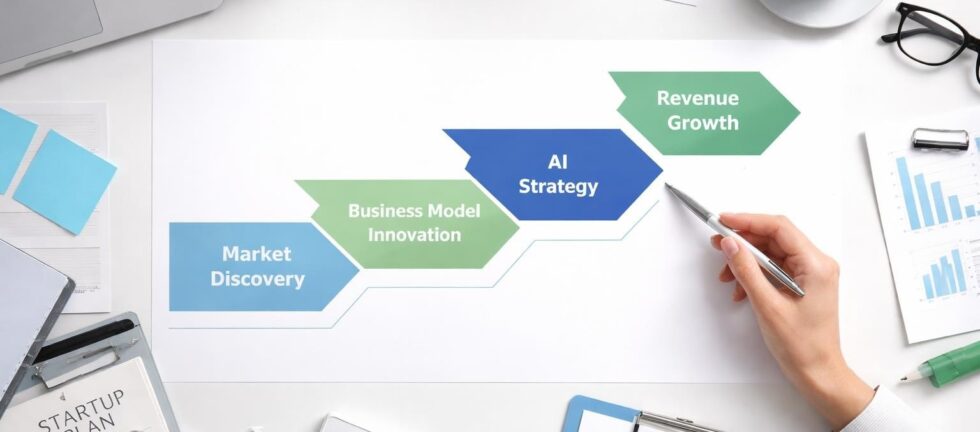
Navigating the complex landscape of building and scaling a new venture requires more than just a great idea. Startup founders face countless strategic decisions, from validating market opportunities to designing innovative business models that capture sustainable revenue. This is where startup consulting services become invaluable, providing experienced guidance that helps ambitious leaders accelerate growth while avoiding costly missteps. In 2026, the integration of AI-powered strategic insights and proven innovation frameworks has transformed how consultants drive measurable results for early-stage companies.
Understanding the Scope of Startup Consulting Services
Startup consulting services encompass a wide range of strategic advisory offerings designed to address the unique challenges facing emerging businesses. Unlike traditional management consulting, these services focus specifically on the dynamics of rapid growth, market entry, and innovation under conditions of significant uncertainty.
Core service areas include:
- Strategic planning and business model development
- Market research and opportunity validation
- Product and service innovation frameworks
- Go-to-market strategy formulation
- Revenue growth optimization
- Organizational design and talent strategy
The value proposition of professional consulting for startups centers on accelerating time-to-market while reducing risk. As detailed in comprehensive guides on startup consulting, founders who engage expert advisors gain access to proven methodologies that have been tested across hundreds of ventures. This external perspective often reveals blind spots and unlocks opportunities that internal teams might miss.
Strategic Innovation as a Growth Catalyst
Modern startup consulting services have evolved beyond basic business planning to embrace sophisticated innovation methodologies. The application of frameworks for innovation enables consultants to help startups systematically discover uncontested market spaces where competition becomes irrelevant.
Strategic innovation consulting focuses on three fundamental questions:
- Where can we compete? Identifying market opportunities that align with capabilities and ambitions
- How will we win? Designing differentiated business models and value propositions
- What capabilities must we build? Developing the organizational competencies required for execution
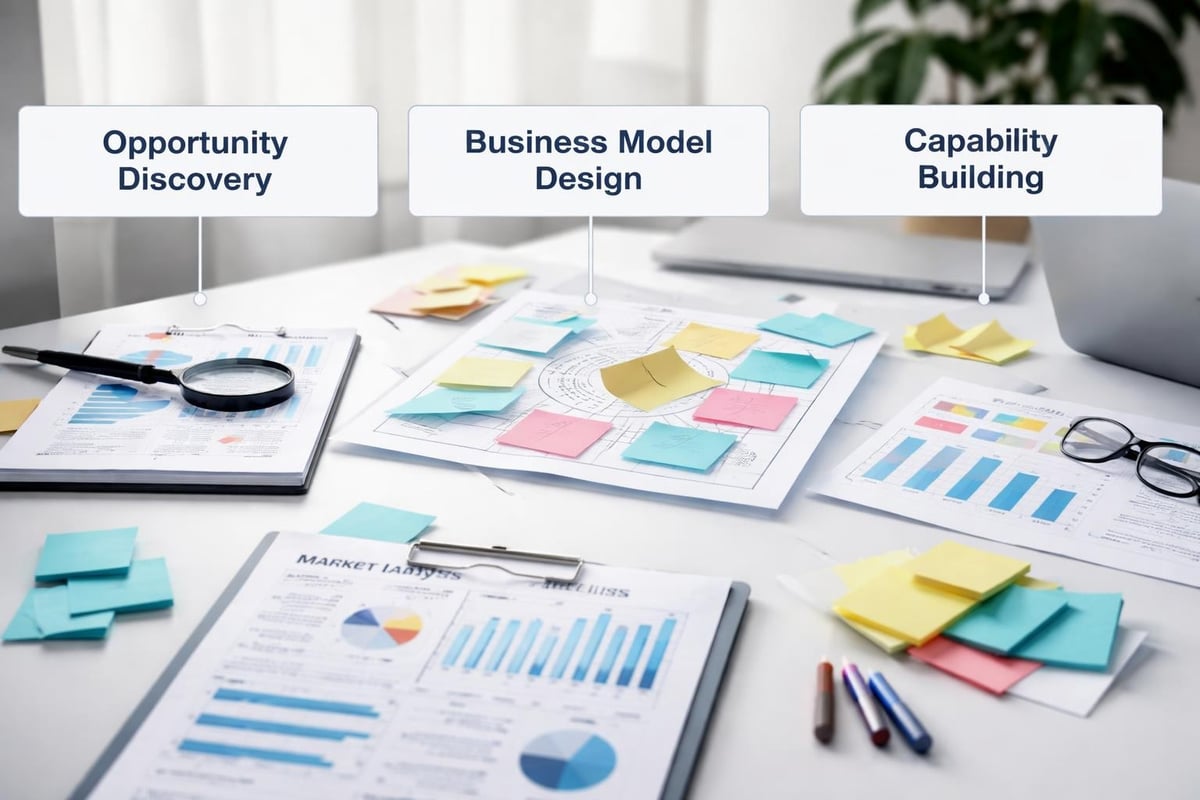
This approach transforms how startups think about growth. Rather than competing in crowded markets with incremental improvements, companies learn to reconstruct market boundaries and create new demand. The methodology draws from established innovation theories while incorporating AI-powered market intelligence that reveals patterns invisible to traditional analysis.
Technology-Enabled Consulting Delivery
The consulting landscape has been fundamentally reshaped by technology adoption. Essential technologies for startup consulting firms now include AI-driven analytics platforms, collaborative digital workspaces, and automated data visualization tools that enhance both the speed and quality of insights delivered.
AI-Powered Strategic Insights
Artificial intelligence has become a critical differentiator in how leading consultancies serve startups. AI applications in startup consulting services include:
| Application Area | AI Capability | Business Impact |
|---|---|---|
| Market Analysis | Pattern recognition across millions of data points | Faster opportunity identification |
| Competitive Intelligence | Real-time monitoring of competitor moves | Proactive strategy adjustment |
| Customer Insights | Sentiment analysis and behavior prediction | Precision targeting and positioning |
| Financial Modeling | Scenario simulation and risk assessment | Data-driven decision making |
These capabilities enable consultants to deliver recommendations grounded in comprehensive data analysis rather than intuition alone. For startups operating in fast-moving markets, this analytical rigor can mean the difference between capturing first-mover advantage and arriving too late.
The integration of AI extends to innovation workshops where interactive tools facilitate rapid ideation, validation, and prioritization. Workshop participants can test assumptions against real market data, iterate on concepts in real-time, and emerge with actionable roadmaps backed by evidence.
Building Sustainable Business Models
One of the most critical contributions of startup consulting services involves designing business models that generate sustainable revenue and profitability. Many founders excel at product development but struggle with monetization strategy and revenue growth optimization.
Key components of business model consulting:
- Value proposition design that articulates clear customer benefits
- Revenue stream diversification to reduce dependence on single sources
- Pricing strategy aligned with perceived value and market dynamics
- Channel optimization to maximize customer acquisition efficiency
- Partnership development that extends capabilities without overhead
Consultants bring frameworks like the Business Model Canvas and Value Proposition Canvas to structure this work. However, the real value emerges from the consultant's ability to challenge assumptions and push founders beyond incremental thinking. Resources on value proposition design demonstrate how systematic approaches to customer-centric innovation yield breakthrough results.

Go-to-Market Strategy Development
Even brilliant products fail without effective market entry strategies. Go-to-market consulting addresses the critical questions of customer targeting, positioning, messaging, and channel selection that determine initial traction.
Effective go-to-market strategies require alignment across multiple dimensions:
- Customer segmentation: Identifying ideal customer profiles based on need intensity and accessibility
- Competitive positioning: Differentiating against alternatives in ways that matter to target segments
- Channel strategy: Selecting distribution and communication channels that reach customers efficiently
- Sales enablement: Equipping teams with tools, training, and processes to convert prospects
- Metrics definition: Establishing KPIs that track progress and inform adjustments
The importance of expert guidance in this area cannot be overstated. According to insights from startup consulting experts, misaligned go-to-market execution is among the top reasons promising startups fail to achieve product-market fit. Professional consultants help avoid this trap by applying battle-tested methodologies and pattern recognition from similar market entries.
Organizational Capabilities and Talent Strategy
Scaling a startup requires more than strategic clarity. It demands building organizational capabilities that can execute consistently while maintaining the agility to adapt as markets evolve. This is where business transformation strategy consulting creates lasting impact.
Consultants help startups address several organizational challenges:
- Leadership team composition: Identifying capability gaps and recruiting complementary expertise
- Culture design: Establishing values and behaviors that support innovation and accountability
- Process development: Creating workflows that enable efficiency without bureaucracy
- Knowledge management: Capturing and sharing insights as the organization grows
- Performance systems: Aligning incentives with strategic priorities
Many founders underestimate the complexity of organizational design, assuming that structure will emerge organically. This approach works until it doesn't, typically coinciding with critical growth inflection points. Professional startup consulting services bring frameworks for intentional organizational development that prevent growth from stalling.
Building In-House Innovation Capabilities
Forward-thinking startups recognize that external consulting delivers maximum value when it builds internal capabilities rather than creating dependency. The most impactful engagements include knowledge transfer components that empower teams to sustain innovation independently.
Training programs typically cover:
- Innovation methodologies and frameworks
- Customer research and validation techniques
- Strategic thinking and scenario planning
- Data-driven decision making
- Agile experimentation processes
This educational dimension transforms consulting from a service transaction into a capability-building partnership. Organizations that invest in developing these competencies position themselves to continuously identify and pursue new growth opportunities without external support.
Measuring Consulting Impact and ROI
Startup founders rightfully demand accountability from service providers. Effective startup consulting services establish clear success metrics at engagement outset and track progress transparently throughout the relationship.
| Metric Category | Example Indicators | Measurement Approach |
|---|---|---|
| Revenue Growth | Monthly recurring revenue, customer acquisition cost | Financial tracking systems |
| Market Position | Market share, brand awareness, customer satisfaction | Surveys and market research |
| Innovation Output | New products launched, patent applications, experiments run | Innovation pipeline metrics |
| Organizational Health | Employee engagement, retention rates, capability assessments | HR analytics and surveys |
| Strategic Clarity | Decision velocity, strategic alignment scores | Leadership assessments |
The benefits of startup consulting services become tangible when these metrics show measurable improvement. Consultants who focus on delivering quantifiable results rather than just recommendations earn the trust and long-term partnerships that define successful advisory relationships.
Selecting the Right Consulting Partner
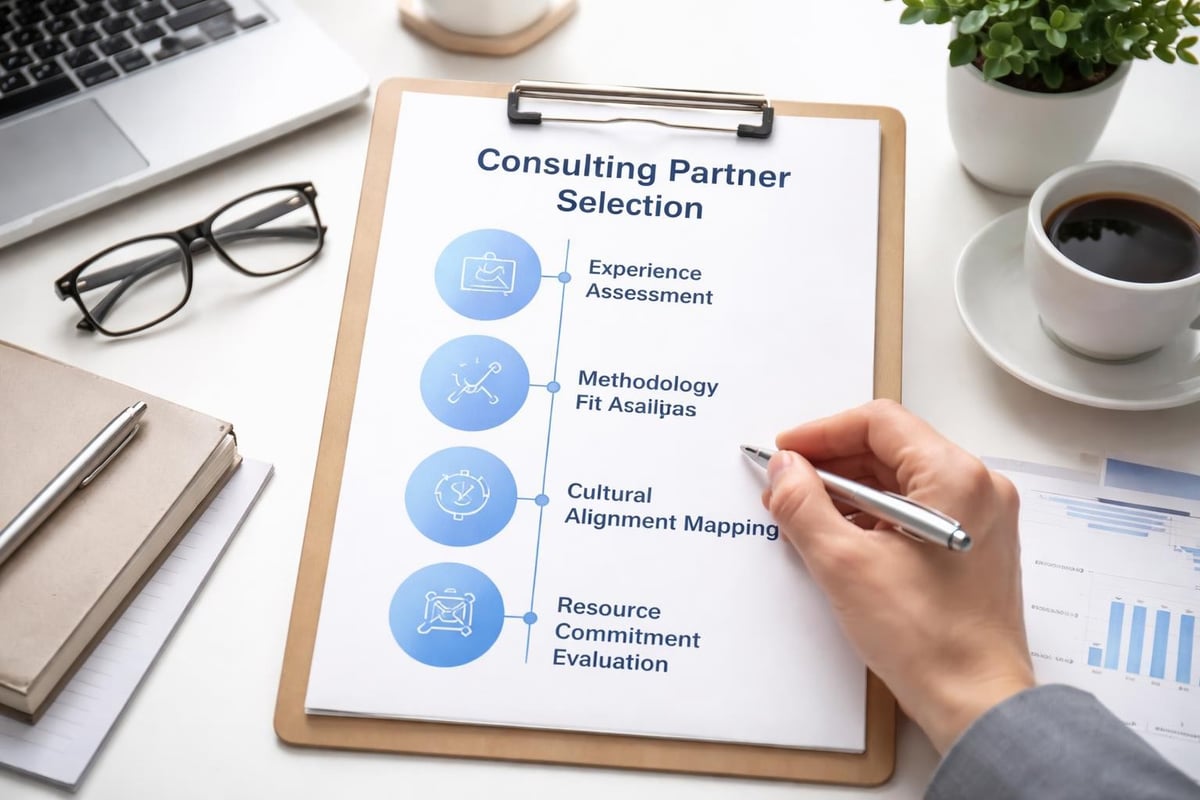
Not all consulting relationships deliver equal value. Startup founders must approach partner selection strategically, evaluating consultants on criteria beyond brand recognition or fee structure. Understanding how mid-size management consulting firms differ from boutique specialists or large multinational practices helps founders identify the right fit.
Evaluation criteria include:
- Relevant experience: Track record with similar business models, industries, or growth stages
- Methodology rigor: Proven frameworks rather than ad-hoc approaches
- Cultural alignment: Working styles and values that complement the organization
- Resource commitment: Appropriate senior attention and team composition
- Knowledge transfer: Commitment to building internal capabilities
- Technology enablement: Use of modern tools and platforms
Founders should also consider whether they need comprehensive strategic guidance or specialized expertise in specific domains. Some engagements benefit from broad strategic consulting, while others require deep technical knowledge in areas like AI implementation, regulatory compliance, or international expansion.
The Role of Specialized Expertise
While generalist strategic consulting provides value, startups tackling complex challenges increasingly benefit from specialized expertise. For companies managing acquisitions or exploring exit strategies, consultants with deep M&A experience can prove invaluable. Similarly, ventures in regulated industries benefit from advisors who understand compliance landscapes alongside growth strategy.
Specialized consulting becomes particularly important when startups address technical domains like artificial intelligence implementation, blockchain integration, or advanced manufacturing. These areas require consultants who combine strategic thinking with genuine technical depth. Information on innovative ideas for business growth demonstrates how cross-functional expertise unlocks possibilities that purely strategic or purely technical advisors might miss.
Financial Considerations and Engagement Models
Startup consulting services are delivered through various commercial models, each with distinct advantages depending on the venture's stage and needs. Understanding these options helps founders structure relationships that align incentives and manage cash flow constraints.
Common engagement structures:
- Project-based: Defined scope and timeline with fixed fees
- Retainer: Ongoing advisory relationship with monthly fees
- Equity compensation: Consultant takes partial payment in company shares
- Performance-based: Fees tied to achievement of specific outcomes
- Hybrid models: Combinations of the above approaches
Early-stage startups often gravitate toward equity compensation to preserve cash, while growth-stage companies with predictable revenue prefer retainer relationships that provide continuous strategic support. The key is ensuring that the commercial model motivates consultants to deliver genuine value rather than maximize billable hours.
Founders should also investigate whether consultants offer flexible arrangements during critical growth periods. Some firms provide scaled pricing or deferred payment options for promising ventures facing temporary cash constraints. Others offer accelerator or cohort-based programs that deliver consulting services at reduced rates in exchange for portfolio exposure.
Industry-Specific Consulting Approaches
While many strategic principles apply universally, effective startup consulting services adapt methodologies to industry-specific dynamics. A software-as-a-service startup faces fundamentally different challenges than a medical device company or consumer packaged goods brand.
Consultants who specialize in particular sectors bring invaluable pattern recognition. They understand typical development timelines, regulatory requirements, distribution channels, and competitive dynamics that shape strategy in those domains. For example, a professional services firm like Eastmure & Associates brings specialized expertise in financial structuring and tax strategy for high-growth businesses, complementing broader strategic consulting.
Adapting Innovation Frameworks Across Sectors
While innovation methodologies like business model innovation and value proposition design apply across industries, their implementation varies significantly. Technology startups might iterate rapidly with minimal capital, while hardware companies require substantial upfront investment before validation. Consultants must calibrate their approaches accordingly.
Service-based startups benefit from frameworks that emphasize customer experience design and operational efficiency. Product companies need robust development methodologies and supply chain optimization. Platform businesses require network effect strategies and ecosystem development expertise. The most effective consultants maintain flexibility while applying proven principles consistently.
Managing Consultant Relationships for Maximum Value
Engaging startup consulting services represents just the beginning. Extracting maximum value requires active client participation and deliberate relationship management throughout the engagement. Passive founders who expect consultants to solve problems independently typically experience disappointing results.
Best practices for productive consulting relationships:
- Executive sponsorship: Senior leader ownership of the engagement and outcomes
- Cross-functional participation: Involving relevant stakeholders in discovery and workshops
- Transparent communication: Sharing challenges, constraints, and concerns openly
- Decisive action: Implementing recommendations rather than collecting reports
- Feedback loops: Regularly assessing progress and adjusting approaches
- Knowledge capture: Documenting insights and methodologies for future application
The most successful engagements feel like true partnerships rather than vendor relationships. Consultants bring expertise and objectivity, while clients contribute deep context and implementation capacity. This collaborative dynamic accelerates learning and ensures recommendations are grounded in operational reality.
The Future Evolution of Startup Consulting
As we progress through 2026, startup consulting services continue evolving in response to technological advancement and changing market dynamics. Several trends are reshaping how consultants create value for emerging businesses.
Artificial intelligence is moving from supporting tool to core capability. Consultants increasingly leverage AI to conduct analysis, generate strategic options, and even facilitate decision-making processes. This augmentation enables advisors to tackle more complex problems while delivering insights faster and more affordably.
The rise of virtual and hybrid work models has democratized access to top consulting talent. Geographic barriers have diminished, allowing startups in secondary markets to engage world-class advisors previously accessible only to ventures in major metropolitan areas. Digital collaboration platforms make distributed consulting relationships highly effective.
Specialization continues intensifying as startup ecosystems mature. Generalist strategic consulting remains valuable, but founders increasingly seek experts in specific domains like corporate innovation strategy, sustainability integration, or emerging technology implementation. This trend favors boutique firms with deep expertise over broad generalists.
Integration with Broader Strategic Planning
Startup consulting services deliver maximum impact when integrated with comprehensive strategic planning rather than treated as isolated interventions. Founders should view external consulting as one component of their broader approach to building organizational capabilities and achieving strategic objectives.
This integration requires connecting consulting insights with internal planning processes, performance management systems, and organizational development initiatives. Recommendations from external advisors should inform priority-setting, resource allocation, and capability-building investments. The most sophisticated startups create feedback loops where consulting engagements directly shape strategic plans, which then guide subsequent consulting needs.
Effective integration also means timing consulting engagements strategically. Major inflection points like funding rounds, market expansions, or product launches represent ideal moments to engage external expertise. These transitions involve elevated risk and complexity where professional guidance delivers disproportionate value. Conversely, routine operational periods might be better suited to building internal capabilities rather than engaging consultants.
Startup consulting services provide ambitious founders with the strategic frameworks, industry insights, and objective perspective necessary to navigate the complexities of building high-growth ventures in 2026. By combining proven innovation methodologies with AI-powered analytics and specialized expertise, professional consultants accelerate time-to-market while reducing costly missteps. Whether you're validating a new market opportunity, designing differentiated business models, or scaling organizational capabilities, the right consulting partnership transforms uncertainty into strategic advantage. Six Paths Consulting helps ambitious leaders discover breakthrough growth opportunities through AI-powered strategic innovation, delivering training programs and frameworks that build lasting competitive advantage while driving measurable revenue growth and profitability.