

The business landscape of 2026 demands more than traditional consulting approaches. Organizations seeking sustainable competitive advantages need partners who can bridge the gap between creative vision and strategic execution. Creative consulting has emerged as a critical discipline that combines imaginative problem-solving with rigorous analytical frameworks to unlock unprecedented growth opportunities. This approach transforms how businesses identify market gaps, develop innovative solutions, and create customer experiences that resonate in an increasingly complex marketplace.
Understanding the Creative Consulting Framework
Creative consulting represents a fundamental shift in how organizations approach business challenges. Unlike conventional consulting that relies primarily on historical data and proven methodologies, this discipline integrates imaginative thinking with strategic analysis to discover solutions that didn't exist before.
The framework encompasses several critical dimensions:
- Strategic imagination that identifies opportunities beyond current market boundaries
- AI-enhanced ideation processes that amplify human creative capacity
- Rapid prototyping methodologies for testing innovative concepts
- Customer-centric design principles embedded throughout the innovation process
- Data-driven validation that ensures creative solutions deliver measurable results
Organizations partnering with firms specializing in creative consulting gain access to structured processes that systematically generate breakthrough ideas. The consulting industry has transformed significantly in 2026, with client expectations demanding more innovative, actionable solutions rather than traditional reports and recommendations.
The Role of AI in Amplifying Creative Potential
Artificial intelligence has fundamentally reshaped creative consulting practices. Rather than replacing human creativity, AI tools serve as powerful amplifiers that enhance ideation, accelerate prototyping, and validate concepts with unprecedented speed and accuracy.
Modern creative consulting leverages AI across multiple touchpoints:
| AI Application | Business Impact | Strategic Value |
|---|---|---|
| Pattern Recognition | Identifies emerging market opportunities | Discovers uncontested market spaces |
| Generative Ideation | Produces diverse solution alternatives | Expands creative possibility space |
| Predictive Analytics | Forecasts concept viability | Reduces innovation risk |
| Customer Insights | Analyzes behavioral patterns | Enhances experience design |
Generative AI is influencing design processes by enabling consultants to rapidly explore multiple creative directions while maintaining strategic focus. This collaboration between human insight and machine intelligence creates solutions that neither could achieve independently.

Strategic Innovation Through Creative Consulting
The connection between creativity and business success has never been more pronounced. Organizations that excel at systematic innovation consistently outperform competitors by identifying opportunities others overlook and developing solutions customers didn't know they needed.
Creative consulting drives strategic innovation through three primary mechanisms. First, it reframes business challenges to reveal hidden opportunities. Second, it applies diverse thinking methodologies to generate novel solutions. Third, it establishes frameworks for sustainable innovation capability.
Reframing Business Challenges
Traditional problem-solving often accepts challenge definitions at face value. Creative consulting questions fundamental assumptions to uncover the real opportunities.
Consider how businesses typically approach market saturation. Conventional analysis suggests competing for existing customers through incremental improvements. Creative consulting reframes the challenge: What if the goal isn't competing in existing markets but creating entirely new ones?
This reframing approach connects directly to frameworks for innovation that systematically identify uncontested market spaces. The methodology doesn't just solve stated problems but discovers better problems to solve.
Key reframing techniques include:
- Challenging industry assumptions about value delivery
- Examining non-customer perspectives to identify barriers
- Analyzing adjacent industries for transferable solutions
- Questioning constraints that may no longer be valid
- Exploring opposite approaches to conventional wisdom
Building Innovation Capabilities
Sustainable competitive advantage requires more than occasional creative breakthroughs. Organizations need embedded capabilities that generate innovation consistently.
Creative consulting establishes these capabilities through structured programs that transfer knowledge while solving immediate business challenges. This dual approach delivers short-term results while building long-term organizational capacity.
The capability-building process addresses three levels:
- Individual skills: Training team members in creative thinking methodologies and innovation frameworks
- Team dynamics: Establishing collaborative practices that enhance collective creativity
- Organizational systems: Implementing processes and structures that support ongoing innovation
Internal innovation development becomes sustainable when organizations develop these layered capabilities rather than relying exclusively on external expertise.
Applying Creative Consulting to Revenue Growth
Revenue expansion represents a primary objective for most organizations engaging creative consulting services. The discipline offers multiple pathways to revenue growth, each grounded in creative problem-solving combined with strategic execution.
Discovering New Market Opportunities
Creative consulting excels at identifying market spaces competitors haven't recognized. This discovery process combines analytical rigor with imaginative exploration to reveal opportunities hiding in plain sight.
The methodology examines several critical dimensions:
- Customer groups currently excluded from industry offerings
- Needs inadequately addressed by existing solutions
- Alternative use cases for existing capabilities
- Emerging technologies that enable new value propositions
- Changing customer behaviors creating new demand patterns
Top innovation consulting firms deploy systematic approaches to opportunity discovery that go beyond traditional market research. These methodologies uncover latent demand and create markets rather than simply segmenting existing ones.

Transforming Business Models
Business model innovation often delivers more significant impact than product or service improvements alone. Creative consulting helps organizations reimagine how they create, deliver, and capture value.
Business model transformation requires creative thinking about fundamental value architecture. This includes revenue models, cost structures, partnership ecosystems, and customer engagement mechanisms.
| Traditional Model Element | Creative Consulting Questions | Innovation Potential |
|---|---|---|
| Revenue Streams | What if customers paid differently? | Subscription, outcome-based, freemium models |
| Value Proposition | What job are customers really hiring us for? | Expanded or redefined offerings |
| Customer Relationships | How can technology enable new interaction models? | Automated, community-driven, personalized experiences |
| Key Resources | What assets could we access without owning? | Platform, partnership, on-demand models |
These transformations often unlock company growth opportunities that incremental improvements cannot achieve.
The Human Element in Creative Consulting
Despite technological advances, human insight remains central to effective creative consulting. Creative trends for 2026 emphasize the integration of human emotion and sensory experiences with technological capabilities.
Successful creative consulting balances analytical frameworks with intuitive understanding. Consultants bring diverse perspectives, cross-industry insights, and pattern recognition capabilities developed through exposure to multiple business contexts.
Customer-Centric Innovation
Understanding customer needs at a profound level requires empathy that technology alone cannot provide. Creative consulting employs methodologies that reveal unarticulated customer desires and pain points.
Customer consulting approaches integrate observational research, behavioral analysis, and direct engagement to build comprehensive understanding. This foundation ensures innovations address real needs rather than assumed problems.
The process involves:
- Ethnographic research to observe customers in natural contexts
- Journey mapping to identify friction points and opportunities
- Jobs-to-be-done analysis to understand underlying motivations
- Prototype testing to validate solution concepts
- Iterative refinement based on customer feedback
Cross-Functional Collaboration
Innovation rarely occurs within functional silos. Creative consulting facilitates collaboration across disciplines, combining technical expertise with market insight and creative vision.
This collaborative approach brings together:
- Strategic thinkers who understand competitive dynamics and market forces
- Creative designers who envision novel solutions and experiences
- Technical experts who assess feasibility and implementation paths
- Customer insights professionals who ensure market relevance
- Business analysts who validate financial viability
The synthesis of these perspectives generates solutions that are simultaneously innovative, feasible, and commercially viable.
Measuring Creative Consulting Impact
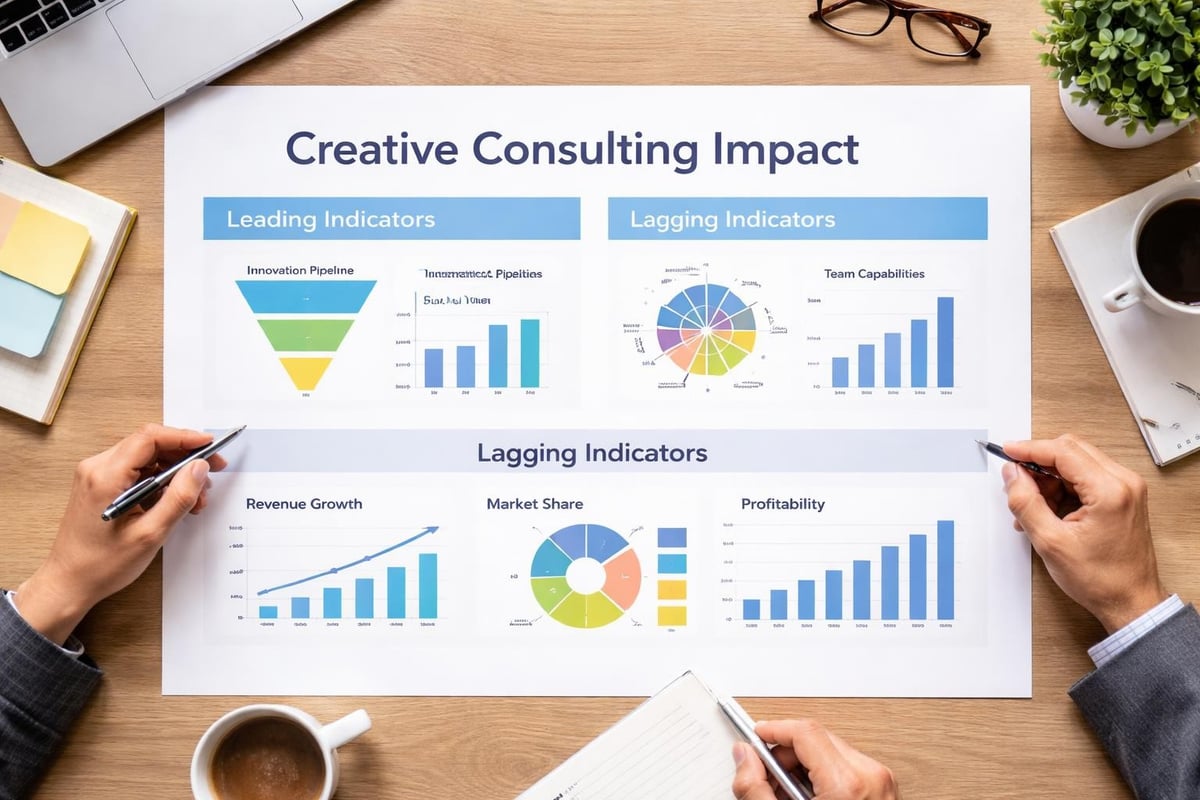
Organizations investing in creative consulting rightfully expect measurable outcomes. While creative processes may seem ambiguous, rigorous metrics demonstrate impact across multiple dimensions.
Leading indicators track innovation pipeline health:
- Number of validated opportunity concepts generated
- Speed from ideation to prototype development
- Quality of customer feedback on new concepts
- Team capability improvement scores
- Cross-functional collaboration effectiveness
Lagging indicators measure business results:
- Revenue from new products, services, or markets
- Customer acquisition in newly identified segments
- Market share gains through innovative positioning
- Profitability improvements from business model changes
- Competitive differentiation achieved
Revenue growth consulting connects creative innovation directly to financial performance, ensuring that imaginative solutions translate into bottom-line results.
Emerging Trends Shaping Creative Consulting
The discipline continues evolving rapidly as technology advances and business complexity increases. Several trends are reshaping how creative consulting delivers value in 2026.
Texture and Authenticity in Design
Graphic design trends for 2026 show a movement toward texture, warmth, and tactile elements. This shift reflects broader demand for authentic, human-centered experiences that contrast with digital perfectionism.
Creative consulting incorporates these sensibilities into strategy development, ensuring innovations feel genuine and emotionally resonant rather than purely functional.
Sustainability Integration
Environmental and social responsibility have moved from optional considerations to central requirements. Creative consulting now integrates sustainability throughout the innovation process.
This includes:
- Circular economy principles in product innovation design
- Social impact assessment for new business models
- Environmental footprint analysis for strategic initiatives
- Stakeholder value creation beyond shareholder returns
Agile Implementation Models
The gap between strategy and execution has narrowed significantly. Modern creative consulting emphasizes rapid implementation and iterative refinement over lengthy planning cycles.
Agile methodologies enable:
- Quick validation of innovative concepts through minimum viable products
- Real-time learning from market feedback
- Adaptive strategy adjustment based on emerging insights
- Reduced risk through incremental investment
- Faster time-to-market for competitive advantage
Selecting the Right Creative Consulting Partner
Organizations seeking creative consulting support face important partner selection decisions. The right relationship can accelerate transformation; the wrong one wastes resources and momentum.
Evaluation Criteria
Experience and expertise matter significantly. Look for firms demonstrating:
- Proven track record generating measurable innovation outcomes
- Deep understanding of your industry dynamics and challenges
- Methodology transparency and willingness to transfer knowledge
- Technology capabilities that enhance rather than replace creativity
- Cultural fit that enables productive collaboration
Portfolio diversity indicates adaptability. Firms that have successfully driven innovation across multiple industries bring cross-pollination insights that spark breakthrough thinking.
Partnership Models
Creative consulting engagements typically follow one of several models:
| Model Type | Scope | Best For |
|---|---|---|
| Project-Based | Defined challenge or opportunity | Specific innovation initiatives |
| Retainer | Ongoing innovation support | Sustained capability building |
| Hybrid | Projects plus capability transfer | Immediate results plus long-term capacity |
| Training-Focused | Skills and framework development | Internal team empowerment |
The optimal model depends on organizational maturity, resource availability, and strategic objectives. Many organizations benefit from hybrid approaches that deliver immediate results while building sustainable capabilities.
Implementing Creative Consulting Insights
The ultimate value of creative consulting materializes through effective implementation. Even brilliant strategies fail without disciplined execution.
Successful implementation requires:
Clear ownership with designated leaders accountable for innovation initiatives. Ambiguous responsibility dilutes focus and slows progress.
Resource commitment that matches innovation ambition. Organizations cannot expect breakthrough results while maintaining business-as-usual resource allocation.
Cultural support from leadership that celebrates experimentation and tolerates intelligent failure. Innovation requires psychological safety to explore unproven ideas.
Systematic processes that integrate creative thinking into regular business operations. One-off initiatives rarely build sustainable competitive advantage.
Business transformation strategy connects creative insights to operational reality, ensuring innovations become embedded practices rather than abandoned experiments.
Overcoming Implementation Barriers
Common obstacles include organizational inertia, risk aversion, siloed thinking, and resource constraints. Creative consulting addresses these barriers through:
- Change management expertise that builds stakeholder buy-in
- Pilot programs that demonstrate value before full-scale investment
- Quick wins that build momentum and confidence
- Communication strategies that maintain visibility and support
- Governance frameworks that balance innovation with accountability
Organizations that systematically address implementation barriers convert creative insights into competitive advantages. Those that neglect execution see initial enthusiasm fade without tangible results.
Creative consulting represents a powerful approach for organizations seeking sustainable competitive advantage through innovation. By combining imaginative problem-solving with strategic rigor, this discipline helps businesses discover new opportunities, develop breakthrough solutions, and build lasting innovation capabilities. Whether you're looking to identify uncontested market spaces, transform your business model, or accelerate revenue growth through systematic innovation, Six Paths Consulting brings AI-powered strategic innovation expertise that transforms creative insights into measurable business results.